








The U.S. Economy: A Jobless Expansion
U.S. economic growth is expected to moderate in 2026 as job creation slows. However, rising productivity – driven by AI adoption and automation – may cushion the slowdown as companies increasingly substitute capital for labor.
Unlike past expansions fueled by hiring, this one may hinge on investment in technology and capital efficiency – creating opportunities in productivity linked sectors, but less so in wage driven consumption. AI remains both a growth catalyst and a disruptor, supporting productivity and profits while also amplifying economic bifurcation.
Data center investment is unprecedented in scale and well-funded through the next year. Yet, beneath headline growth, consumption patterns are diverging. Higher income households, supported by wealth gains and job security, continue to spend. Lower income households, however, face tighter credit and persistent inflation. This K-shaped divergence should favor companies with pricing power, strong brands, and exposure to affluent consumers, while firms reliant on broad based consumer strength remain vulnerable.
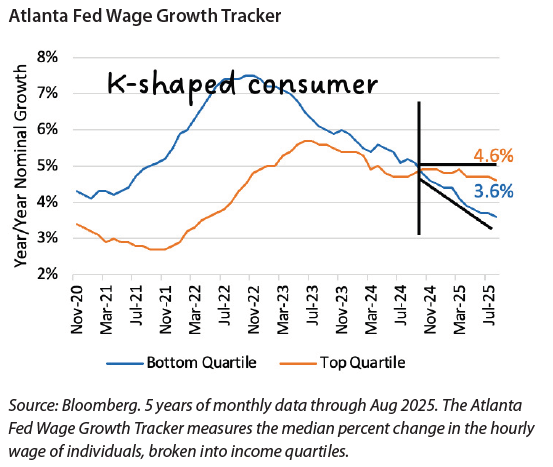
Meanwhile, the Trump administration appears increasingly focused on affordability for lower-to-moderate income consumers, a group with limited spending power but substantial electoral weight. While short term relief measures could improve sentiment, the broader uncertainty around trade and immigration policy keeps business investment decisions on edge.
Overall, forecasting remains unusually challenging in this atypical cycle. We are slightly less constructive on U.S. risk assets as valuations already reflect optimism, and policy initiatives like tariffs and deportations pose downside risks. Combined with growing consumer strain and ongoing geopolitical uncertainty, these factors warrant a more risk aware posture.
We are not turning negative, as the economy appears relatively resilient amid normalizing monetary conditions, AI spending initiatives, and the administration is likely to continue pro-business deregulation.
Positioning Summary: Positive but Mindful of Risks
We approach 2026 with measured optimism, though we are not expecting a smooth ride. We maintain our strategic allocations between stocks and bonds, with a slight underweight to U.S. equities given high valuations and risks tied to lower income consumers.
We hold a slight overweight in mid caps for their more balanced risk/reward profile and remain underweight large Growth stocks, given concentration risk and high valuations. We are slightly overweight international equities, favoring emerging markets as the Fed lowers rates and cheap valuations offer attractive exposure to AI and its capacity buildout. We remain moderately overweight higher quality fixed income drawn by the asset’s lower economic sensitivity.
Please read further for deeper insights into asset classes.
Fixed Income: Stability Amid Uneven Growth
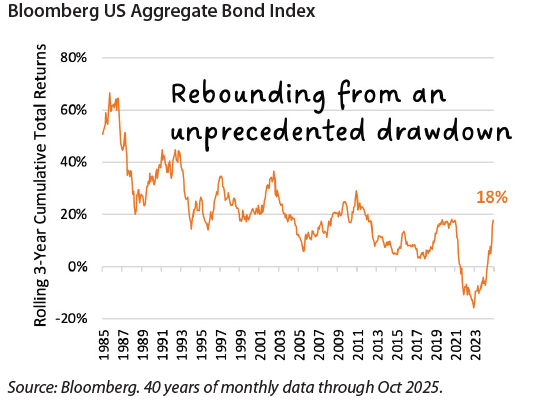
The U.S. bond market is not K-shaped today with returns from interest rate sensitive sectors catching up to credit risk segments of the market, producing fairly even returns across the board for the year. Going forward we see this balance largely continuing absent an economic or market dislocation.
Fixed income continues to serve its essential role as portfolio ballast. In an environment where growth is positive but uneven, and equity volatility could resurface, we believe high-quality bonds remain a critical counterbalance, providing income today and potential downside protection tomorrow.
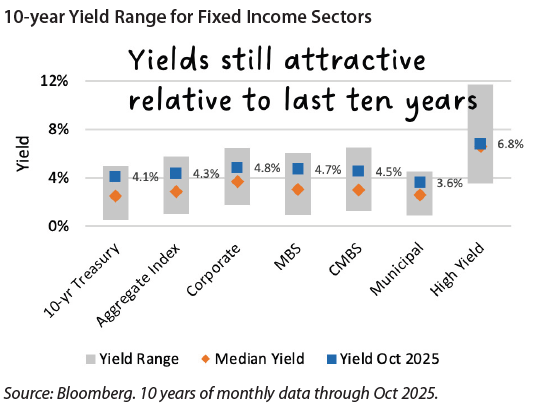
We expect another year of decent returns given high starting yields near the upper end of their 10-year range. Historically, bond returns have often been positive during easing cycles, even after the 1995 soft landing. The Fed’s cautious approach to rate cuts and large Treasury issuance will likely keep the yield curve steep and long-term yields elevated.
While long Treasuries have rallied, we remain cautious about extending duration at current levels. We prefer to stay focused on the intermediate part of the curve, which offers an attractive yield without excessive interest rate risk.
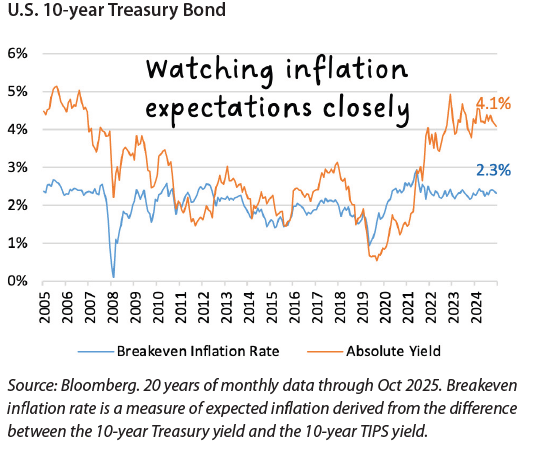
Investment grade bonds remain our preferred segment given strong corporate balance sheets and appealing yields. High yield spreads are tight, leaving little margin for error, but improved credit quality and stable profits suggest limited downside.
Municipal bonds, especially longer term high quality issues, offer relative safety and solid income, supported by healthy state and local finances. Structural deficits at the federal level, however, remain a long term concern and could keep pressure on Treasury yields.
Domestic Equities: Navigating Divergence
The U.S. equity market has taken on a K-shape of its own. The upper leg is dominated by AI-related stocks, which are less economically sensitive, and the rest of the market is on the lower leg (though not pointing down).
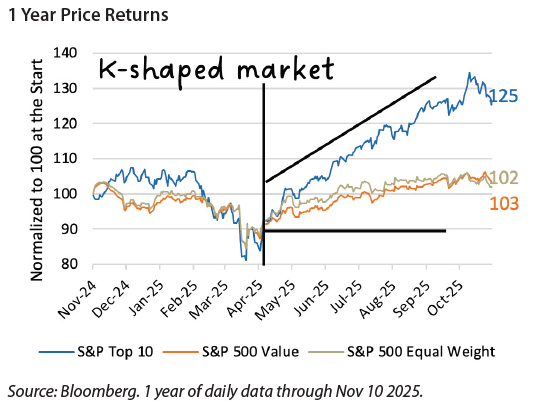
Market concentration remains a defining feature. The largest Growth stocks, fueled by AI enthusiasm, continue to drive index returns. Their earnings power is impressive, but so are their valuations, and leadership is unusually narrow. We maintain a modest underweight in Growth to manage concentration risk while retaining exposure to innovation leaders.
Are we in a bubble? We don’t think so. While AI-related valuations have risen, they remain below dot.com era extremes, though the risk of a bubble forming is real (a risk to our Growth underweight).
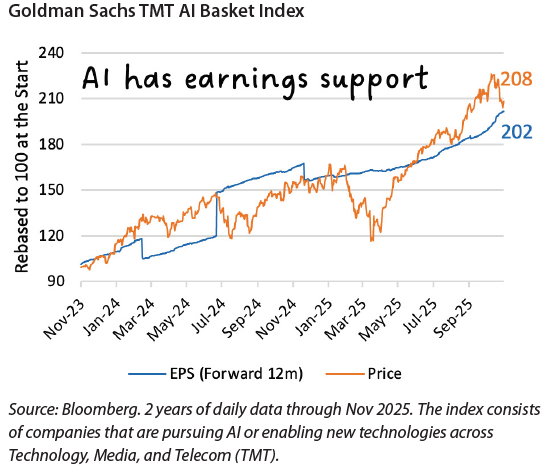
Technology will not be the sole sector benefiting from AI, as its application use spreads into other sectors, such as Financials, Industrials, and Health Care. As that occurs, we expect the market to broaden and become less concentrated.
We expect S&P 500 earnings growth in the low double digits, led by roughly 17% growth among the largest eight index constituents. Aggregating weights implies an overall growth rate near 13%. Given high valuations, we see little room for more multiple expansion, making 13% the upper end of
expected price returns.
Mid and Small Caps: Worthy of Attention
We slightly favor mid caps over small caps for their attractive balance of growth and stability.
Both segments are on track to underperform in 2025 as first half weakness stalled earnings progress. For 2026, analysts project an earnings rebound – 17% for small caps and 18% for mid caps – which seems like a stretch, but valuations suggest they aren’t being taken seriously. With earnings still below their 2022 peaks, these forecasts may be within reach, aided by easier comparisons in the first half, loose monetary and fiscal conditions, and a likely pickup in M&A activity. Additionally, unlike large caps, they have the potential for multiple expansion, currently trading at 14-15x 2026 earnings estimates. We see reasons for optimism, but softer labor conditions and uneven demand suggest patience is warranted.
International Equities: Stay Engaged
In Japan, corporate reforms continue to drive improved profitability and shareholder returns. The risk lies in the Bank of Japan turning more hawkish to contain inflation and offset fiscal stimulus, which could strengthen the yen and offset some competitive advantages.
Overall, developed international markets appear better positioned than in recent years, with earnings and dividends expected to be the primary return drivers.
EM equities remain tied to global manufacturing and the AI supply chain—particularly in semiconductors, India’s technology services, and Latin American resources. China’s more cooperative stance toward technology companies and DeepSeek’s LLM have revived growth prospects.
Concluding Thoughts: Guardedly Optimistic
Market cycles tend to follow earnings cycles, which track economic cycles. While we see some potential backsliding in economic resilience, we don’t foresee a contraction. AI remains a durable growth engine and is less sensitive to the business cycle.
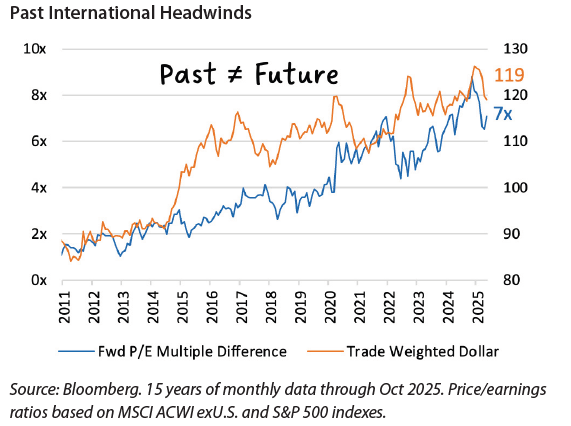
U.S. fixed income remains appealing, offering attractive yields in both absolute and real terms. Lastly, international equities also warrant attention. Over the past 15 years, dollar strength and rising U.S. stock valuations have been the main factors behind international underperformance. With the
S&P 500 trading at 22x 2026 earnings estimates versus 13-14x in international ex-U.S., we see better risk/reward abroad. Looking forward, we don’t anticipate U.S. stock multiples or the dollar to rise from these high levels.