







Since ChatGPT’s release in late 2022, the investment community has discussed, dissected, and debated artificial intelligence (AI) as primarily an equity story. What is the shape of the adoption curve? How do we size the potential opportunity? Which companies are most likely to benefit? And perhaps most contentious and consequential, will future productivity gains ultimately justify the massive costs required to deploy AI at scale?
These elements are all still vigorously debated. However, as spending on data center shells, AI semiconductors, electricity generation, and transmission infrastructure continues to rise, another important question has come to the fore: How will this extraordinary surge in AI investment be financed?
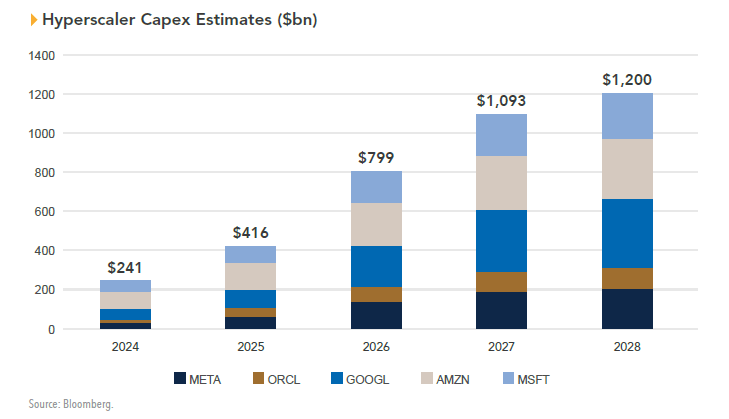
The Growing Financing Need
Capital expenditures for the major hyperscalers have grown rapidly over the past two years and are now projected to rise north of $1 trillion annually in 2027 and beyond. Even for some of the largest and most profitable companies in the world, this magnitude of spending has outstripped their ability to fund AI investments purely through internally generated cash flow. Increasingly, the AI ecosystem has turned to external financing sources, primarily in the form of the fixed income markets.AI's Expanding Footprint in Credit Markets
Over the last 12 months, the bond markets have absorbed more than $300 billion of new AI-related issuance from hyperscalers. On its surface, $300 billion of new supply is meaningful but seems well within the ability of a nearly $10 trillion corporate credit market to absorb. What makes the current issuance unique relative to other recent waves of supply is its concentration, from both an issuer and ultimately a fundamental perspective. A handful of companies—all borrowing for similar investments in a single new and unproven technology—have driven the vast majority of issuance. This has rapidly increased the nominal weight of hyperscalers within the investment grade bond market, but has had an even greater impact on hyperscalers’ risk contribution due to the significant amount of long-duration maturities being issued.

The Rise of "Shadow Supply"
Amplifying the bond market’s supply indigestion is the non-index-eligible issuance that is also occurring across 144A project debt, loans, private credit, high yield bonds, and asset-backed finance. While the total issuance is spread among various credit markets and bond structures, we commonly find that the ultimate source of cash flows and credit support reduces to that same select group of hyperscaler issuers flooding the corporate bond market with new senior unsecured bonds. Consider the following simplified example of a typical data center project bond.
 While the obligor is technically a Special Purpose Vehicle (SPV) created by a data center developer, the ultimate source of cash flows and bond repayment is a hyperscaler making lease payments for use of that data center. We think of this as “shadow supply” from hyperscalers and calibrate our risk exposures based on the actual underlying source of credit support—not just the nominal identity using ticker or issuer. This leads to risk-based limits on the size of the position we’re willing to take in the debt supported by a single corporate entity, no matter how many markets, obligors, or tickers that debt has been issued under.
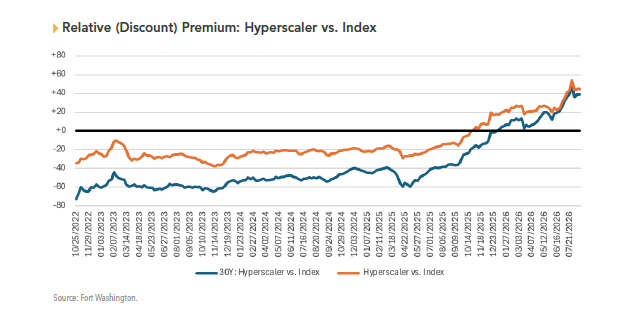
A material widening in the credit spreads of hyperscaler bonds suggests that many other investors have also started to reach internal position limits and now require increasing risk premia to absorb additional supply. With issuance expected to grow again into 2027, considerations of forward supply are undoubtedly coloring views on appropriate pricing levels today.
Lastly, the buildout of an AI ecosystem extends beyond the usual suspects in the direct AI and semiconductor space. The need for additional electricity generation and transmission infrastructure to support power-hungry data centers has been a major theme within the Utilities and Midstream sectors. As we think about the portfolio’s exposure to the broader theme of AI financing, those issuers and the potential risks associated with stranded assets are also a key consideration.
Underwriting AI and Data Center Debt
While top-down exposure to the AI theme is an important risk consideration, our view is that success on the AI trade will ultimately prove to be one driven by bottom-up analysis and security selection. Traditional corporate bonds from long-standing issuers have relatively consistent terms and well-understood risks. AI and data center project debt lacks this standardization. Debt structures vary widely, underlying contractual terms are bespoke for each data center project, and the future shape, including the ultimate winners and losers of the AI ecosystem, is still highly uncertain. The diversity of opportunities and outcomes creates the natural conditions for security selection.
So how do we approach underwriting data center bonds? As a starting place, we consider a variety of different risk factors that capture one of three key risks:
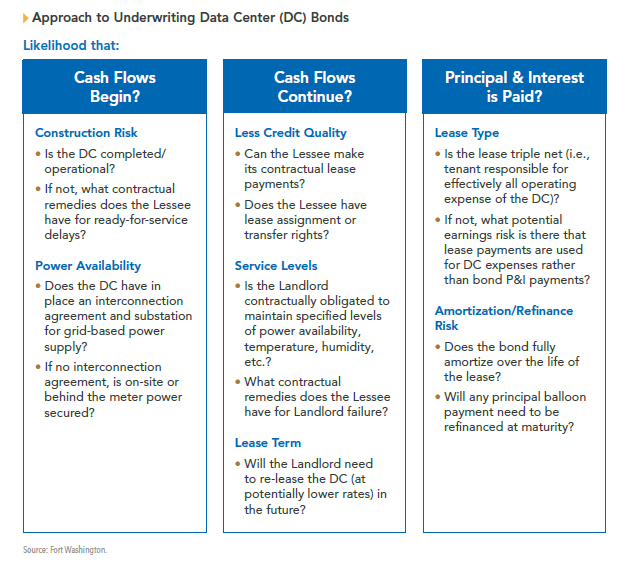
With respect to the bonds issued directly by the hyperscaler corporate entities, there is again differentiation. The scale of CAPEX needs and projected debt issuance are the most salient factors driving credit spreads today, but the market has also clearly started to price in the differences between the strongest underlying credit profiles and those with less margin for error in their AI strategy and execution. We consider elements such as the strength, scale, and durability of the non-AI business, strategy and key counterparties within the AI ecosystem, and ultimate leverage to the AI buildout. Given the amount of shadow supply and the (at times) opaque disclosures in regulatory filings, this last element can be difficult to precisely quantify, but our exposure to deal flow across a variety of funding channels is proving advantageous in monitoring the space.
What Comes Next—and What Could Change the Thesis
To date, much of the project debt we have seen has financed the physical data center shell and related power/mechanical infrastructure. We anticipate the next phase will increasingly involve financing for the semiconductors and compute equipment placed inside those facilities.
Recent announcements illustrate the scale of capital formation beginning to emerge around the next phase of AI infrastructure investment.
 This represents a meaningful shift for the market. Compute assets typically cost two to three times as much as the data center building itself but have a useful life that is considerably shorter than that of the physical structure. The higher cost and more frequent replacement cycle could result in a step change higher in gross and net financing needs as data centers currently under construction come online over the next 1 to 3 years, further pressuring spreads as lenders contend with a new, larger wave of supply.
The credit underwriting for chips may also prove to be a new challenge. Financing long-lived infrastructure presents a different underwriting problem from financing rapidly depreciating technology with uncertain useful lives, residual value, and technological relevance. The form and placement of this financing are still uncertain, but we would expect the same degree of structural variation already evident in data center project debt.
The larger question is whether end users ultimately derive economic benefits commensurate with the massive cost of producing and operating AI products. A disappointing payoff from AI-related investment could benefit AI-related credit spreads broadly from slower future CAPEX and reduced financing needs, while still resulting in financial distress for specific poorly structured projects and issuers. This again speaks to the importance of thoughtful underwriting and prudent security selection within the AI sector.
That distinction is central to our approach.
Portfolio Implications: Selectivity Over Thematic Exposure
We view AI-related investment as both an economic tailwind and an increasingly important credit-market supply story. It is supporting business investment while introducing more issuance, more duration, and greater concentration into fixed income benchmarks.
Credit fundamentals remain healthy across much of the market, but valuations are tight. Against that backdrop, we view AI-related financing as a source of security-specific opportunity rather than a broad beta allocation.
Within investment grade, our current posture is a modest overweight, with a preference for project financings that combine stronger counterparties with protective structures. In high yield, we have participated selectively but remain underweight in the data-center segment where spreads do not adequately compensate us for construction, execution, and liquidity risks. In securitized credit, we are not currently expressing the AI/data-center theme because we do not believe spreads have widened enough to compensate for the risk, and the market’s size limits the capacity for larger positions.
Those differences are intentional. We do not view AI credit as a single asset class or a single trade. It is a growing collection of financing structures in which supply, price, documentation, counterparty quality, and downside protection can vary materially from one security to another.
We expect the AI buildout to remain an important source of issuance and relative-value dispersion across fixed income. The opportunity is not simply to add exposure to AI. It is to distinguish among issuers, structures, and maturities—and to require adequate compensation for the specific risks that sit beneath the broader theme.