






Table of Contents
Macro Insights
Strong Earnings Mask a Tougher Market
WHAT HAPPENED
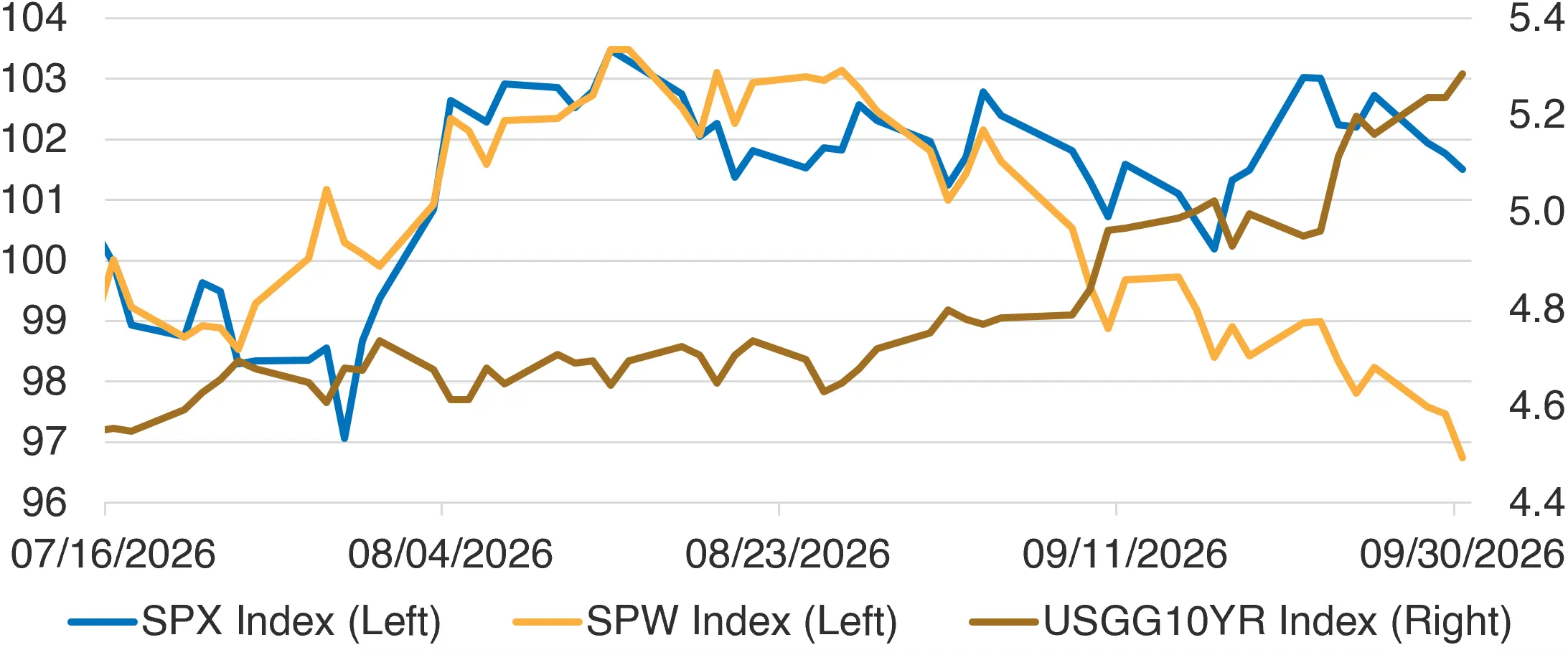
The stock market appeared remarkably resilient in the face of higher interest rates and continued geopolitical uncertainty. The S&P 500 declined just 0.3% in September and remains near record levels despite the Fed raising interest rates, the 10-year Treasury yield reaching 5.3%, and oil remaining above $100 per barrel. That resilience has raised an increasingly common question: Why doesn't the stock market seem to care about the bad news?
Look beneath the major indexes, however, and the market is reacting. The equal-weighted S&P 500 fell 5.2% in September and the Russell 2000 declined 5.4%, while Financials, Materials, Real Estate, Utilities, and Consumer Discretionary all fell more than 5%. Technology and Communication Services were the only sectors to advance. The result was an unusually wide gap between the performance of the headline S&P 500 and the experience of the average stock.
Higher interest rates are also being reflected in valuations. The S&P 500 began the year trading at roughly 22 times forward earnings and now trades closer to 19 times. That contraction is consistent with a higher-rate environment: as the return available on bonds rises, investors generally require a higher expected return, and therefore a lower valuation, from equities.
What has prevented that valuation adjustment from producing a larger decline in the S&P 500 has been exceptional corporate profit growth. Earnings have grown faster than valuation multiples have contracted, allowing the index to remain resilient even as investors pay less for each dollar of expected earnings. That strength has been particularly pronounced among many of the large technology and AI-related companies that carry significant weights in capitalization-weighted indexes.
Economic data remained firm while the Fed tightened policy. The Fed raised its target rate by 25 basis points, while stronger employment, consumer spending, and business activity reinforced expectations that monetary policy could remain restrictive. Treasury yields moved sharply higher as a result, creating additional pressure on rate-sensitive portions of the economy and financial markets.
WHAT IT MEANS
The market's apparent indifference to higher rates and other risks is therefore somewhat misleading. Investors are responding—they are simply doing so through lower valuations and greater differentiation rather than a broad decline in the major indexes. The average stock has weakened considerably, smaller companies have struggled, and rate-sensitive sectors have borne much of the adjustment.
At the index level, however, earnings growth has so far outrun multiple compression. This distinction is important. A market supported by rising valuations requires investors to continually become more optimistic about the future. A market supported by earnings growth has a fundamentally different foundation. Despite significant multiple compression this year, strong corporate profits have allowed the S&P 500 to remain resilient.
That does not make higher interest rates irrelevant. The higher the risk-free rate moves, the greater the hurdle for equity valuations and capital investment. And the effects are uneven: housing, smaller businesses, leveraged companies, and other capital-intensive areas are considerably more sensitive to borrowing costs than large technology companies that fund AI investment through substantial internal cash generation and for which the perceived opportunity for growth has so far overwhelmed concerns about the cost of financing it.
That asymmetry complicates the Fed’s task. Inflation remains above target, but some current pressures reflect energy prices and supply constraints rather than excessive economy-wide demand. This month's Spotlight examines whether additional monetary restraint is likely to address those sources of inflation—or primarily increase pressure on the portions of the economy already most sensitive to higher rates.
We remain constructive toward equities, while recognizing that the environment has become more demanding. Strong earnings growth continues to provide fundamental support, but higher interest rates are lowering valuations and increasing dispersion across companies and sectors. September demonstrated that the market does care about higher rates—the impact is simply more visible beneath the surface than in the headline index.
The Market Is Reacting to Higher Rates
As rates have risen, the equal-weighted S&P 500 (SPW) has declined sharply, while the market-cap-weighted S&P 500 (SPX) has been supported by the fundamentals of the AI trade.
What to Watch
With the Fed initiating a hiking cycle due to stubborn inflation, incoming data around price stability will be a primary focus for investors. Consumer spending remains resilient, but higher prices appear to be putting pressure on spending, warranting continued monitoring. Headlines surrounding the conflict in the Middle East will continue to create volatility in energy markets.
|
Monthly Spotlight
The Fed Is Hiking Again—Is This Cycle Different?
The Fed raised the policy rate by 25 basis points in September, its first hike since 2023. Historically, an initial rate hike has often been followed by a series of additional tightening. However, the backdrop for this round of tightening is different from most hiking cycles. That leaves us asking two related questions: Will this time be different, and what are we watching?
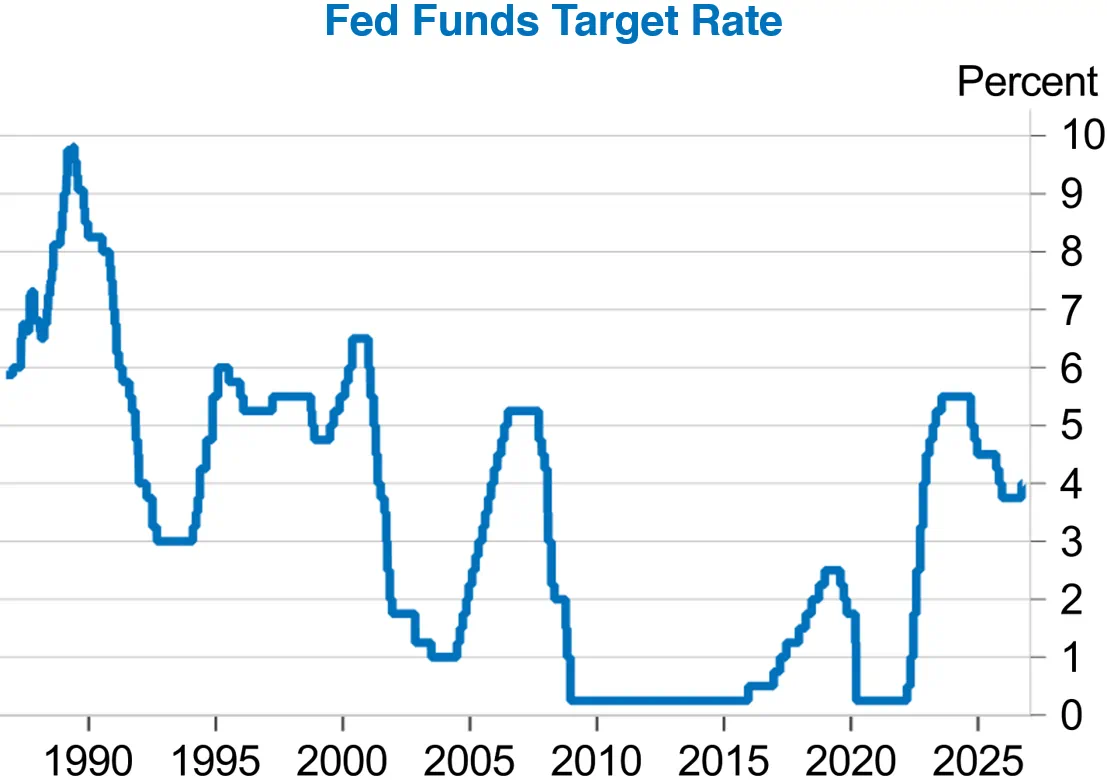
The Fed’s decision to raise rates reflects inflation that has remained above its 2% target for too long, while economic growth and the labor market remain solid. Elevated energy prices and other supply-side pressures create additional uncertainty around the inflation outlook, while resilient consumer spending and robust capital investment, including the AI buildout, continue to support demand.
This backdrop suggests monetary policy may need to remain restrictive and become somewhat more so to bring inflation back toward 2% in a timely manner. What makes this cycle unusual, however, is the Fed’s starting point. Unlike many hiking cycles of the past 40 years, policy was not clearly accommodative when tightening began. The Fed is therefore not moving rapidly from easy to restrictive policy, but rather recalibrating from a level already near neutral or modestly restrictive.
Inflation has remained elevated partly due to a series of supply shocks over recent years, most recently the ongoing conflict in the Middle East. Higher energy prices have a clear impact on headline inflation, but the magnitude and persistence of their effect on core inflation are more difficult to judge. The Fed’s traditional playbook is to look through supply shocks because one-time price increases do not necessarily generate sustained inflation. Recently, however, this line of reasoning has been called into question by several Fed participants. Given the recent strength of the economy and recurring supply shocks, the Fed is becoming more concerned that there will be a sustained impact on inflation. Upcoming inflation data will therefore be critical in determining how far the Fed will raise rates.
At the same time, the economy has proven relatively insulated from higher rates. The job market continues to grow despite recent headwinds. Consumer and business spending remain solid, providing a foundation for continued growth. Many households and corporations locked in low borrowing costs before rates rose, while healthy balance sheets have further reduced near-term sensitivity to monetary policy. Whether this recent economic momentum continues will also factor into the ultimate path of Fed policy. Strong growth will give the Fed confidence that the economy can withstand higher interest rates as it seeks to bring inflation back to target.
In our judgment, this cycle may ultimately look more like a mid-cycle recalibration and somewhat different from the past few hiking cycles. While inflation remains above target, underlying inflation has not shown clear signs of renewed acceleration, and we expect economic growth to settle near its longer-term trend of roughly 2%. Against this backdrop, we think the Fed will hike more slowly than the market currently expects, giving policymakers more time to assess incoming data as they navigate this challenging environment.
Chart sources: Bloomberg and Macrobond.
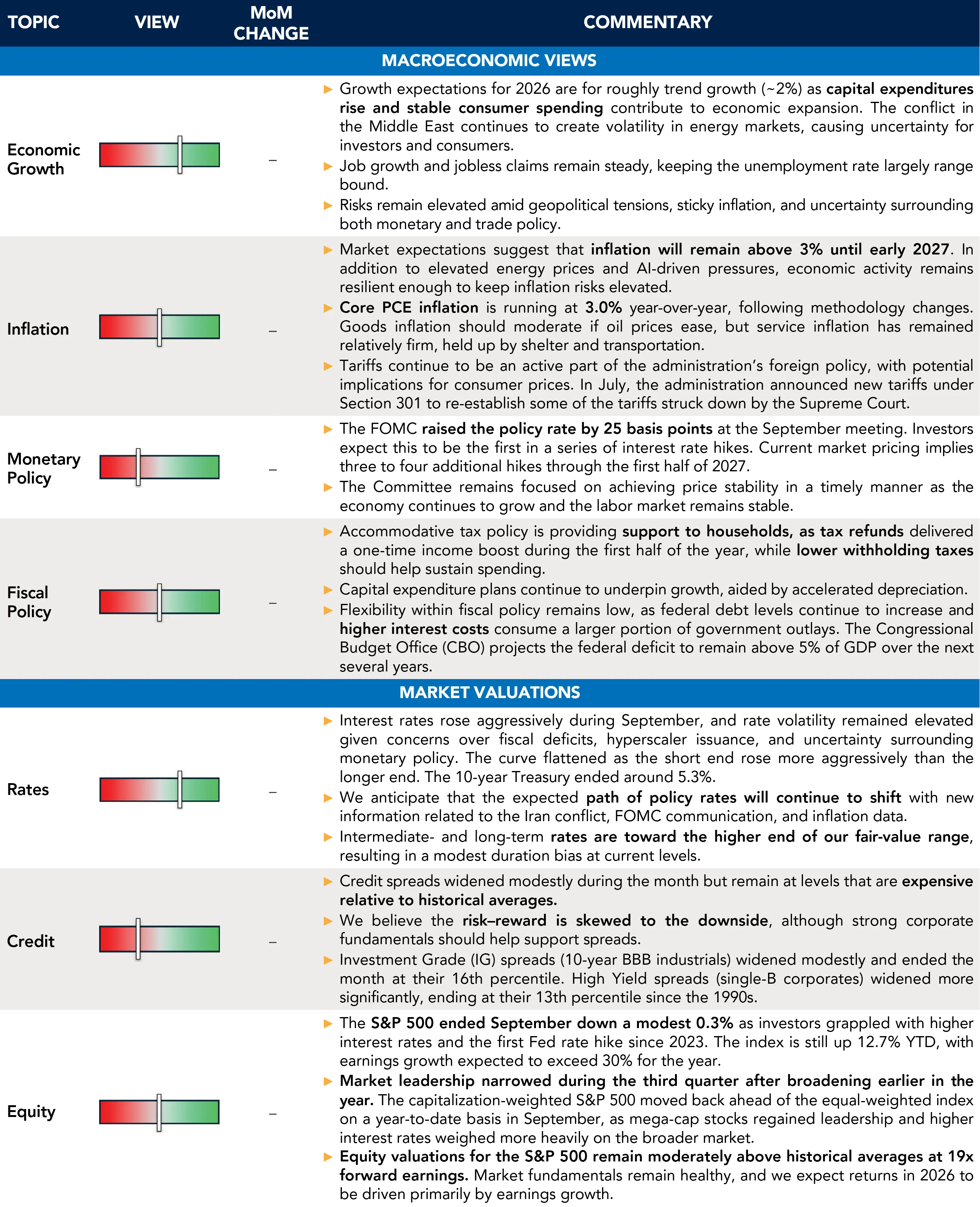
Current Outlook
Market Data & Performance
As of 09/30/2026
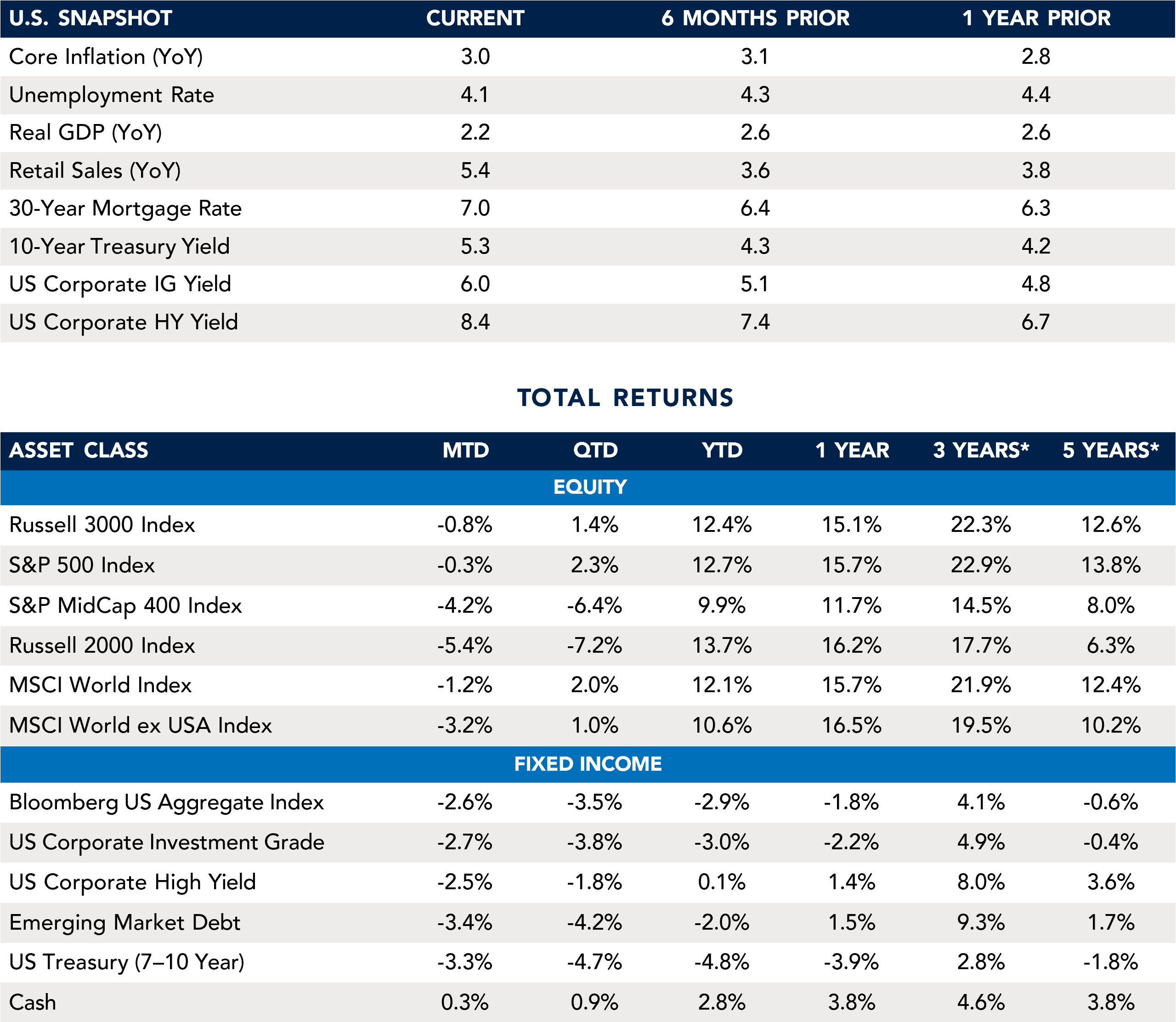
Source: Fort Washington and Bloomberg. *Returns for periods greater than one year are annualized. Past performance is not indicative of future results.
Download Monthly Market Pulse – October 2026
Download Monthly Market Pulse – October 2026