






Table of Contents
Macro Insights
Duration Will Determine DirectionU.S. equities declined sharply in March as the Iran conflict dominated headlines and market psychology, driving a broad-based selloff across asset classes. The S&P 500 fell 5.0%, its third negative month in the past four, while the Nasdaq declined 4.8%. Small caps were similarly weak, with the Russell 2000 down 5.0%. Unlike prior months, declines were broad-based, with the equal-weight S&P 500 underperforming the cap-weighted index—evidence that selling pressure extended well beyond mega-cap leadership. |
Beneath the surface, the defining feature of the month was the energy shock. The escalation of conflict in Iran and the resulting disruption to global supply—particularly through the SoH—drove a sharp spike in oil prices, with crude posting its strongest monthly gain since 2020. Notably, while prices moved materially higher, they remained relatively contained versus worst-case expectations, as a prolonged disruption could have pushed oil materially beyond current levels. Energy stocks were the clear outperformers, alongside select commodity-linked areas, while most cyclical and growth-oriented sectors lagged. Mega-cap technology broadly declined, with continued pressure in software and semiconductors as investors balanced long-term AI tailwinds against near-term uncertainty and positioning.
Even as confidence in a speedier end to the conflict has grown—though that confidence remains volatile, including the dashed hopes of a quick resolution following President Trump’s April 1 primetime address—the economic aftereffects are likely to persist. Iran retains the capacity to disrupt the SoH, and the process of restoring shut-in production and damaged infrastructure suggests commodity prices may remain elevated relative to pre-conflict levels—an issue we explore further in this month’s Spotlight.
Rates and macro dynamics compounded the pressure. Treasury yields moved sharply higher during the month, reflecting both the inflationary implications of higher energy prices and reduced expectations for near-term Fed easing. The Fed maintained a cautious stance, signaling that policy flexibility remains constrained absent clearer progress on inflation. Economic data softened at the margin, with weaker payrolls, a modest uptick in unemployment, and early stagflationary signals emerging across survey data. While not yet indicative of a downturn, the direction of travel has become incrementally less supportive.
Despite the challenging backdrop, markets showed a degree of resilience. For much of the month, equities held up relatively well given the magnitude of the geopolitical shock and associated volatility in oil and rates. That resilience was tested but ultimately reinforced late in the period, as reports of a potential diplomatic resolution to the conflict drove a sharp rally into quarter-end, with the S&P 500 rising nearly 3% on the final day of March.
Looking ahead, the path of the conflict remains the key variable. A prolonged disruption—particularly if confidence in a near-term resolution fades—could drive oil materially higher, an outcome not currently reflected in either commodity or equity pricing. Conversely, a quicker resolution and reopening of the Strait would likely support a recovery in risk assets, even if oil markets take longer to fully rebalance. While uncertainty remains elevated, U.S. incentives to bring the conflict to a close suggest a shorter duration, which remains our base case.
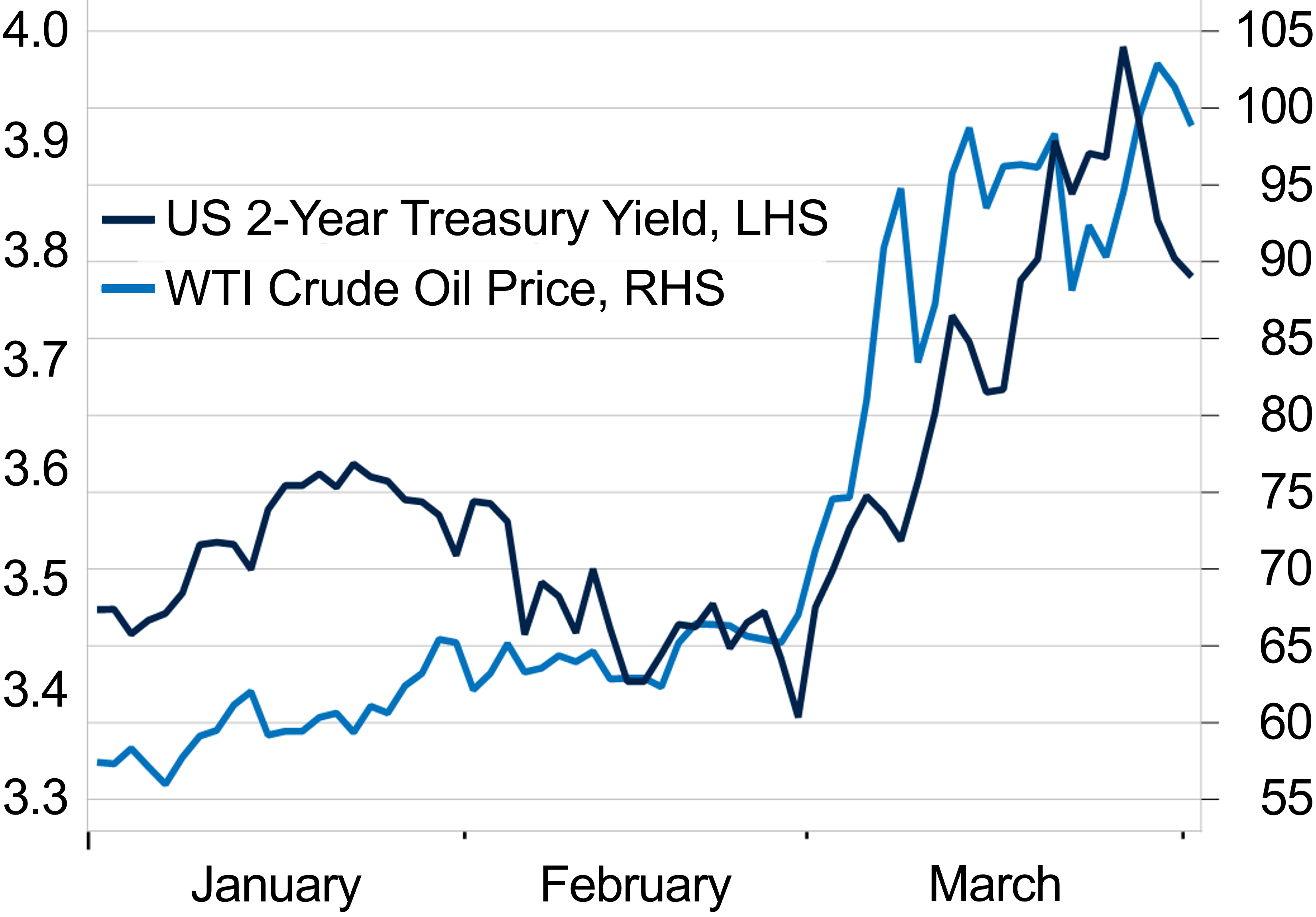
Oil Creates a Sticky Situation for Inflation
2-year Treasury yields have followed oil prices higher, reflecting expectations of more durable inflation and a Fed on hold.
What to Watch
Developments surrounding the Iran conflict will remain in focus, with implications for economic forecasts and risk sentiment. Given the potential impact on inflation—both directly through energy prices and via second-round effects—investors will monitor upcoming inflation data to gauge the path of policy moving forward. Consumer spending and sentiment data will also be important to watch as tax season is underway; however, the positive effects of larger refunds could be offset by higher gas prices.
|
Monthly Spotlight
The Lingering Impact of the Iran Conflict
Armed conflicts are notoriously difficult to predict, and the war with Iran is no exception. The most noticeable impact from restricted passage through the SoH has been on energy markets, but many other vital commodities also pass through the waterway. The intensity of the resulting economic shock will depend on the duration of hostilities, and disruptions are likely to persist for some time even after fighting ceases. The fallout will produce relative winners and losers across industries and countries, with these distinctions likely to be particularly pronounced in emerging markets.
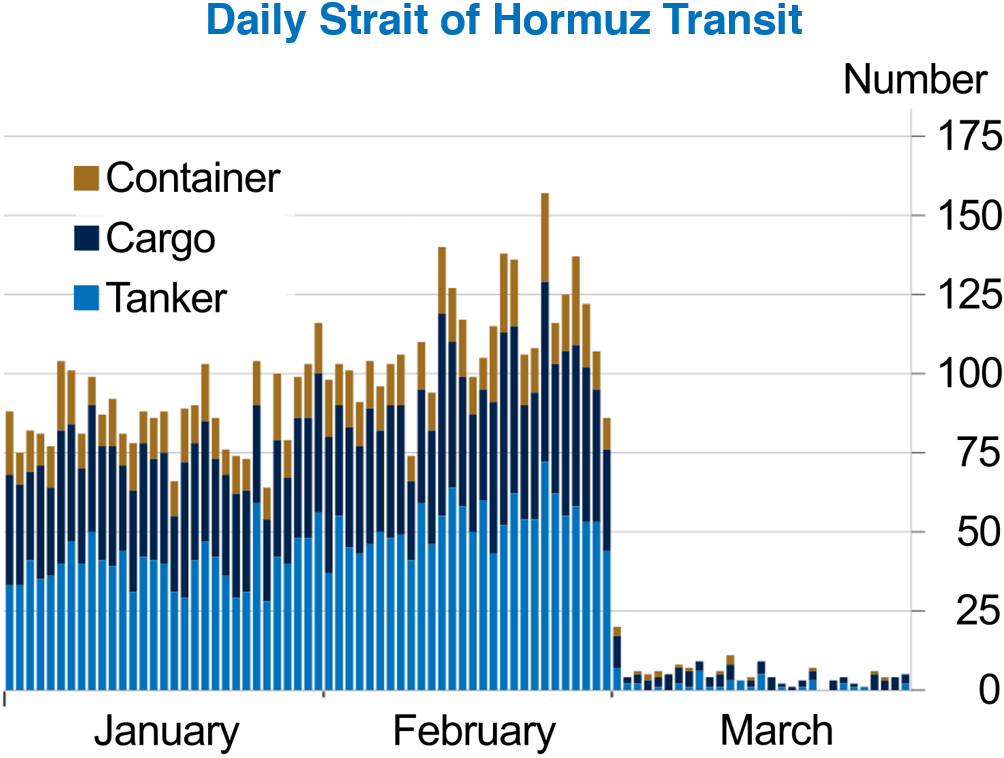
Iran continues to threaten vital shipping lanes and infrastructure across the region despite the degradation of its traditional military capabilities. The impact on energy markets is most acute, as roughly 20% of global crude oil and liquefied natural gas (LNG) flows through the SoH. Only a portion of this oil can be rerouted through pipelines that circumvent the SoH. Even once the Strait is fully reopened, restarting production and normalizing flows will take several weeks. Some critical infrastructure in the region has already been damaged, such as the world’s largest LNG complex at Ras Laffan in Qatar, and repairs could take years.
Energy disruptions are creating clear divergence across countries. Energy exporters not directly constrained by the conflict stand to benefit from improved fiscal balances and terms of trade. Exporters such as Angola, Ecuador, and Papua New Guinea are likely to see near-term tailwinds. Growing energy exporters in Latin America, such as Argentina, Brazil, and Suriname, are particularly well positioned and stand to attract accelerated foreign investment as buyers place an increased premium on the relative safety of the Western Hemisphere. Conversely, energy importers, such as the Philippines and Turkey, face headwinds. Governments that subsidize fuel, such as the Dominican Republic and Pakistan, will be forced to weigh the fiscal cost against the political consequences of passing higher prices on to vulnerable consumers. If the conflict persists, fuel shortages could become a reality. Asia is most at risk, as more than 80% of crude that passed through the SoH prior to the conflict was destined for the region.
Beyond energy, the conflict has implications for broader supply chains. The region is a key producer of fertilizer inputs such as ammonia and sulfur, as well as industrial products such as natural gas liquids and helium. Fertilizer prices, in particular, are critical given their downstream impact on global food prices. Net food importers with a higher weighting of food in their CPI baskets, such as Egypt and Indonesia, are therefore more vulnerable to renewed inflationary pressures. This dynamic complicates the policy backdrop for central banks. Supply chain disruptions extend as far as the semiconductor industry, which relies on helium and sulfur. Conversely, certain petrochemical producers, long suffering from Chinese overcapacity, stand to benefit as supply from the Persian Gulf is curtailed.
Ultimately, the uneven impact of the conflict reinforces the importance of selectivity across geography and industry. For investors, understanding how these crosscurrents affect trade, inflation, and fiscal accounts will be key when allocating capital globally.
Chart sources: IMF and Macrobond.
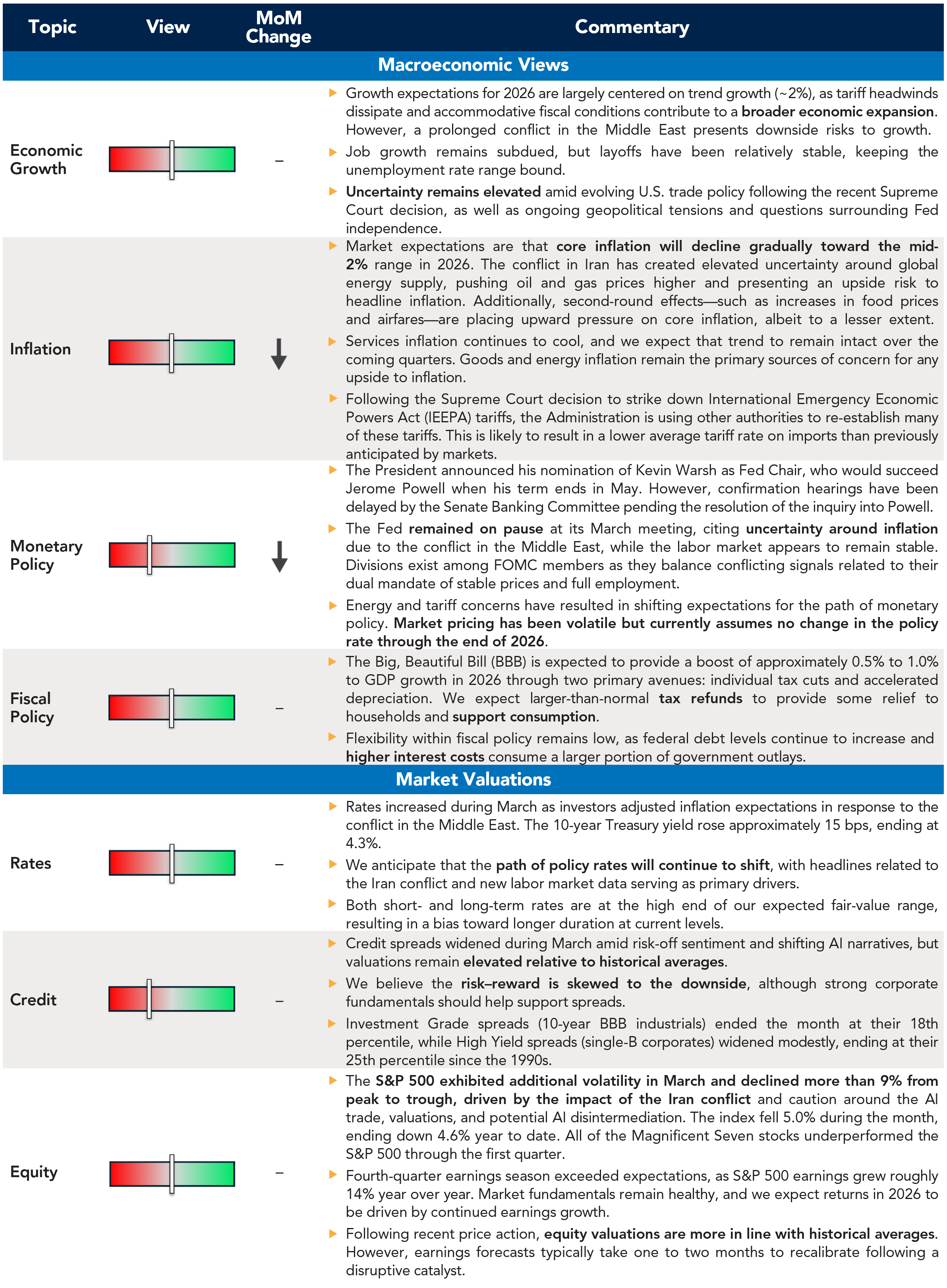
Current Outlook
Market Data & Performance
As of 03/31/2026
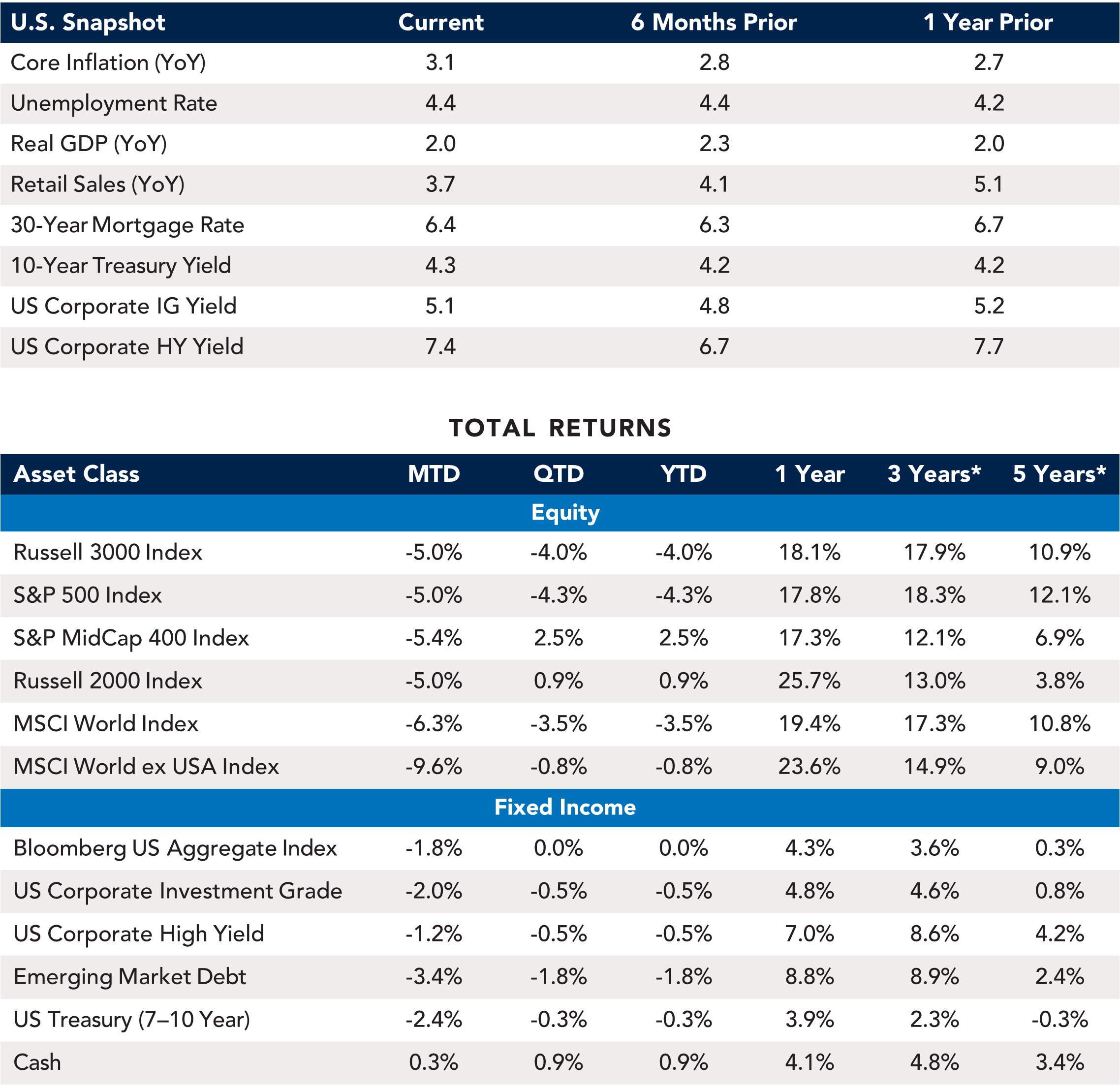
Source: Fort Washington and Bloomberg. *Returns longer than 1 year are annualized. Past performance is not indicative of future results.
Download Monthly Market Pulse – April 2026
Download Monthly Market Pulse – April 2026