






Table of Contents
Macro Insights
Flat Month Caps Another Strong YearU.S. equities delivered a mixed performance in December, reflecting a period of consolidation after an extended rally. The S&P 500 (price return) slipped slightly, snapping a seven-month winning streak, while performance beneath the surface was more dispersed. Leadership continued to rotate away from crowded mega-cap themes, with selective pockets of strength emerging even as several formerly dominant areas lagged. While much of the Magnificent Seven trade softened, Nvidia and Tesla posted gains, highlighting the increasing dispersion across large-cap technology. Rate-sensitive and defensive sectors, along with several consumer-facing cyclicals, underperformed during the month. |
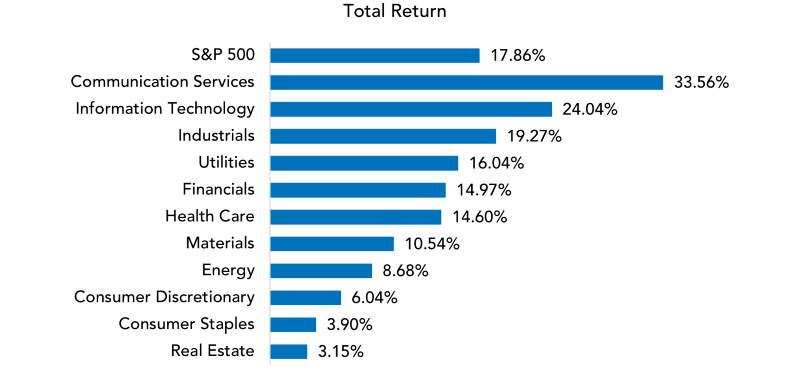
Despite the modest pullback, December capped an impressive year for U.S. equities. The S&P 500 returned 17.9% in 2025, again led by Communication Services and Information Technology, as AI-related investment, resilient earnings growth, and expanding profit margins supported valuations. While leadership rotated late in the year, full-year performance reflected broad confidence in U.S. growth assets.
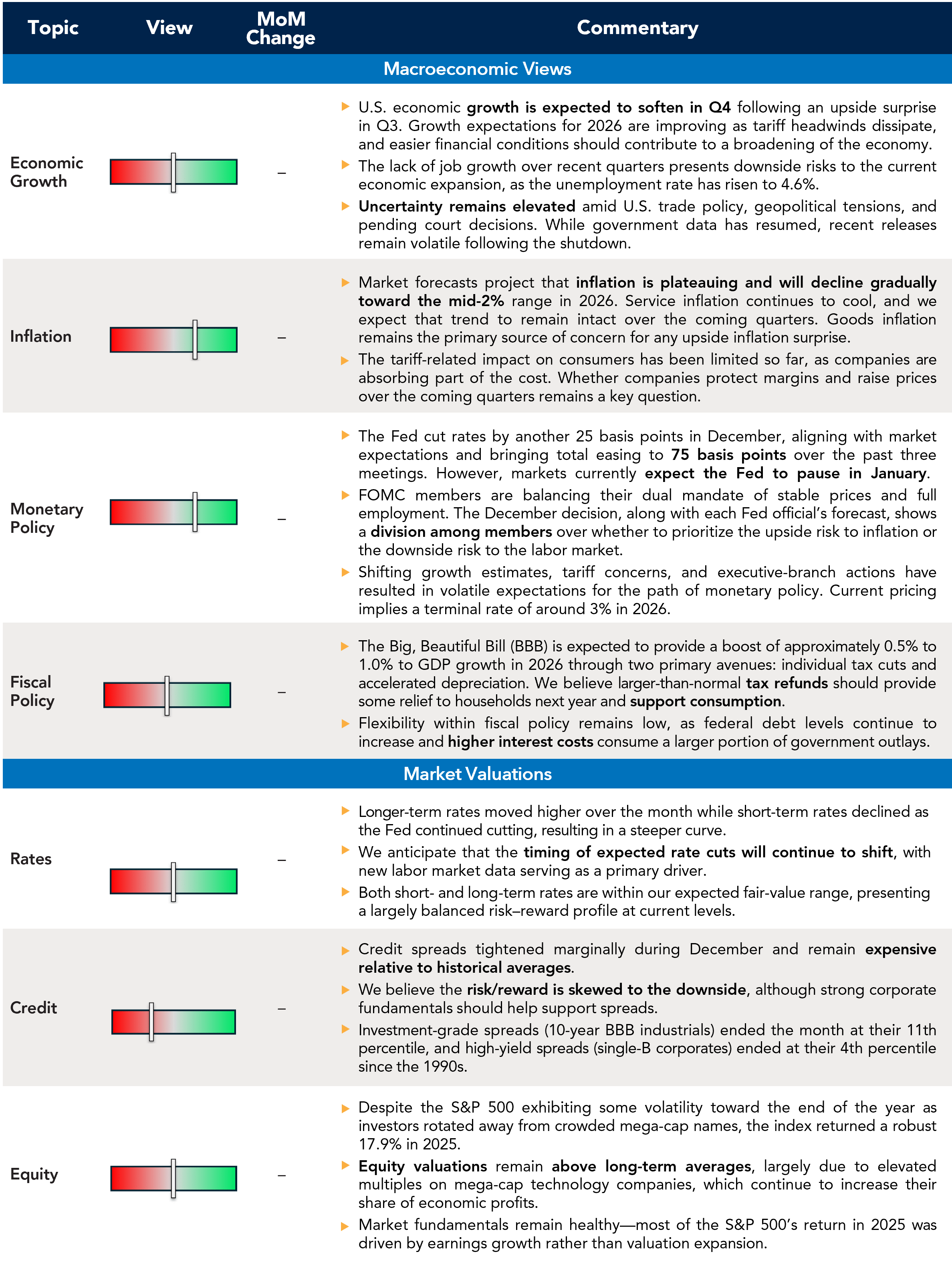
Macro developments in December were largely supportive but increasingly nuanced. The Fed delivered a widely expected 25-basis-point rate cut at the December Federal Open Market Committee (FOMC) meeting, bringing total easing to 50 basis points over the final two months of the year. Policymaker commentary emphasized emerging labor market softness—with unemployment edging up to 4.6%—alongside renewed disinflation progress, while maintaining flexibility around the future policy path. Treasury yields were mixed, with modest curve steepening, the dollar weakened further, and gold extended its rally, signaling ongoing crosscurrents beneath headline growth resilience.
Economic data reinforced a “soft-landing-plus” narrative. Inflation continued to cool, helped by housing, while consumer spending proved resilient through the holiday season. At the same time, labor market indicators showed signs of gradual normalization, underscoring the increasingly bifurcated nature of economic outcomes. Investor focus also remained on AI, where scrutiny around capital intensity and execution risks grew even as long-term demand fundamentals remained intact. AI is not just a story for the equity market—a subject we explore further in this month’s Spotlight.
Overall, we view December’s consolidation as healthy digestion following a strong run, rather than a deterioration in fundamentals. Entering 2026, easing financial conditions, resilient consumers, and improving policy clarity remain constructive, though greater dispersion and heightened selectivity argue for balanced positioning after another impressive year for U.S. equities.
S&P 500 Again Led by Technology Sectors in 2025
While leadership broadened late in the year, 2025 returns were again led by the communication services and technology sectors.
2025 Total Return by Sector
What to Watch
The FOMC has cut rates by 75 basis points over the past three meetings. Investors will continue to monitor inflation and labor market data for implications for future rate decisions. In addition, questions around the strength of the consumer persist, and sentiment surveys as well as spending data will provide signals for future consumption.
|
Monthly Spotlight
AI’s Impact on Fixed Income
The growth of artificial intelligence has had significant impacts across the economy and investment markets. While investors often hear about its effects on equity markets—where a relatively small number of AI-related companies are driving returns and index concentration—many overlook the impact AI is having on fixed income markets.
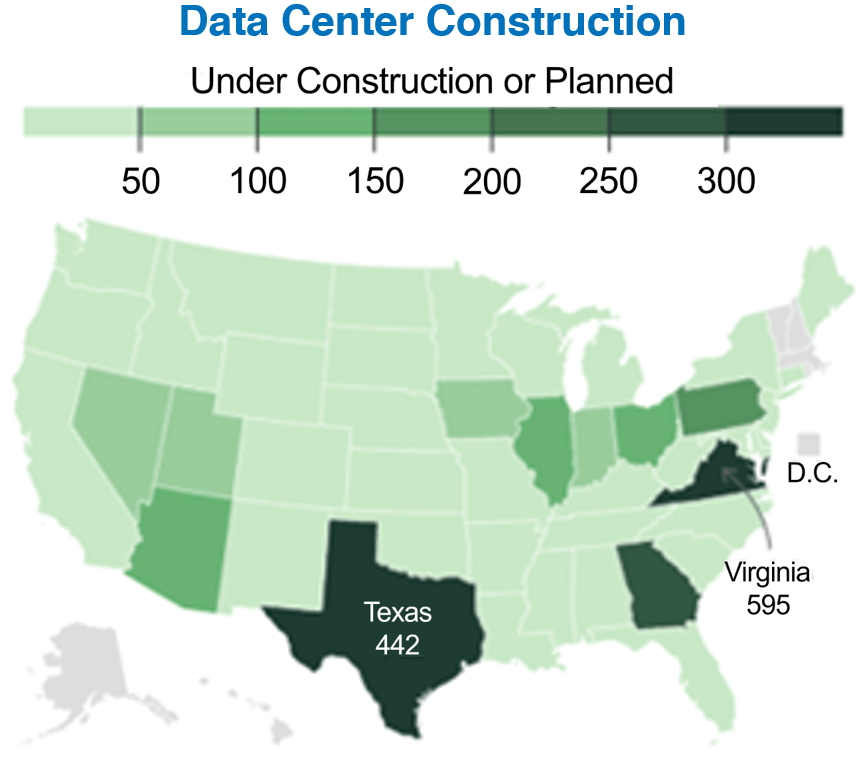
AI is highly capital intensive, with substantial upfront costs related to data centers, semiconductors, energy, and other infrastructure. Estimates for newly developed data centers are approximately $35 billion per GWh (gigawatt hour), and roughly 200 GWh of new capacity is planned across approximately 3,300 data centers that are either under construction or have been announced.1 As firms undertake these multiyear buildouts, many are turning to fixed income markets to fund these projects. Issuance by hyperscalers (Google, Meta, Microsoft, Amazon, and Oracle) has been significant over the past year, totaling roughly $120 billion, and we expect annual supply to increase to more than $200 billion in 2026. While at first glance this additional issuance will increase the technology sector’s footprint in fixed income indices, it also carries broader implications for fixed income investors.
First, the rise in AI-related debt issuance is increasing issuers’ interest burdens, placing pressure on free cash flow and pushing leverage higher. In some cases, this has already resulted in spread widening, or cheaper valuations, as markets incorporate the pro forma impact on fundamentals. For example, Oracle has experienced spread widening tied to increased leverage expectations, as well as higher lease commitments and concerns over customer concentration. Separately, hyperscaler issuance has been skewed toward longer maturities—often 10 years or longer—affecting relative value across individual issuers’ credit curves.
Technology is not the only sector affected by the capital demands of AI investment. Within corporate credit, utilities and power generators have also seen increased issuance, as data centers require substantial and reliable energy. Estimates suggest that approximately 30% of the total cost of a new data center is related to energy infrastructure.1 Beyond corporates, we expect growing volumes of securitized and infrastructure debt tied to AI development. These financings are often structured around specific projects, such as Meta’s Louisiana data center. Importantly, not all companies are funding these ventures in the same way. In Meta’s case, much of the financing is expected to be off balance sheet, with Blue Owl issuing private debt to support its commitment to the project. These structural nuances are particularly important for investors evaluating the growing volume of AI-related issuance.
AI-related debt is likely to continue growing as a share of fixed income indices due to the reinvestment cycle—the useful life of chips is typically four to six years—and continued investment to improve models (scaling laws). While many of these investments have the potential to drive future revenue growth, a loss of confidence among credit investors could materially impact future development.
In our view, relative value should be a key consideration when evaluating these opportunities, particularly because data-center-specific issuance carries idiosyncratic risks related to both the evolution of AI and the economic significance of individual projects. Given current valuations and the expected increase in AI-related debt issuance in the years ahead, we believe more attractive opportunities to add value exist elsewhere in fixed income.
Sources: 1Bernstein. Chart: American Edge Project and Technology Councils of North America. Map: Axios Visuals. Data as of October 29, 2025.
Current Outlook
Market Data & Performance
As of 12/31/2025
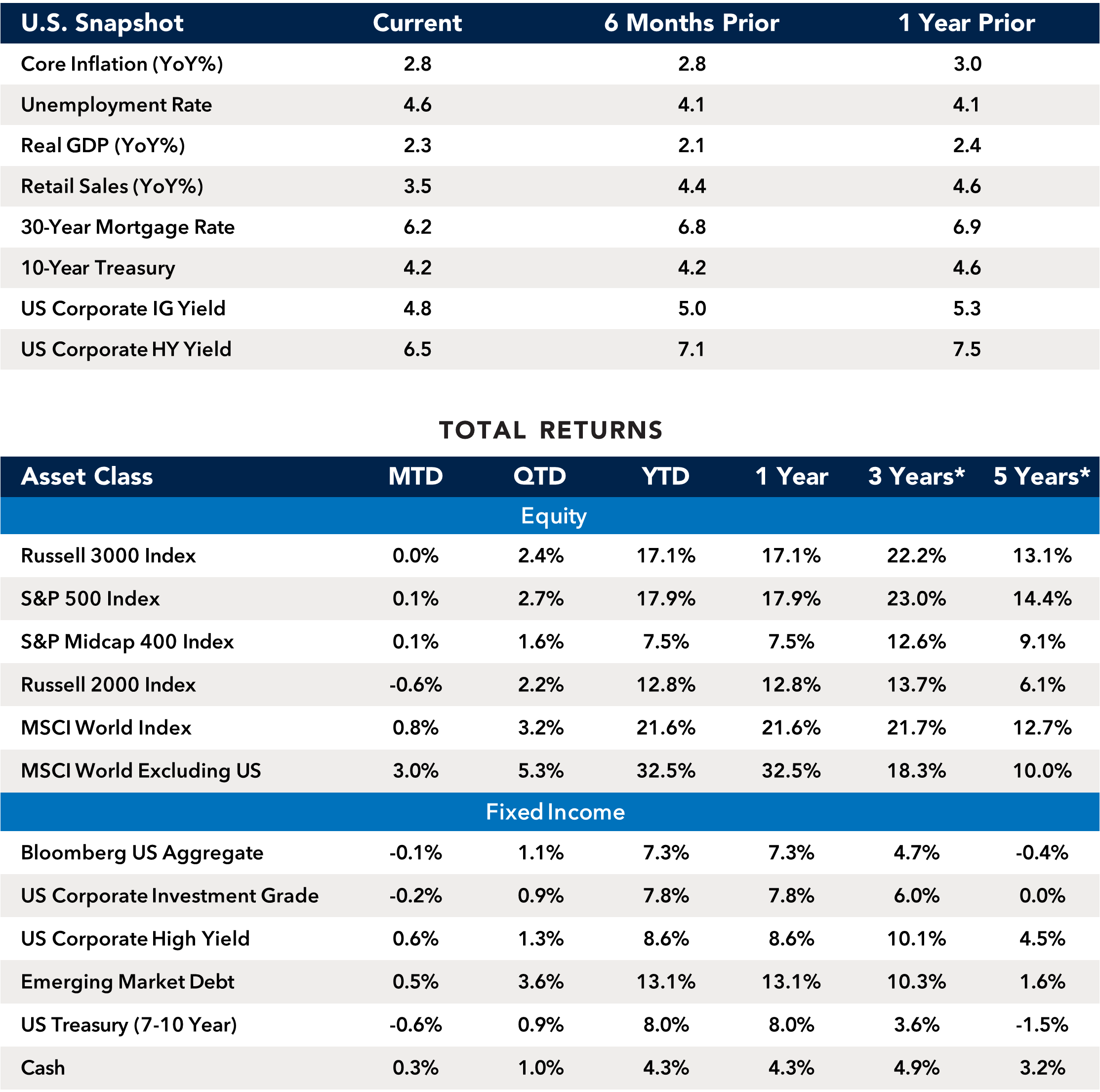
Source: Fort Washington and Bloomberg. *Returns longer than 1 year are annualized. Past performance is not indicative of future results.
Download Monthly Market Pulse – January 2026
Download Monthly Market Pulse – January 2026