






Table of Contents
Macro Insights
Tariffs, Tensions, and TransitionU.S. equities were mixed in February, with headline index performance masking meaningful rotation beneath the surface. The S&P 500 declined 0.8%, its second negative month in the past three, while the Nasdaq fell 3.3%, marking its weakest month since March of last year. The Dow edged up 0.2%, and the Russell 2000 gained 0.8%. Notably, the equal-weight S&P 500 rose 3.5%, outperforming the cap-weighted index for a fourth consecutive month—further evidence that leadership continues to broaden beyond the largest Technology names. |
Beneath the index level, market leadership continued to evolve. Energy, Utilities, and defensive growth areas such as Pharma and Staples were among the relative winners. Select infrastructure-oriented Technology names held up better than the broader tech complex. In contrast, mega-cap Technology—particularly Software—lagged as investors weighed AI-driven disruption against still-elevated capital spending plans. Financials, including credit card companies and investment banks, were also under pressure. The pattern reflected repositioning rather than wholesale risk aversion.
Trade policy moved back into focus during the month. In a 6–3 decision, the Supreme Court struck down the Administration’s use of emergency tariff authority under the IEEPA, removing a central pillar of the current framework. While some legal constraint had been anticipated, the ruling introduces a new phase of uncertainty, as the White House signaled it would rely on alternative authorities and announced a new 10% “global tariff,” with discussion of a potential increase to 15%. We address the broader implications of this shifting trade landscape in this month’s Spotlight.
Economic data remained broadly supportive. January payrolls surprised to the upside, inflation continued to run modestly above target, and the Federal Reserve (Fed) remained in a holding pattern. Treasury yields declined meaningfully, with the 10-year falling roughly 30 basis points to finish below 4%, and markets continue to price in two rate cuts later this year. Fourth-quarter earnings season also concluded constructively: S&P 500 earnings grew approximately 14% year over year, marking a fifth consecutive quarter of double-digit growth and exceeding expectations entering the season. However, the magnitude of earnings beats was more muted, and stock reactions became increasingly selective.
Geopolitical tensions escalated late in the period as the U.S. launched strikes on Iranian targets following weeks of military buildup and rhetoric. Oil prices moved higher in response. For lower-income consumers already strained by housing, insurance, and utility costs, sustained strength in gasoline prices would represent an additional headwind. Beyond the direct energy impact, escalation risk warrants close monitoring given Iran’s regional proxies and its strategic alignment with major powers, including China. While markets often look through geopolitical shocks, the energy channel remains particularly relevant in the current environment.
Disruption as a Service
AI-driven innovation is pressuring traditional Software-as-a-Service (SaaS) models and raising the bar for return on capital.
S&P 500 Software Sector vs. S&P 500

What to Watch
Markets are likely to remain focused on developments surrounding the Iran conflict, with implications for risk sentiment. However, as the Fed remains on pause, investors will monitor upcoming inflation data to gauge the likelihood of additional rate cuts in 2026. A notable softening in employment data could also bring those cuts forward. Consumer spending and sentiment data will be important to watch as tax season begins, with larger refunds expected to support household finances.
|
Monthly Spotlight
IEEPA Tariffs Struck Down
The Supreme Court recently struck down a key component of the Administration’s trade policy, ruling that the President does not have authority under the IEEPA to impose tariffs. The decision, issued in a 6–3 vote, represents a meaningful check on executive power; however, it is important to understand both what the Court did—and did not—do. The ruling applies only to tariffs enacted under IEEPA. Other trade authorities remain intact, and the Administration has already begun using alternative tools to offset the decision. With multiple moving pieces—including the potential for tariff refunds—the situation warrants a closer look.
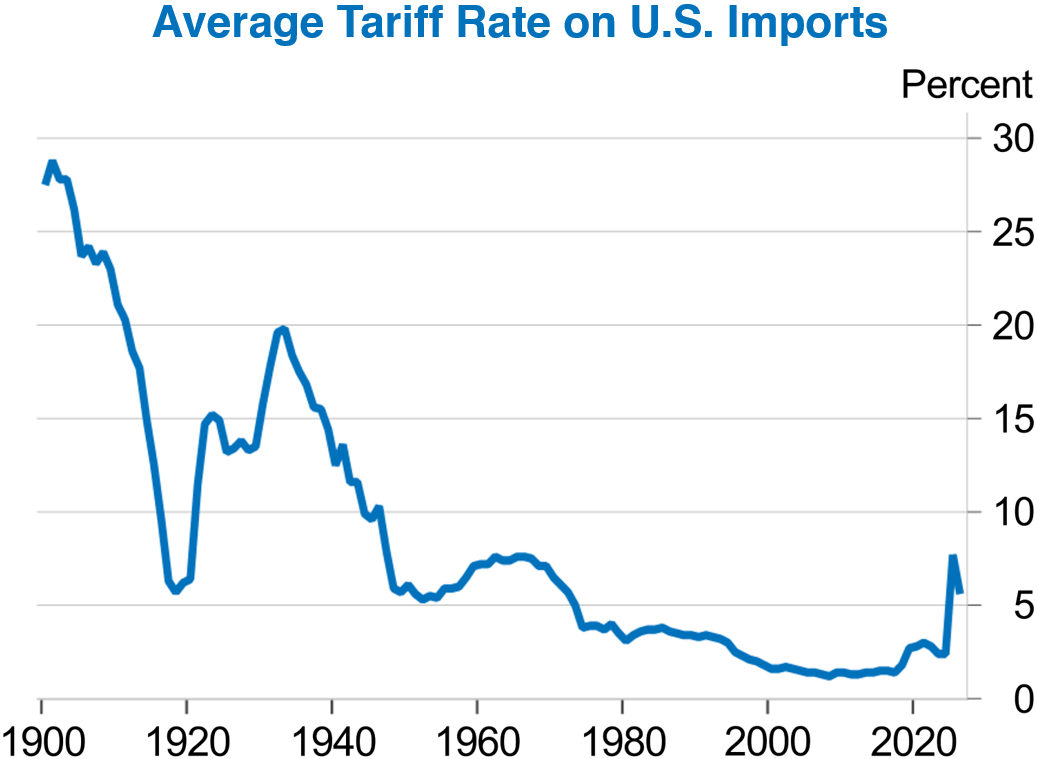
Prior to the ruling, the Administration relied on three primary statutes to raise tariffs: Section 232 of the Trade Expansion Act of 1962, which permits sector-specific tariffs on national security grounds; Section 301 of the Trade Act of 1974, which authorizes country-specific retaliation in response to unfair trade practices; and the IEEPA, which had been used to implement broad “reciprocal” tariffs under a declared national emergency. The IEEPA measures were a significant contributor to the sharp rise in the average effective tariff rate on U.S. imports. While the effective rate remained below 3% in the decades prior to 2025, it moved into the double digits following the combined expansion of Section 232 and 301 measures, as well as the subsequent IEEPA actions in 2025.
The Court concluded that, while IEEPA permits the President to regulate imports during a national emergency, it does not explicitly authorize the imposition of tariffs, which are constitutionally rooted in Congress’s taxing power. As a result, the IEEPA-based tariffs are invalid. However, tariffs enacted under Sections 232 and 301 were unaffected by the ruling and remain in place.
Market reaction was relatively muted, in part because legal observers had long viewed the use of IEEPA for tariffs as a vulnerable foundation for broad-based measures. Additionally, the Administration was prepared for this outcome. Within hours of the decision, the President invoked Section 122 of the Trade Act of 1974, which allows for temporary tariffs of up to 15% on countries with which the United States runs a trade deficit. A 10% across-the-board tariff was announced, with the possibility of increasing the rate to 15%. While Section 122 authority is limited to 150 days, it provides a bridge as the Administration considers more durable actions under Sections 232 and 301.
Looking ahead, the temporary nature of Section 122 suggests the Administration is likely to pursue additional Section 232 investigations and potentially expand Section 301 actions to replace part—though likely not all—of the invalidated IEEPA tariffs. Meanwhile, the question of refunds for duties already collected under IEEPA, as well as the timing of those refunds, remains unresolved and will likely be addressed in lower courts, as the Supreme Court did not rule on remedies. Given the implications for federal revenue, inflation dynamics, and monetary policy expectations, developments in trade policy remain a key variable for investors in the months ahead.
Chart sources: Tax Foundation and Macrobond.
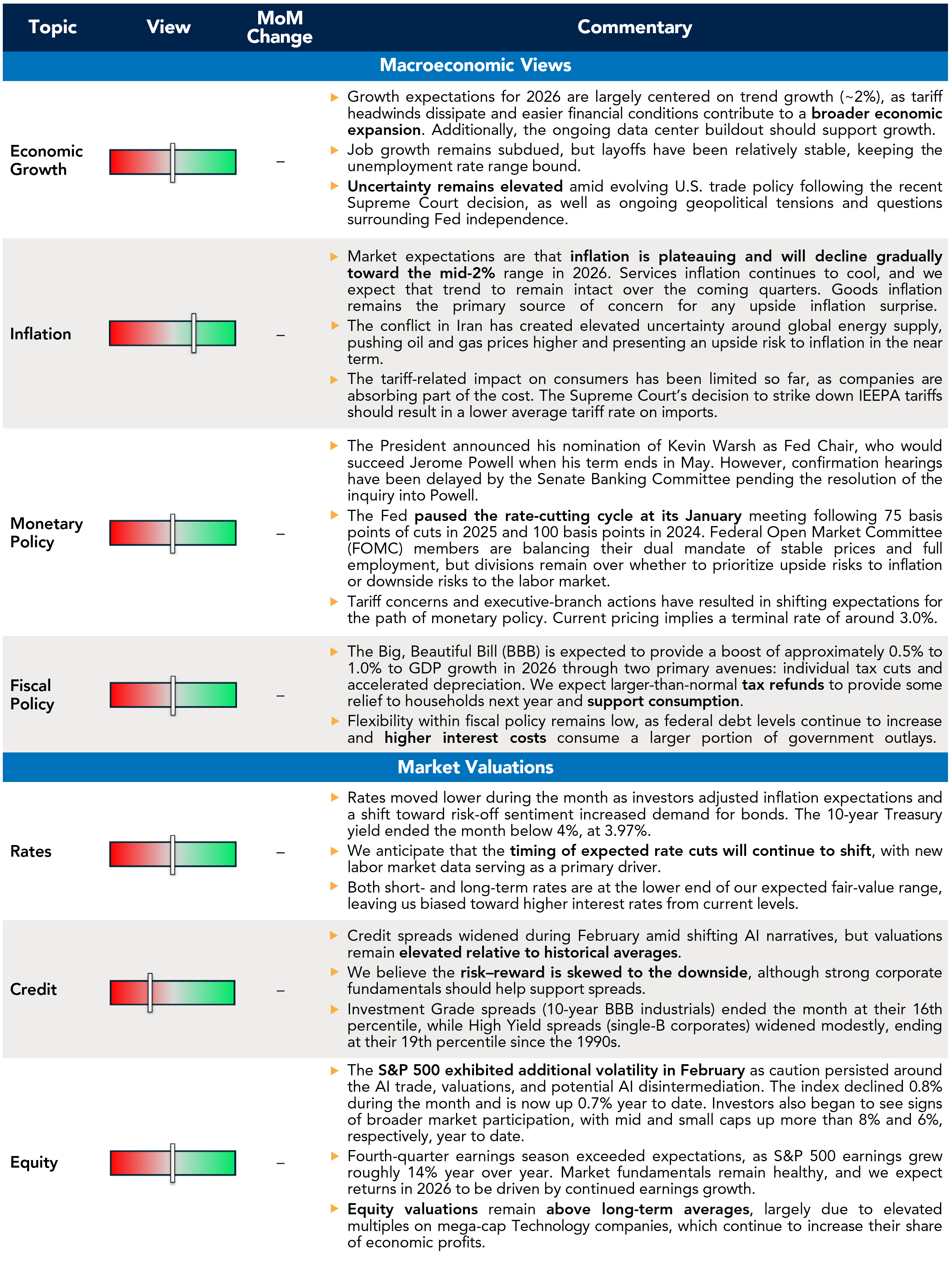
Current Outlook
Market Data & Performance
As of 02/28/2026
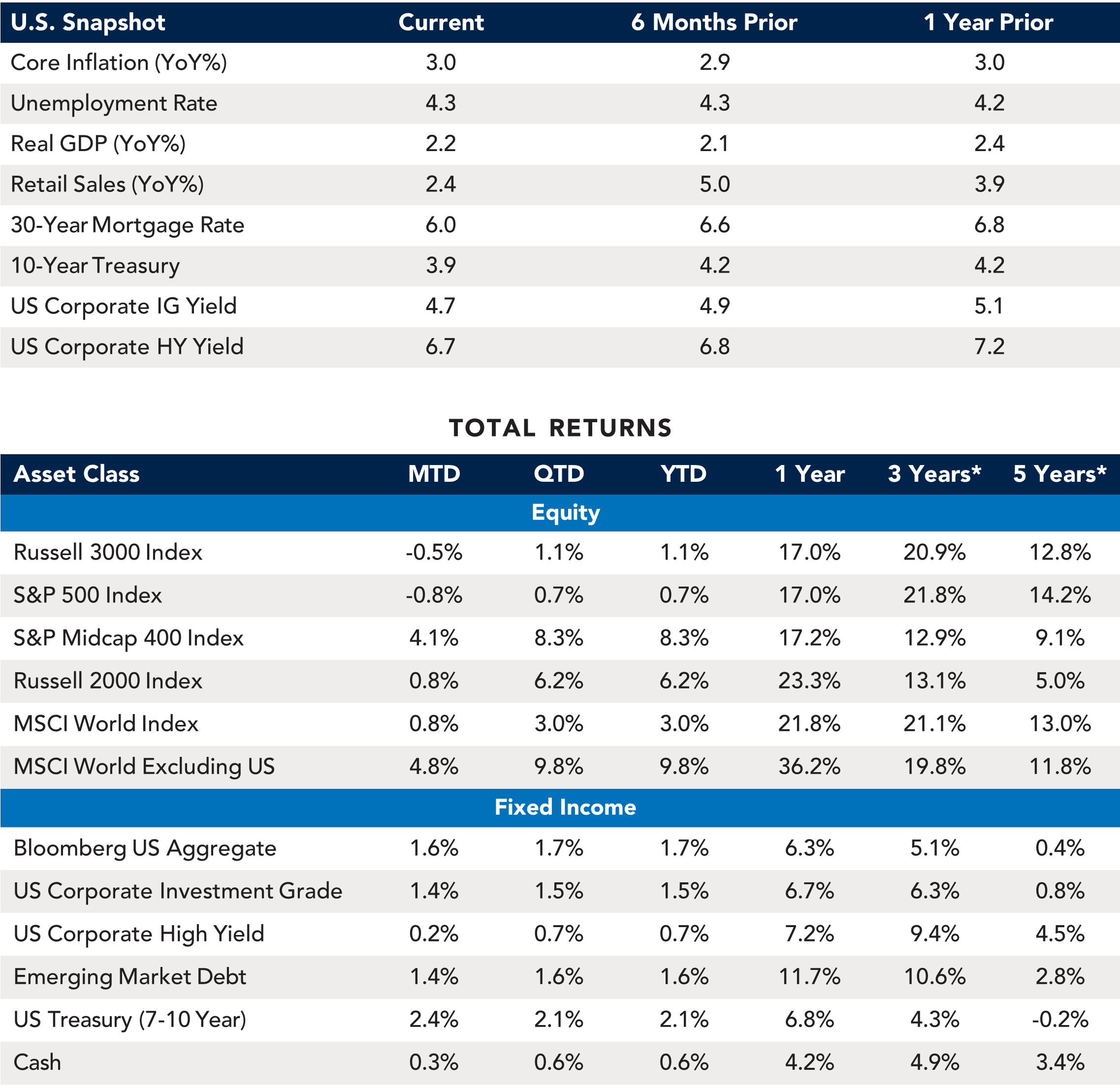
Source: Fort Washington and Bloomberg. *Returns longer than 1 year are annualized. Past performance is not indicative of future results.
Download Monthly Market Pulse – March 2026
Download Monthly Market Pulse – March 2026