






Table of Contents
Macro Insights
Equities Surge to Record Despite Unresolved RisksU.S. equities rebounded sharply in April, reversing March’s drawdown and pushing major indices to fresh record highs. The S&P 500 rose 10.5%, its strongest monthly gain since late 2020, while the Nasdaq jumped 15.3% for its best performance since the pandemic-era rally. Small caps participated meaningfully, with the Russell 2000 advancing 12.2%. In contrast to the prior month’s broad-based weakness, April’s advance was leadership-driven, with mega-cap Technology and AI-linked names accounting for a significant share of the upside, while improving sentiment lifted most segments of the market. |
Leadership was once again concentrated in the AI ecosystem. Mega-cap platforms, semiconductor companies, and infrastructure plays drove returns, supported by strong earnings, rising capital expenditures, and a steady cadence of partnership and investment announcements. The largest Technology companies all finished higher, with particularly strong gains among those tied to cloud and compute demand, while semiconductors delivered one of their strongest months on record. More speculative areas of the market also outperformed, reflecting a sharp improvement in risk appetite. The earnings backdrop remained supportive, with strong growth and positive revisions reinforcing confidence in forward demand, while corporate commentary pointed to continued strength in both enterprise spending and a resilient U.S. consumer, with spending holding up despite softer sentiment and some like pressure on discretionary demand from higher gasoline prices.
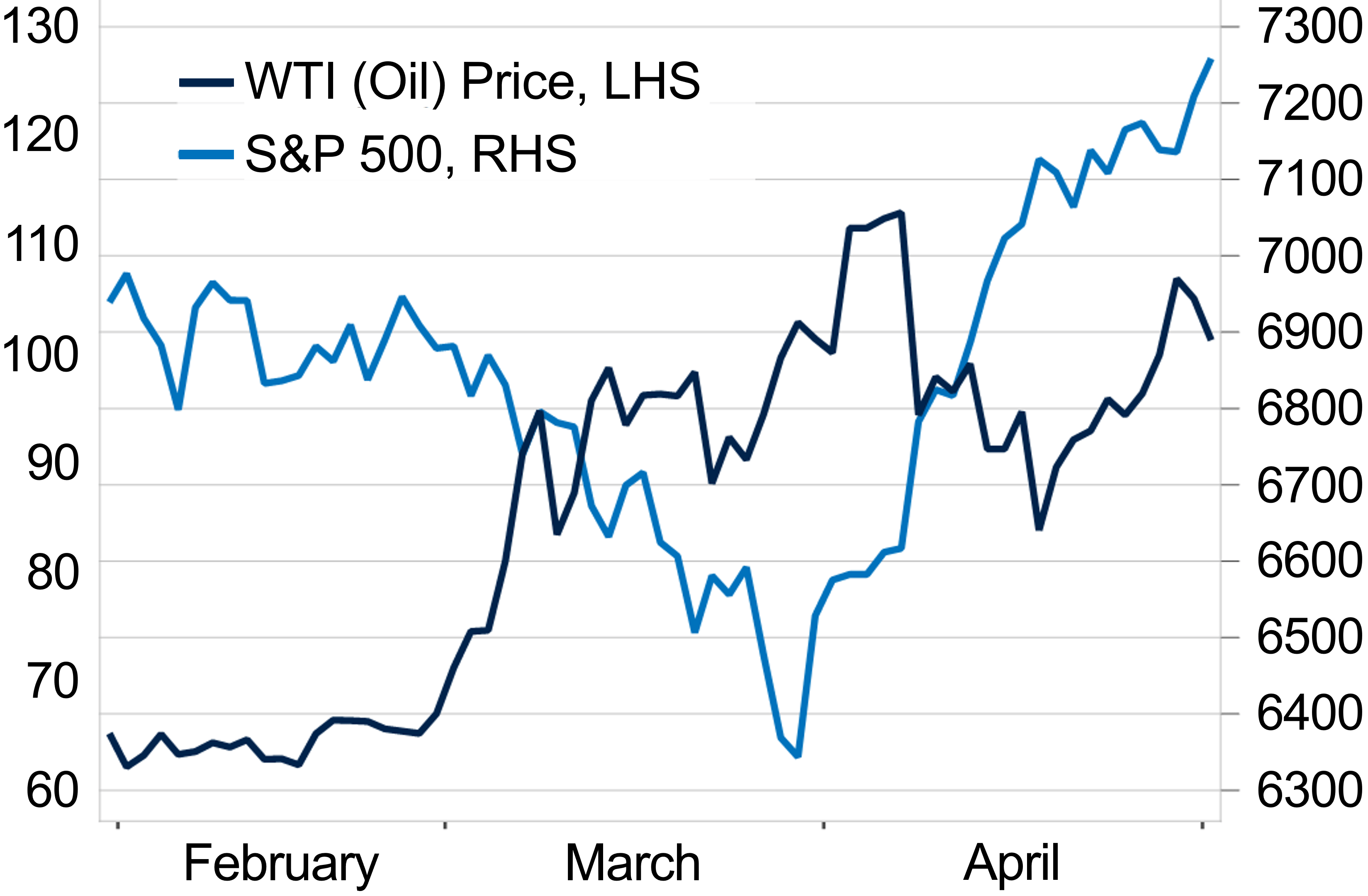
Geopolitical developments continued to generate headlines but had a more limited direct impact on equities. The conflict with Iran persisted through the month, marked by stalled negotiations and periodic escalation, including a U.S. blockade of the Strait of Hormuz. Despite the lack of resolution, equity markets largely looked through the uncertainty, supported in part by confidence that an eventual off-ramp will be found. While oil prices ended the month near four-year highs, markets appear to be discounting a path toward moderation that would limit the risk of a material slowdown in economic activity. This divergence—resilient equities alongside more reactive commodity and rates markets—remains a key dynamic.
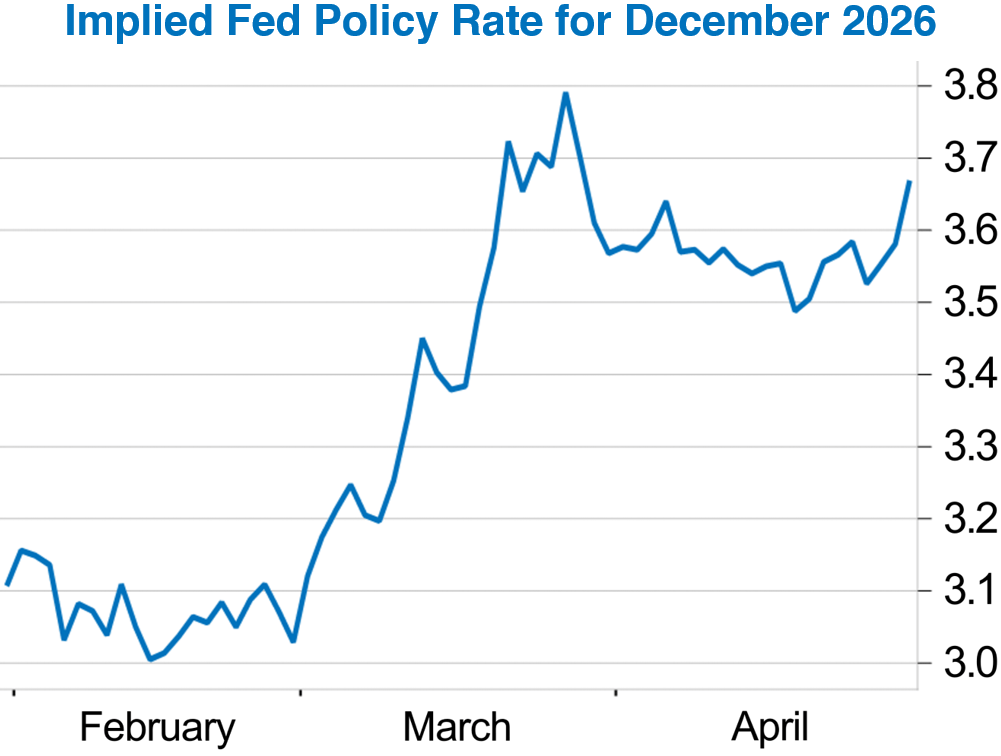
The macro backdrop offered mixed but still constructive signals. Treasury yields moved modestly higher, reflecting resilient economic data and persistent inflation pressures, while markets repriced expectations for Fed policy toward no rate cuts this year. Consumer spending accelerated during the quarter, and earnings growth remained firm, reinforcing the view of an economy that continues to expand despite higher input costs. The April Federal Open Market Committee (FOMC) meeting reinforced this shift, with a more divided committee and limited signaling of near-term easing. Importantly, the transition to new Fed leadership is now in focus, with Chair nominee Kevin Warsh expected to take the helm in May. While policy continuity is the base case, the combination of elevated inflation, firm growth, and a leadership transition introduces an additional layer of uncertainty—one we explore further in this month’s Spotlight.
Looking ahead, the outlook continues to be supported by healthy underlying economic fundamentals. Solid earnings growth, an accelerating consumer, and ongoing AI-driven investment remain constructive for risk assets and underpin our modest overweight positioning. However, the ongoing conflict in Iran represents a notable threat to those fundamentals should the situation remain unresolved and commodity prices push higher still. At the same time, the sharp improvement in sentiment and positioning suggests the AI trade may be prone to bouts of volatility following its recent strength.
Stocks Rebound Despite Oil Remaining Elevated
The S&P 500 hit all-time highs despite WTI over $100 per barrel.
What to Watch
While the market has lowered its expectations for severe downside outcomes related to the Iran conflict, the focus will continue to center on the impact on inflation. Investors will monitor direct impacts on consumer energy prices, as well as second-round effects. Consumer spending and sentiment data will be important to watch as tax refunds support household spending, partially offset by rising energy prices. The continued AI/compute buildout will remain a key theme.
|
Monthly Spotlight
New Fed Chair Finally Set to Take Control
Jerome Powell’s term as Chair of the Fed ends in May 2026, with Kevin Warsh set to take over following his nomination earlier this year. While there was initial uncertainty surrounding his confirmation due to the probe into Powell related to Fed construction costs, that overhang cleared in April, paving the way for a leadership transition. Given the Fed’s broad influence across the U.S. economy, it is worth evaluating how Warsh may shape its direction. We examine his approach and potential impact across three key levers: policy rates, the balance sheet, and forward guidance. It is also important to note that the Chair does not act unilaterally. Monetary policy decisions are made by a 19-member committee (12 voting members), meaning Warsh will need to build consensus around any shift in direction.
On policy rates, Warsh has recently leaned more dovish, signaling openness to lower rates. His argument appears grounded in the view that the Fed has been overly backward-looking, particularly in its assessment of inflation. He has pointed to artificial intelligence as a potential driver of productivity gains, which could allow for stronger growth without corresponding inflationary pressure. If realized, that would create room for rate cuts. However, this view faces a near-term challenge: the recent rise in inflation driven by higher energy prices. This adds complexity to the case for easing and would make it difficult to secure majority support for a cut.
Beyond rates, the balance sheet represents a second key lever. Warsh has suggested that the Fed has become too reliant on unconventional tools and may have overstepped aspects of its mandate in recent years. This points to a preference for a smaller balance sheet over time. Any meaningful reduction, however, would likely be gradual, a view Warsh himself has acknowledged. Even so, a shift in this direction could have important market implications, particularly by putting upward pressure on longer-term interest rates as the Fed steps back from being a large buyer of Treasuries and mortgage-backed securities.
Finally, on forward guidance, Warsh has been critical of the Fed’s heavy use of signaling around the future path of policy. He appears to favor a more restrained approach, potentially reducing the emphasis on detailed communication about where policy may be headed. While changes to rates or the balance sheet would likely take time, adjustments to forward guidance could occur more quickly, given that the Chair holds a press conference after each FOMC decision to discuss the decision and answer questions.
Taken together, these views suggest that a transition from Powell to Warsh is not likely to materially alter the near-term path of monetary policy—particularly given current inflation dynamics and the committee-based structure of the Fed—but differences could emerge over time. One unique dynamic to watch in this transition is that Jerome Powell will remain on the Board of Governors after stepping down as Chair. While uncommon, recent legal challenges to the Fed’s independence prompted this decision, and we believe he will remain on the Board through the Inspector General’s report, which could take a few months.
Chart sources: Bloomberg and Macrobond.
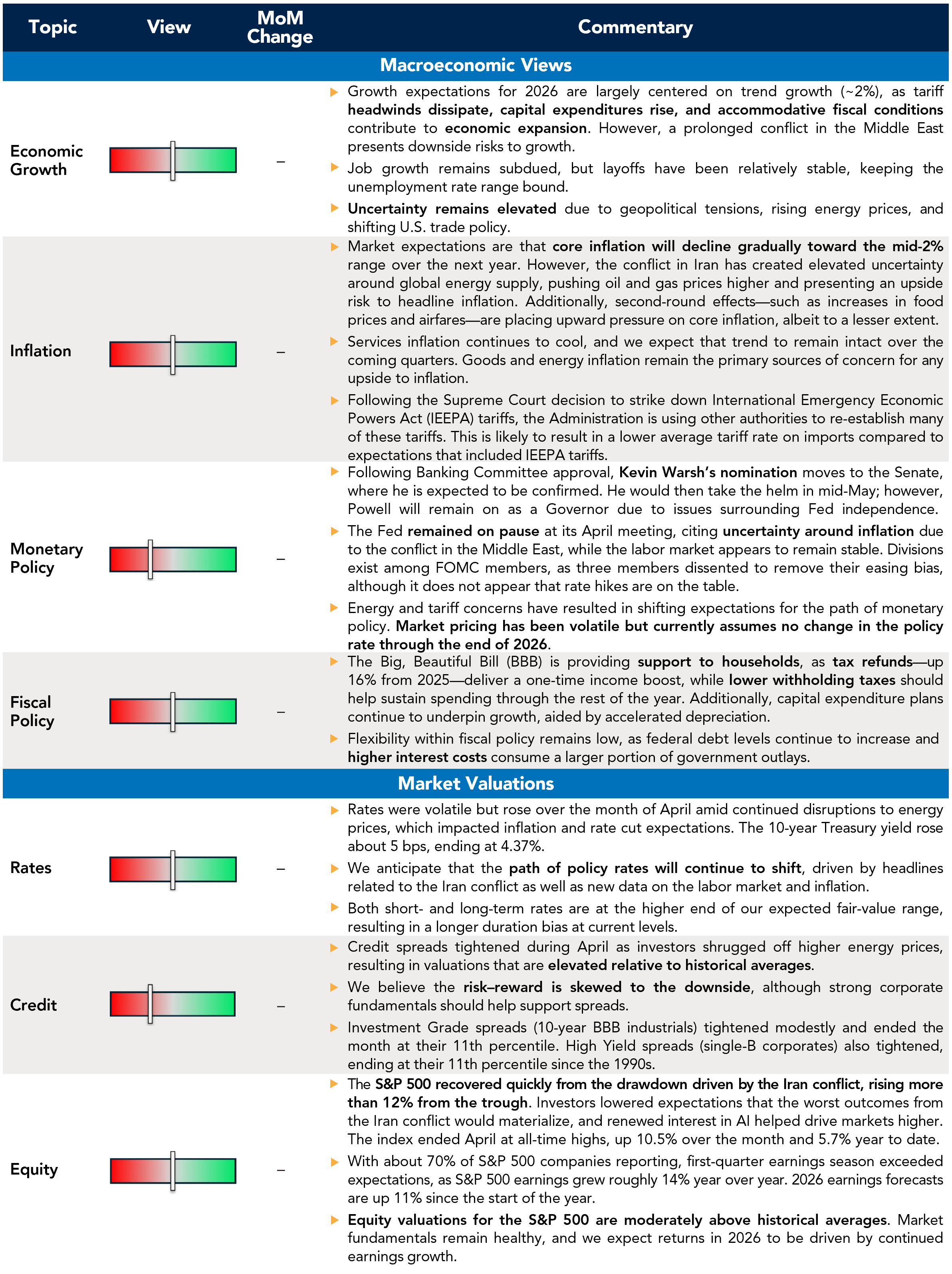
Current Outlook
Market Data & Performance
As of 04/30/2026
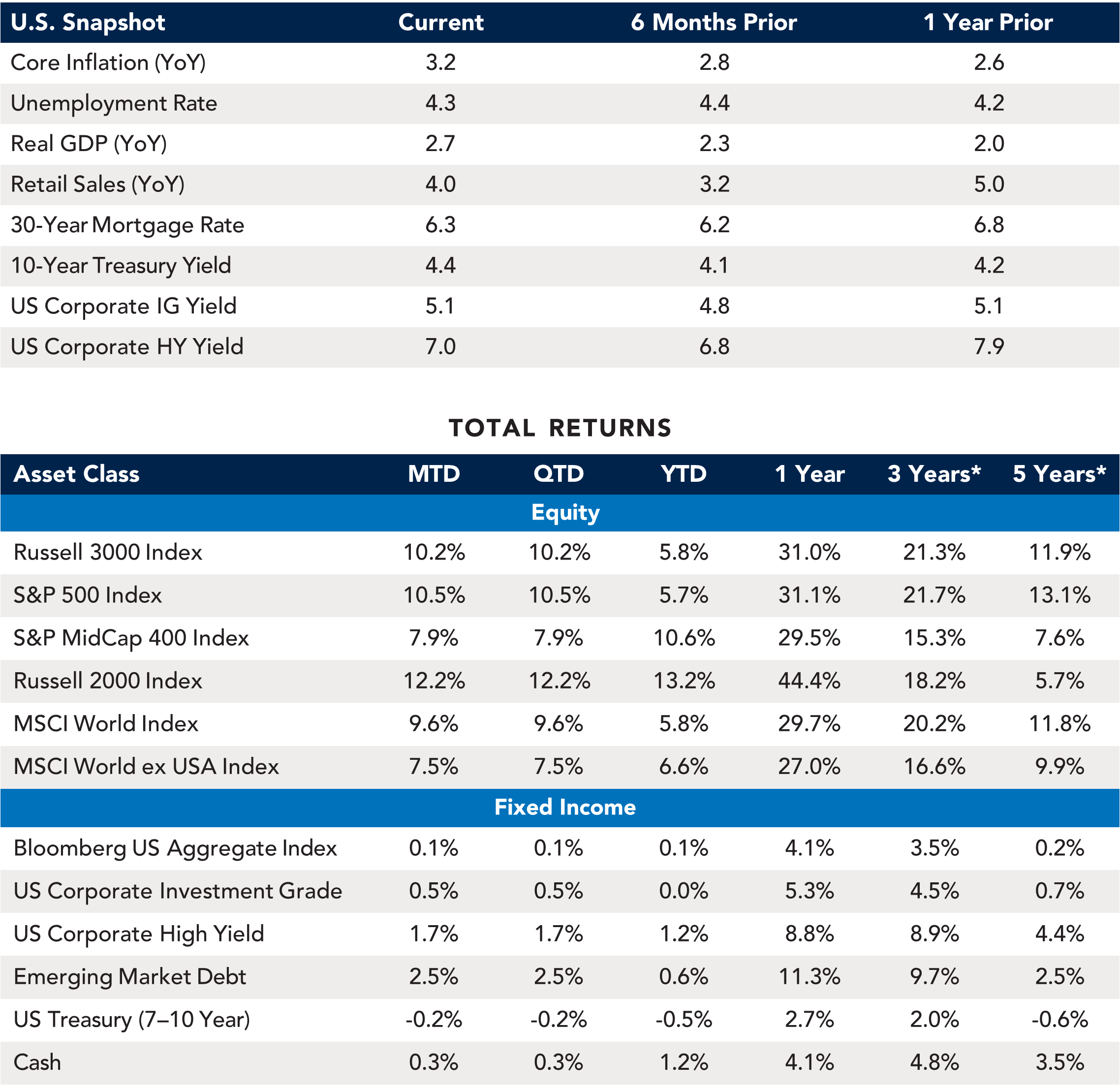
Source: Fort Washington and Bloomberg. *Returns longer than 1 year are annualized. Past performance is not indicative of future results.
Download Monthly Market Pulse – May 2026
Download Monthly Market Pulse – May 2026