






Table of Contents
Macro Insights
Fundamentals in Focus as AI Leadership ShiftsJuly produced another mixed month for U.S. equities as strength outside the largest technology companies offset renewed pressure on the major growth indices. The Dow gained 0.3%, while the S&P 500 declined 0.1% and the Nasdaq fell 3.2%, leaving both indices lower for a second consecutive month. The equal-weighted S&P 500 rose 1.1%, outperforming its cap-weighted counterpart by roughly 120 basis points and extending the broadening trend. Energy and Financials led sector performance, while Technology, Industrials, Utilities, and Materials lagged. |
Investor attention within the AI complex shifted from the durability of demand toward the returns being generated on unprecedented levels of capital spending. Semiconductor and memory stocks sold off sharply amid concerns about hyperscaler investment requirements, expanding supply, open-source competition, and the possibility that compute capacity could eventually outpace demand. Even so, earnings commentary from the largest cloud platforms continued to indicate robust usage, improving monetization, and little appetite to slow investment. July’s weakness therefore appeared less like a rejection of AI and more like a reassessment of where the economic value will accrue. Widening credit spreads among hyperscalers added another dimension to that debate, a development we explore further in this month’s Spotlight.
Renewed conflict between the U.S. and Iran pushed oil prices sharply higher, reversing much of June’s decline. WTI gained roughly 21% as repeated strikes, Houthi attacks, and concerns surrounding key regional shipping routes revived the risk of supply disruption. Broader financial markets remained relatively calm, however, as investors continued to assume that neither side wanted a prolonged interruption to energy flows. The recurring pattern of escalation followed by diplomatic efforts has reduced the market impact of each new flare-up, although a sustained disruption would likely produce a more significant response.
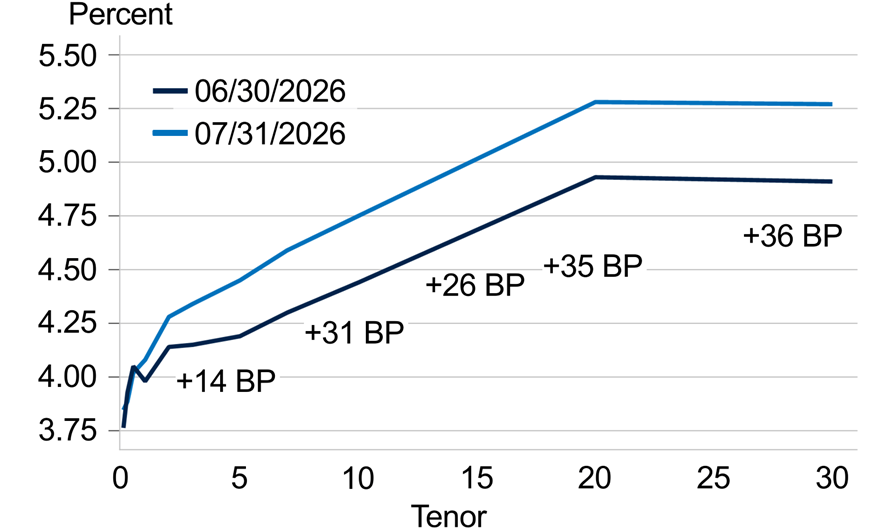
Economic and corporate fundamentals remained supportive. With more than 60% of the S&P 500 having reported, earnings growth substantially exceeded expectations, and results pointed to resilient consumer demand, pricing power, productivity gains, and strength extending beyond technology. Labor market data also remained firm, while inflation readings were cooler than anticipated despite the rebound in oil prices. The Fed held rates unchanged, but three officials dissented in favor of a rate hike, highlighting increasing disagreement over the appropriate policy path. Treasury yields rose across the curve, with the 30-year yield reaching its highest level since 2007 as investors weighed stronger growth, higher energy prices, fiscal concerns, and the possibility of additional tightening.
The market enters August with several competing forces. Earnings remain strong, economic activity continues to expand, and broader participation has reduced dependence on a narrow group of mega-cap stocks. At the same time, higher yields, renewed geopolitical uncertainty, and greater scrutiny of AI investment returns could sustain elevated dispersion across sectors and companies. We remain constructive on equities, but July reinforced that future leadership will likely depend less on exposure to powerful themes and more on the ability to convert investment into durable earnings and cash flow.
Longer Rates at Multi-Year Highs
The move higher in nominal Treasury yields was not driven by inflation expectations alone; it also reflected increases in both real yields and the term premium.
Yield Curve
What to Watch
With the Strait of Hormuz effectively closed and the conflict in the Middle East appearing broader, further developments—and their impact on oil prices—will create volatility in markets. The Fed continues to articulate a reaction function that is biased toward inflation. As a result, investors will be watching incoming data closely. Consumer spending appears resilient but will be monitored to ensure ongoing stability. The AI and compute buildout remains a key theme supporting growth.
|
Monthly Spotlight
The Quiet Repricing Beneath the Investment Grade Market
On the surface, the Investment Grade (IG) corporate bond market has been relatively uneventful this year. Credit spreads remain broadly range bound, supported by resilient corporate fundamentals, steady demand, and yields that continue to attract buyers. Beneath the index level, however, a meaningful shift is underway. Technology spreads—particularly among hyperscalers and other AI-related issuers—have widened as the market adjusts to a structural change in how the AI buildout is being financed. The massive amount of capital required to construct AI infrastructure means even the largest technology companies can no longer internally fund their capital expenditures and must instead turn to the bond market for funding.
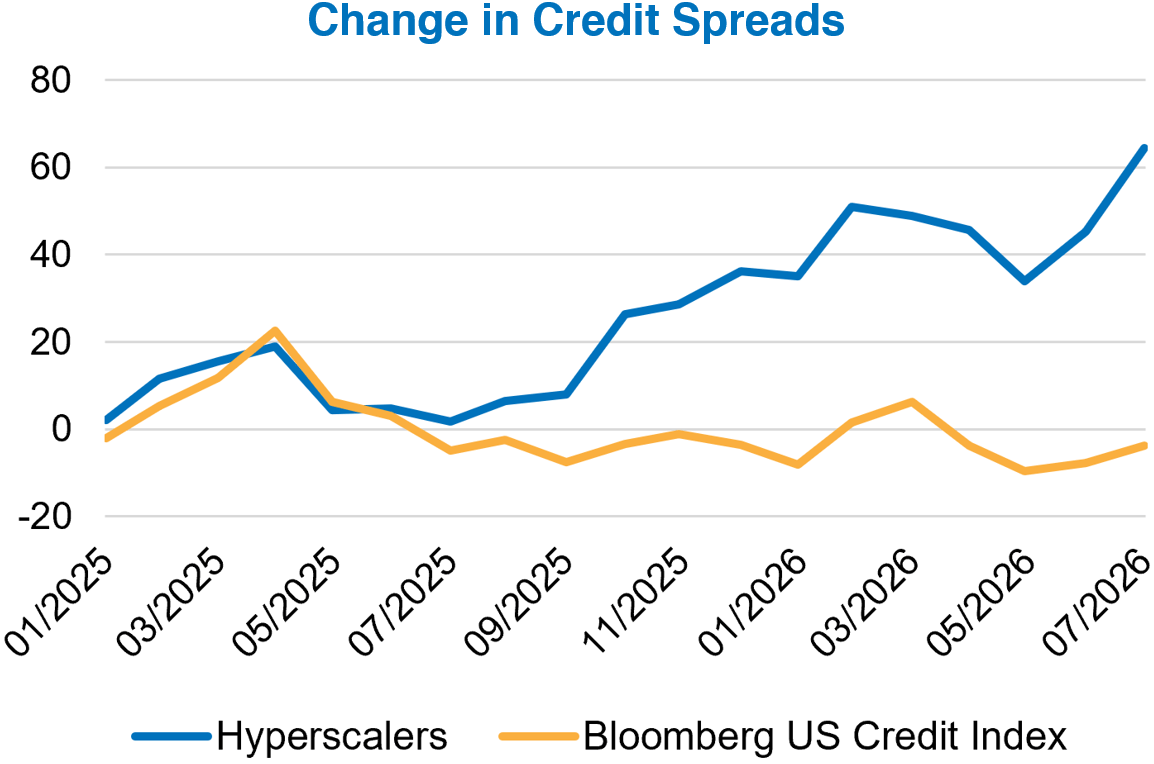
This has driven a notable divergence in issuer performance. Hyperscaler bonds have materially underperformed the broader IG market, although the magnitude of underperformance varies by issuer and maturity. This weakness does not primarily reflect broad concerns about near-term corporate solvency. Most hyperscalers continue to benefit from substantial earnings generation, modest leverage, and strong credit ratings. Instead, investors are being asked to absorb a dramatic increase in issuance as these companies fund the infrastructure required for AI. Goldman Sachs estimates that the five largest hyperscalers could issue roughly $250 billion of bonds this year and $400 billion in 2027. Additionally, issuance of data center and semiconductor project finance debt is expected to exceed $200 billion annually.
This represents a meaningful change for the credit market. Technology companies that were once relatively infrequent borrowers are becoming some of its largest issuers. As their debt outstanding grows, they are also becoming a larger component of corporate bond indices, increasing the exposure of benchmark-oriented portfolios to AI-related capital spending. The impact has been most pronounced at the long end of the curve, where hyperscalers account for roughly one-third of new issuance this year. Including data center financing, that share rises to nearly 60%. The result has been steeper credit curves and larger new-issue concessions. Because much of the debt is long dated, these issuers account for an even larger share of index risk when measured on a duration-times-spread basis.
This creates a difficult technical dynamic. Even when existing bonds appear attractive relative to the broader market and history, investors may hesitate to add exposure today when additional, potentially cheaper new debt is expected tomorrow. Importantly, wider spreads may not materially slow issuance. For many hyperscalers, credit spreads remain a relatively small component of all-in borrowing costs, while management teams continue to believe the returns on AI investment will exceed the cost of debt.
For investors, the opportunity is therefore more complicated than simply buying technology after spreads have widened. This is an environment in which security selection becomes especially important. Hyperscaler credit should not be viewed as a single trade. Some issuers primarily present supply, valuation, and duration risk, while others carry more meaningful leverage, execution, or rating risk. The analysis becomes even more nuanced in data center financings, where differences in structure, collateral, tenants, lease terms, construction risk, and residual value can materially alter the credit profile.
Chart source: Bloomberg.
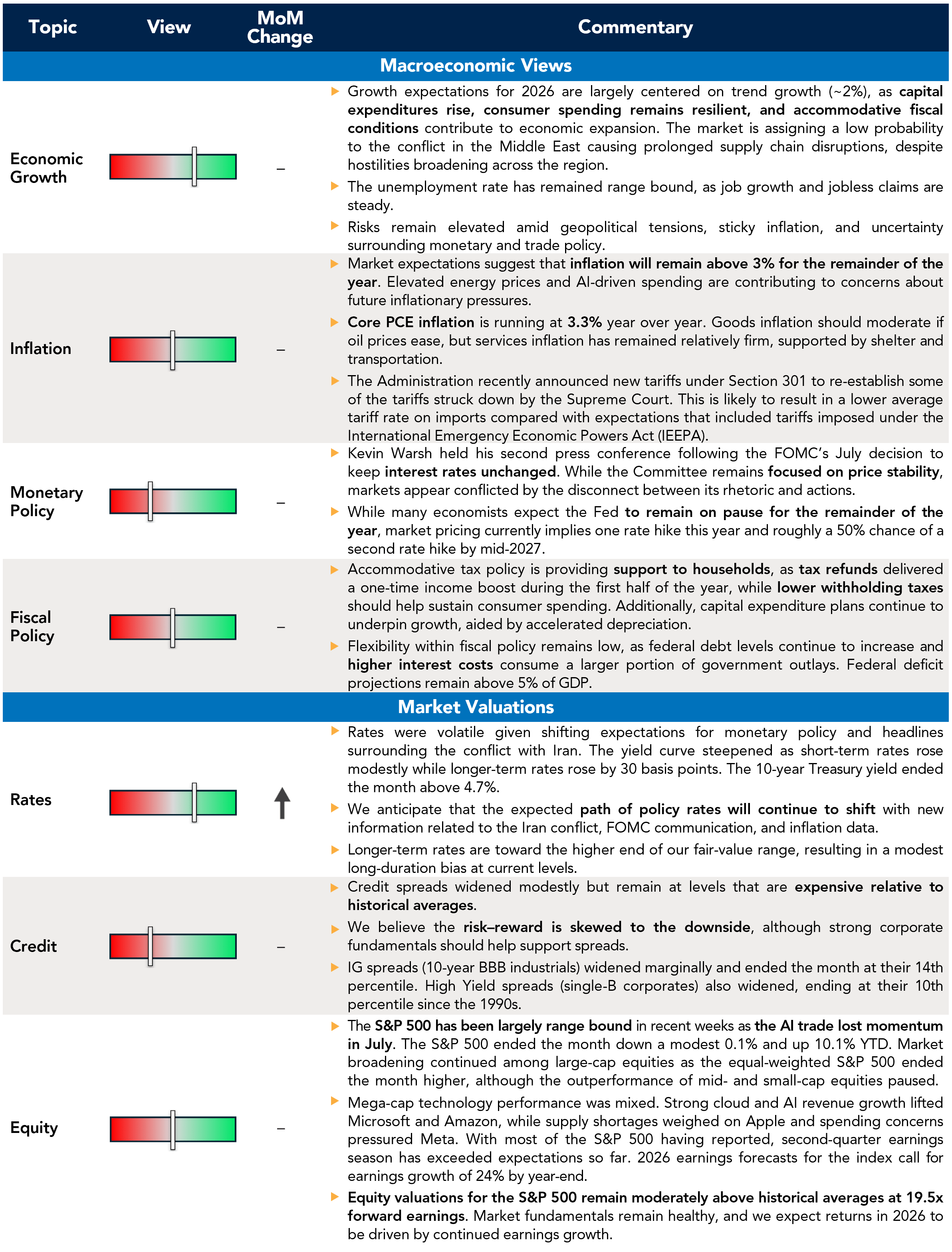
Current Outlook
Market Data & Performance
As of 07/31/2026

Source: Fort Washington and Bloomberg. *Returns longer than 1 year are annualized. Past performance is not indicative of future results.
Download Monthly Market Pulse – August 2026
Download Monthly Market Pulse – August 2026