






Table of Contents
Macro Insights
Fundamentals in Focus as AI Leadership ShiftsWHAT HAPPENEDEquities rebounded and participation remained healthy. The S&P 500 gained 2.7% and the Nasdaq rose 4.0% in August, snapping two consecutive monthly declines, while the equal-weight S&P 500 advanced 2.0%. Strength extended across several areas of the market, with Technology, Energy, Materials, and Healthcare among the leaders. Software was particularly strong, rising more than 16%, while semiconductor shares stabilized following July’s sharp decline. |
Corporate fundamentals remained supportive. Earnings continued to demonstrate healthy demand and strong investment activity, particularly around artificial intelligence. NVIDIA highlighted exceptional growth that remains constrained more by supply than demand, while cloud and technology companies continued to report robust AI-related demand and adoption. More broadly, corporate results continued to support expectations for very solid earnings growth.
The economy moderated but remained resilient. Payroll growth softened, retail sales were mixed, and consumer sentiment remained subdued, but household spending remained resilient and unemployment remained low. Importantly, inflation data were relatively benign, with few signs that higher energy prices were producing a meaningful broader acceleration, though the level of inflation remains above the Fed’s 2% target.
Fed policy remained a source of uncertainty. Fed Chair Warsh emphasized at Jackson Hole the need for greater confidence that inflation is returning toward 2% at a sufficient pace, increasing market-implied odds of a potential September rate hike. However, unexpected weakness in the upcoming payroll report could take a September hike off the table. Short-term Treasury yields rose modestly in August, while longer-term yields were relatively stable following the sharp move higher earlier this summer.
WHAT IT MEANS
August largely reinforced our constructive view. Earnings are growing, consumers remain engaged, and business investment continues to support economic activity. At the same time, market participation has broadened, reducing dependence on the narrow group of semiconductor and mega-cap technology companies that drove much of the market’s earlier gains.
The evolution within the AI complex is particularly notable. For much of the year, investors rewarded the companies supplying the infrastructure required to build AI capacity. More recently, attention has begun to broaden toward companies positioned to deploy and monetize that capacity. We view that as a natural progression rather than evidence that the AI investment cycle is weakening. This month’s Spotlight examines where the next phase of AI value creation may emerge.
Monetary policy remains an important risk, particularly with the Fed maintaining a restrictive posture as inflation remains above target despite some moderation in economic data. However, weakness in rate-sensitive areas has been evident for some time and has not translated into broader economic deterioration. We question the need for tightening policy in response to a supply disruption in oil and demand strength in a rate-insensitive area such as AI infrastructure.
We therefore remain favorable toward equities. Valuations and elevated interest rates argue for selectivity, but healthy earnings growth, continued capital investment, and broader market leadership provide a solid foundation for returns. As the AI cycle matures, we expect differentiation to increase, with investors placing greater emphasis on companies that can turn technological adoption into durable fundamental growth.
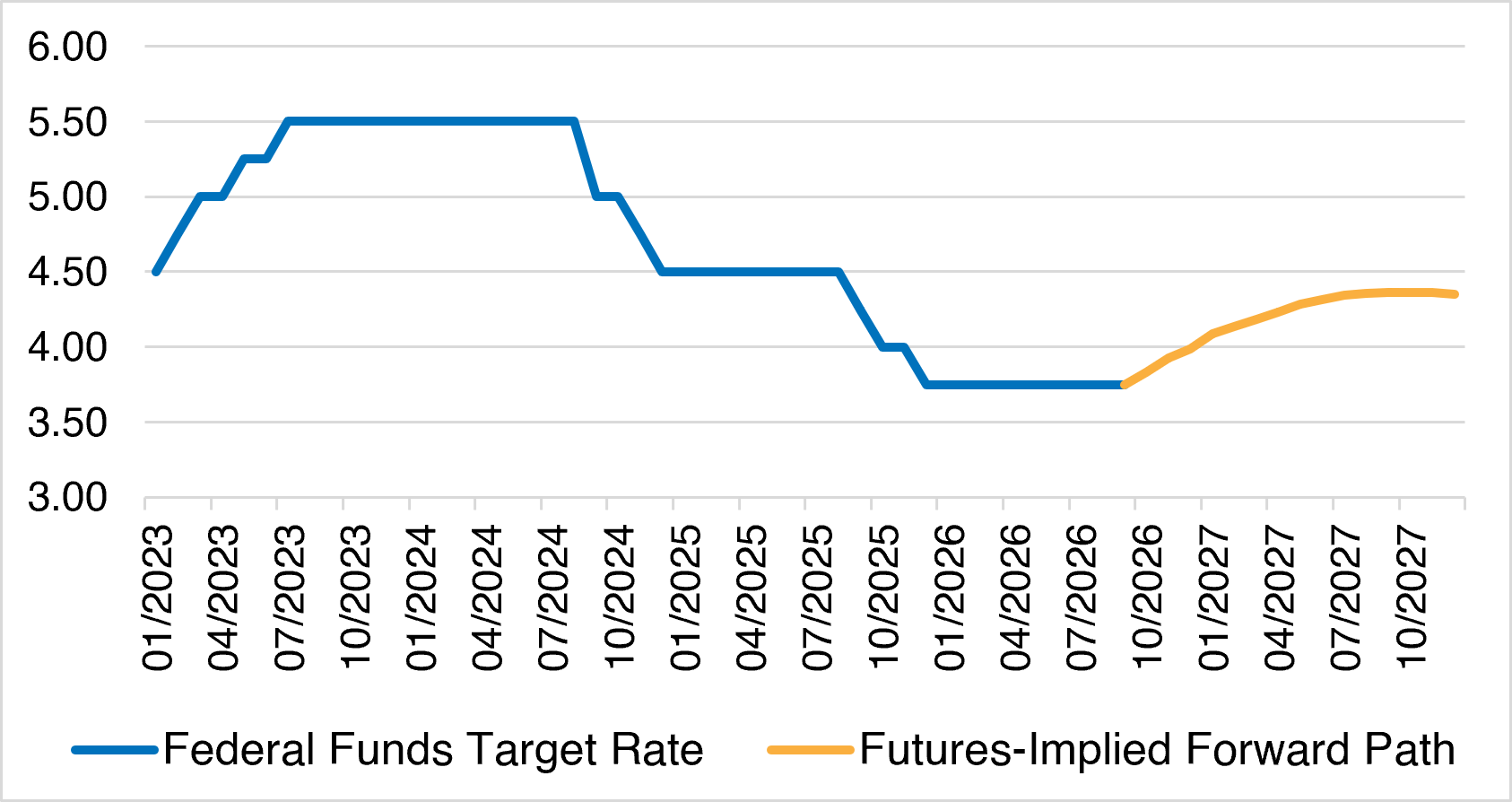
Markets Reprice the Fed Path Higher
Chair Warsh emphasized at Jackson Hole the need for greater confidence that inflation is returning toward 2% at a sufficient pace. Markets responded by increasing the probability of additional tightening.
What to Watch
The Fed continues to articulate a reaction function that is biased toward inflation. As a result, incoming data will be the focus for investors. Consumer spending appears resilient, but higher energy prices may be starting to pressure spending, warranting continued monitoring. Headlines surrounding the conflict in the Middle East will continue to create volatility in energy markets.
|
Monthly Spotlight
The Next Phase of the AI Trade
For much of this year, the market has treated artificial intelligence as a hardware-winner, software-loser trade. Although software has outperformed since the end of June, semiconductors remain well ahead year to date, with the Semiconductor ETF (SOXX) up 70%, compared with just 4% for the Tech-Software ETF (IGV). The divergence reflects a reasonable dynamic: the massive investment in AI infrastructure translates directly into demand for semiconductors, memory, networking equipment, and other components needed to build computing capacity. But as AI moves beyond the initial infrastructure buildout, an important question for investors is where the economic value ultimately accrues—and which companies are positioned to capture it.
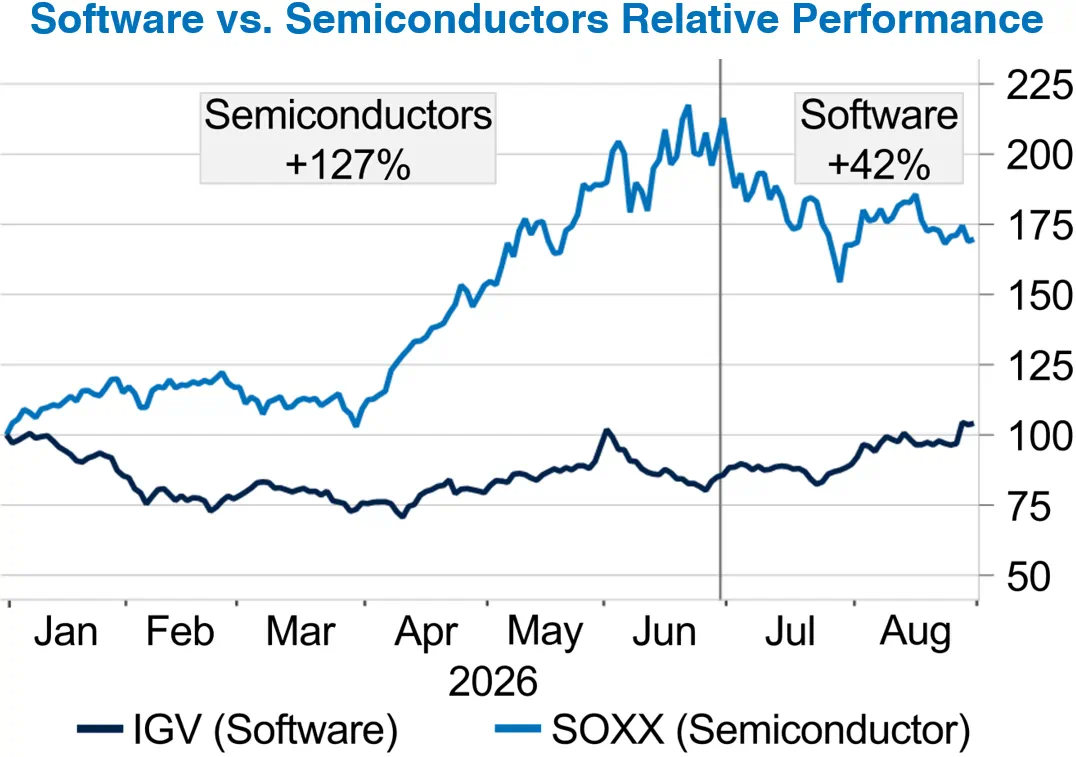
In our view, it is unlikely that semiconductor firms will capture a disproportionate share of the economics indefinitely. Instead, the AI opportunity should broaden as the technology moves from building the infrastructure to deploying it at scale and monetizing it through applications. Semiconductors have been the clearest beneficiaries of the build phase. Hyperscalers increasingly represent the deployment phase, owning the cloud infrastructure, distribution, data, and customer relationships through which AI is delivered. Importantly, there are early signs that the enormous capital commitment is producing attractive economics.
Amazon recently noted that its server and networking investments typically break even in less than three years, while the equipment has useful lives of at least five to six years and much of its AI capacity is contracted for five years or longer. While significant investment is still required up front, these economics illustrate why hyperscalers continue to aggressively build capacity.
Further down the value chain, we expect more of the focus to shift toward monetization, including the software applications that sit on top of that infrastructure. However, the implications for software are nuanced. AI will undoubtedly disrupt portions of the industry, particularly where it lowers barriers to entry or commoditizes existing capabilities. But software is not a homogeneous category. Deeply embedded, mission-critical applications with high switching costs, proprietary data, and important positions within customer workflows should be considerably more resilient. For these businesses, AI can become an enhancement rather than a disruption—making the product more valuable to customers and more difficult to replace.
Recent performance may offer an early glimpse of this broadening. Since June, IGV gained 21%, compared with a 20% decline in SOXX. Two months does not establish a lasting shift in leadership, and we do not believe the semiconductor opportunity is over. Rather, investors may be beginning to look beyond the infrastructure buildout toward the businesses positioned to capture the next phase of AI value creation.
AI is not one trade, and its long-term value will not be distributed evenly. As the technology matures, the investment question will likely shift from who builds the infrastructure to who controls the customer relationship, captures the productivity gains, and can use AI adoption to drive durable returns above the cost of capital. Ultimately, valuations will determine how much of that opportunity investors capture.
Chart sources: Bloomberg and Macrobond.
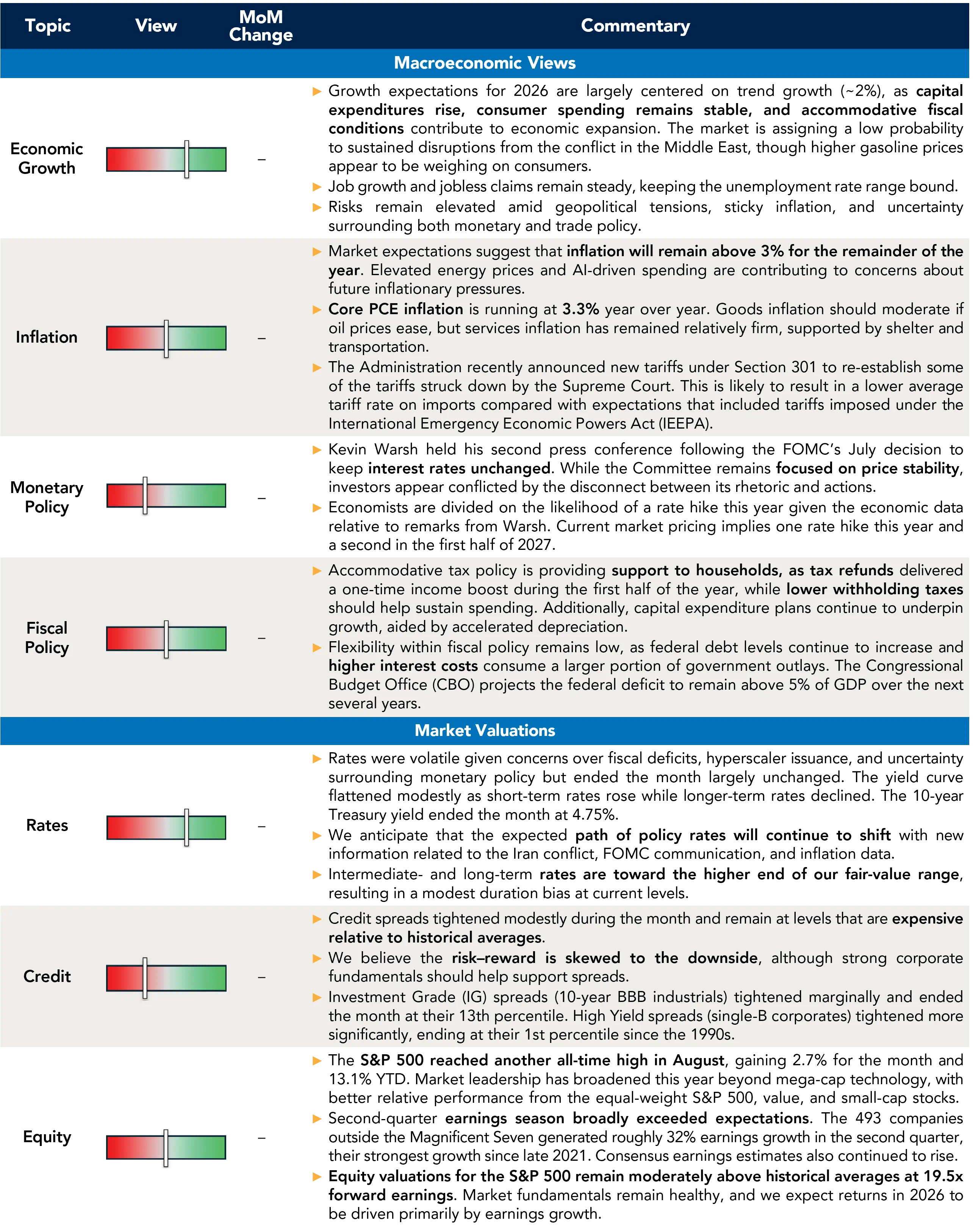
Current Outlook
Market Data and Performance
As of 08/31/2026
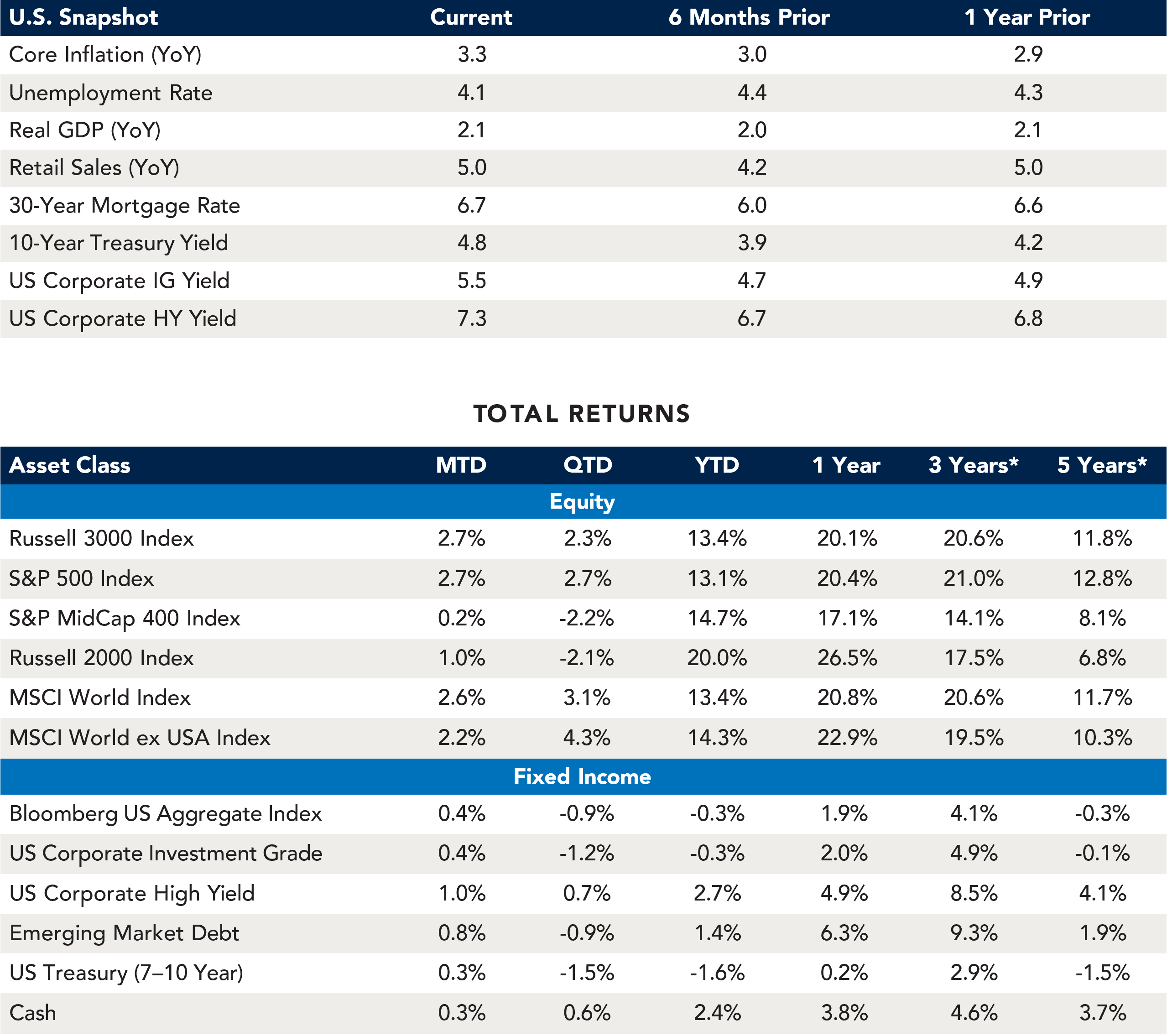
Source: Fort Washington and Bloomberg. *Returns for periods greater than one year are annualized. Past performance is not indicative of future results.
Download Monthly Market Pulse – September 2026
Download Monthly Market Pulse – September 2026