






Table of Contents
Macro Insights
October Surprise in Market Leadership
WHAT HAPPENED
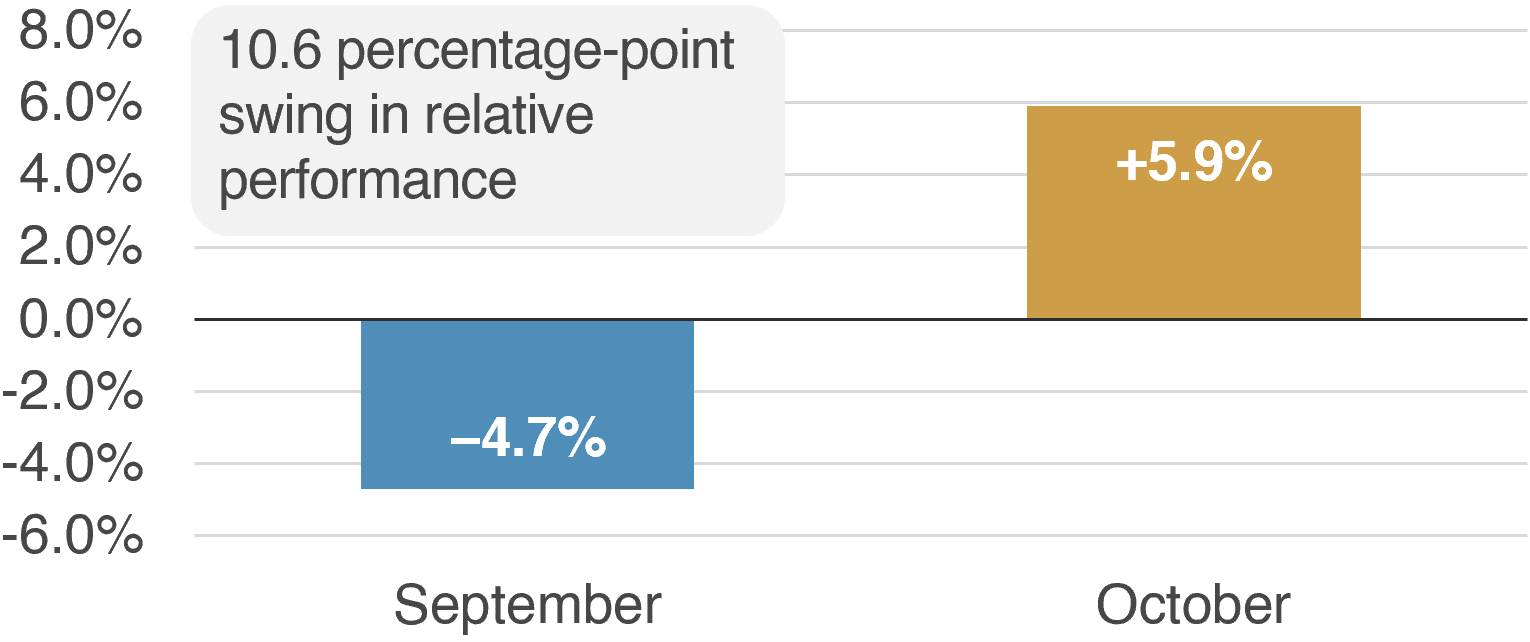
October produced a striking reversal in market leadership. The S&P 500 declined 0.9% and the Nasdaq fell 5.3%, but the equal-weighted S&P 500 gained 5.0%, outperforming the capitalization-weighted index by nearly six percentage points. The Russell 2000 also finished modestly higher. Unlike September, weakness in the headline indexes masked considerably stronger performance beneath the surface.
The reversal was most pronounced among the year's AI-related leaders. Semiconductors fell more than 15%, with memory stocks down more than 20%, while several large technology companies also declined sharply. At the same time, Energy gained 14%, Consumer Staples 11%, Utilities 10%, and Health Care nearly 10%. By month-end, approximately 60% of S&P 500 companies were trading above their 50-day moving averages, up from roughly 20% in late September.
Importantly, the rotation occurred despite strong corporate fundamentals. Third-quarter S&P 500 earnings are on pace to grow approximately 30% from a year ago, with more than 80% of companies exceeding earnings expectations. Economic growth also remained resilient, with third-quarter GDP expanding at a 3.4% annualized rate.
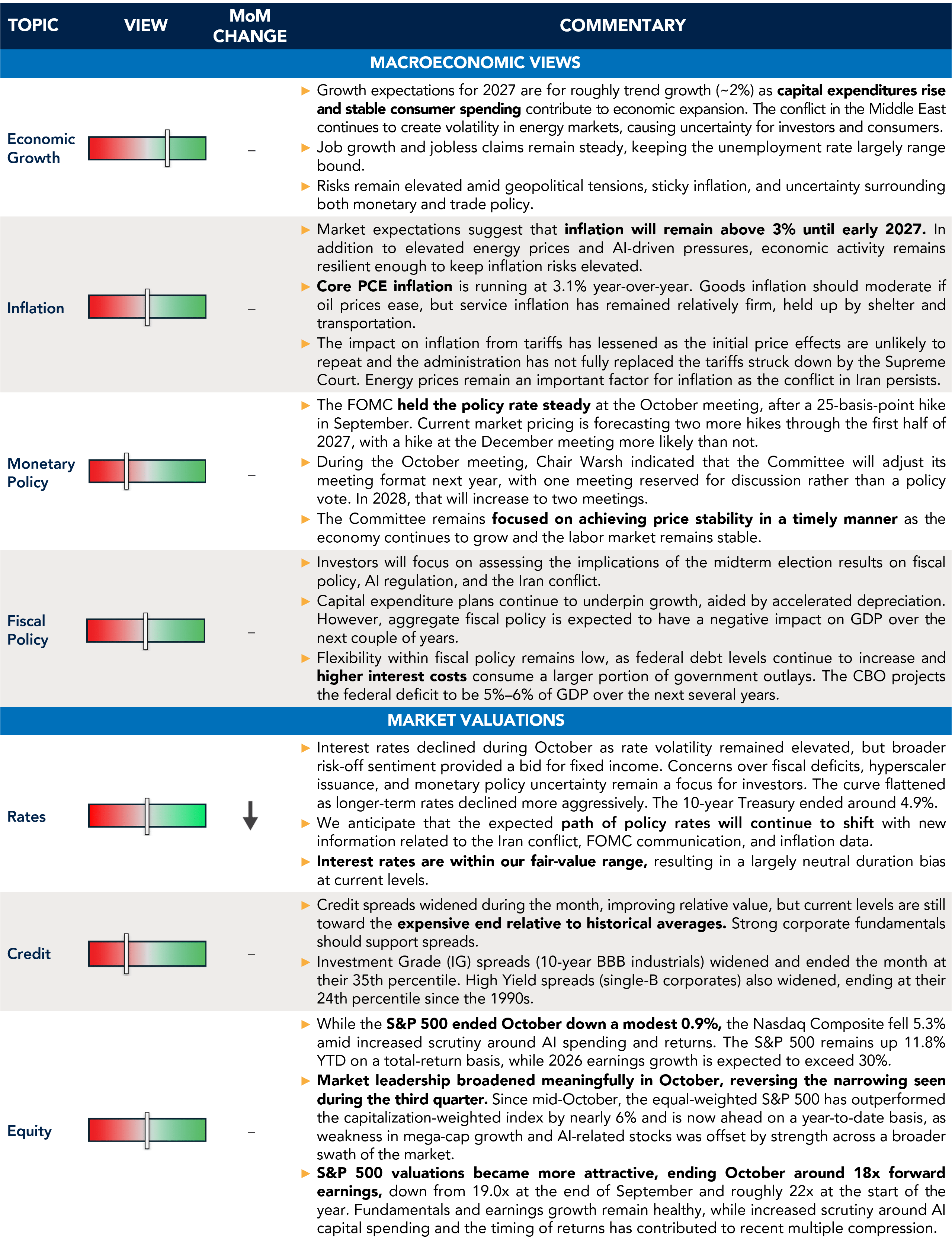
Interest rates provided additional support. The 10-year Treasury yield declined approximately 35 bps during October, reversing much of September’s increase. Concerns surrounding future growth and the financing requirements of the AI buildout helped offset persistent inflation and fiscal concerns.
The Fed left interest rates unchanged as expected. Inflation remains above target and economic activity has remained resilient, but softer employment data provided some evidence that restrictive monetary policy is having an effect. Another rate increase remains possible, although market expectations for the path of rates have moderated.
WHAT IT MEANS
October brought a sharp decline in Treasury yields and significant weakness in technology stocks, but little evidence of a broad equity selloff. Instead, investors sought safety in Treasuries while capital rotated toward other areas of the equity market.
That is an encouraging development. September demonstrated how higher interest rates were weighing on the average company even as large technology stocks supported the major indexes. October demonstrated the opposite: weakness among the largest technology companies obscured considerably better performance across the broader market. In fact, the equal-weighted S&P 500 recovered nearly all of its September decline.
The weakness among AI-related stocks is particularly notable because there has been little evidence that underlying demand has weakened. Cloud growth remains strong, AI capacity continues to be absorbed quickly, and companies continue to describe constraints across compute, data centers, power, and networking. The debate appears to be shifting from whether AI demand exists to what it will cost to meet that demand and what returns those investments will ultimately generate.
That distinction matters more as the scale of investment grows. The largest technology companies remain exceptionally profitable and financially strong, but capital requirements are increasing rapidly at the same time that the cost of capital remains elevated. This month’s Spotlight examines the market’s rising standard of proof for AI investment, as attention shifts from the strength of demand toward capital requirements, financing costs, and ultimately the returns generated on that investment.
We remain constructive toward equities. Corporate earnings remain strong, economic growth has been resilient, and improving market breadth suggests opportunities are broadening beyond a relatively narrow group of companies. October also offered an important reminder that weakness in the major indexes does not necessarily mean weakness in the broader market—just as September demonstrated that strength in those indexes did not necessarily mean strength beneath the surface.
Market Leadership Reversed Sharply in October
After lagging significantly in September, the equal-weighted S&P 500 outperformed the cap-weighted index by nearly six percentage points in October.
EQUAL-WEIGHTED S&P 500 VS. S&P 500
What to Watch
With inflation still above the Fed’s forecast, investors will monitor incoming price data for indications of the path of monetary policy. Consumer spending appears resilient, though higher energy prices are weighing on spending in other areas, warranting continued monitoring. Headlines around the conflict in the Middle East will continue to create volatility in energy markets.
|
Monthly Spotlight
AI’s Higher Bar: From Demand to Returns
DEMAND IS NOT THE ISSUE
Third-quarter earnings season is underway. Several technology companies reported this past week. One message was consistent: AI-related demand remains strong. Microsoft and Alphabet pointed to AI as a major cloud growth driver. Amazon said newly installed AI capacity is being absorbed quickly. Supply remains tight across compute, data centers, power, and networking.
However, the market’s reaction has been more mixed.
THE COST OF MEETING AI DEMAND
We may be nearing a shift in the AI debate. For the past several years, investors focused on whether AI demand would materialize. The focus is now shifting toward what it costs to meet that demand and how quickly record capital spending can translate into earnings, free cash flow, and attractive returns.
The scale of the buildout explains the higher hurdle. Based on guidance, Amazon, Alphabet, Microsoft, and Meta are on pace to spend roughly $730 billion in combined 2026 capital expenditures—nearly 80% above 2025 levels.
For perspective, $730 billion is comparable to the projected annual economic output of Belgium or Ireland.
At that scale, utilization, monetization, financing costs, and payback periods simply matter more. A higher cost of capital raises the hurdle further.
GOOD IS NO LONGER GOOD ENOUGH
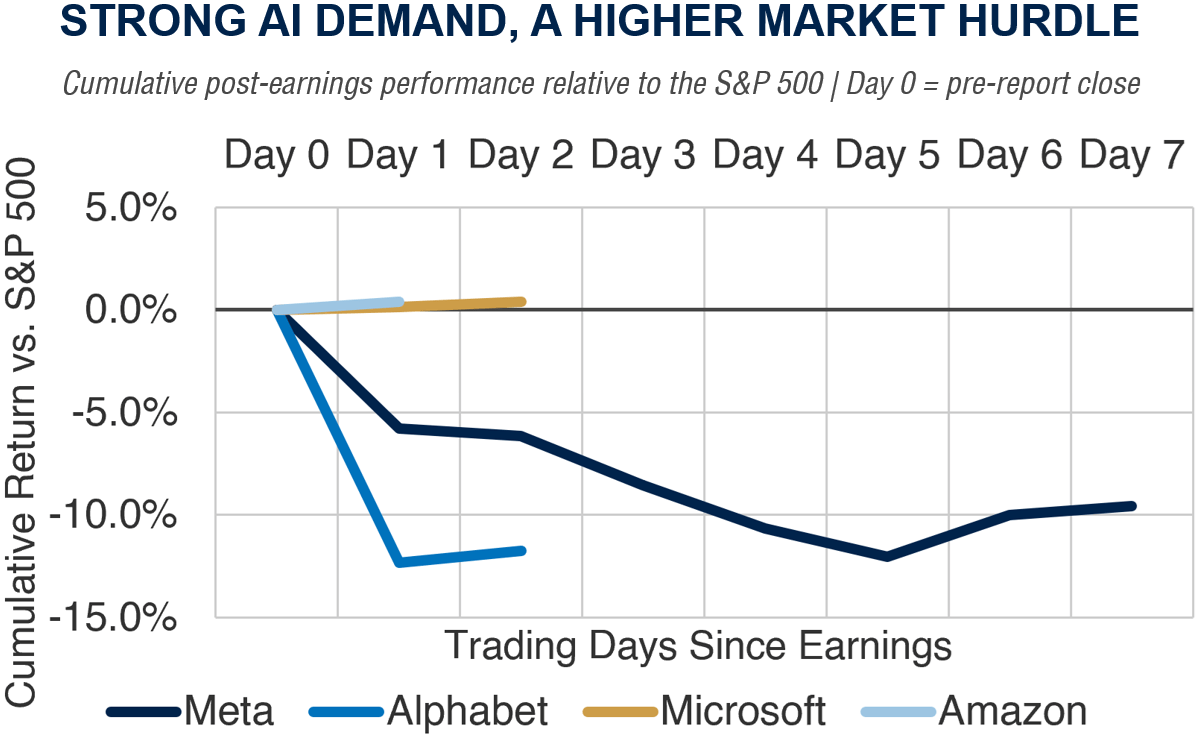
Recent earnings offer different examples of the same issue. Meta’s core business remains strong, yet investors focused on the scale and likely duration of its AI buildout. Alphabet reported exceptional cloud growth, but investors also weighed softer-than-expected search monetization, negative free cash flow, and another large increase in capital spending ahead. AI can be both a new growth engine and a potential disruptor to the profit pool funding the buildout.
Microsoft presented a cleaner operating picture. Azure growth accelerated, margins held up, and cash generation remained healthy. Amazon also showed strong AWS growth and profitability, while quarterly capital spending came in far above expectations.
The stock reactions illustrate the higher bar. Strong operating results did not translate into uniformly strong stock performance. Investors appear more willing to look through a strong quarter if spending is rising faster than expected or the path to cash returns remains unclear.
WHO PAYS FOR THIS?
These businesses are not capital-constrained in the traditional sense. As the scale of AI investment grows, though, how that investment is funded is becoming part of the return equation. Microsoft priced a $25 billion debt offering, its first U.S. investment-grade offering since 2017, while Meta outlined nearly $100 billion of potential equity financing.
None of this signals balance-sheet stress. It does illustrate how the size of the buildout is broadening the funding toolkit. For investors, the question is not simply whether these companies can fund the investment, but whether the returns ultimately justify both the capital being committed and the cost of funding it.
The opportunity remains significant. Demand is strong and supply is constrained. What is changing is the market’s standard of proof. Strong growth alone may no longer be enough. Investors increasingly want evidence that AI demand can be monetized efficiently, converted into cash flow, and generate attractive returns on the capital being committed.
Chart source: Stock Analysis and S&P 500 historical prices. Returns through October 30, 2026. Relative return equals company cumulative price return minus S&P 500 cumulative price return. Lines end at the latest completed post-earnings trading day available for each company.
Current Outlook
Market Data & Performance
As of 10/31/2026
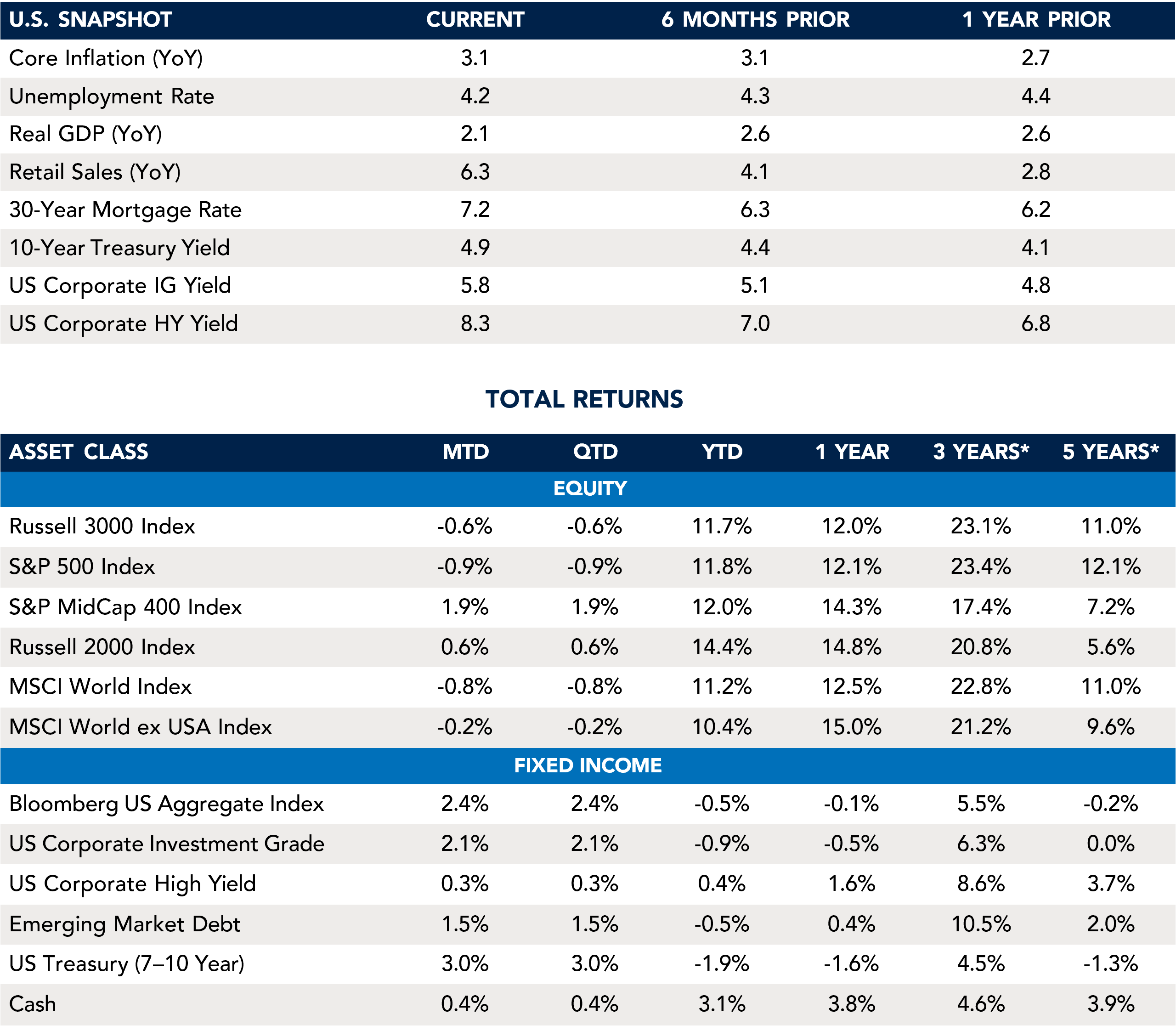
Source: Fort Washington and Bloomberg. *Returns for periods greater than one year are annualized. Past performance is not indicative of future results.
Download Monthly Market Pulse – November 2026
Download Monthly Market Pulse – November 2026