






On the surface, the Investment Grade (IG) corporate bond market has been relatively uneventful this year. Credit spreads remain broadly range bound, supported by resilient corporate fundamentals, steady demand, and yields that continue to attract buyers. Beneath the index level, however, a meaningful shift is underway. Technology spreads—particularly among hyperscalers and other AI-related issuers—have widened as the market adjusts to a structural change in how the AI buildout is being financed. The massive amount of capital required to construct AI infrastructure means even the largest technology companies can no longer internally fund their capital expenditures and must instead turn to the bond market for funding.
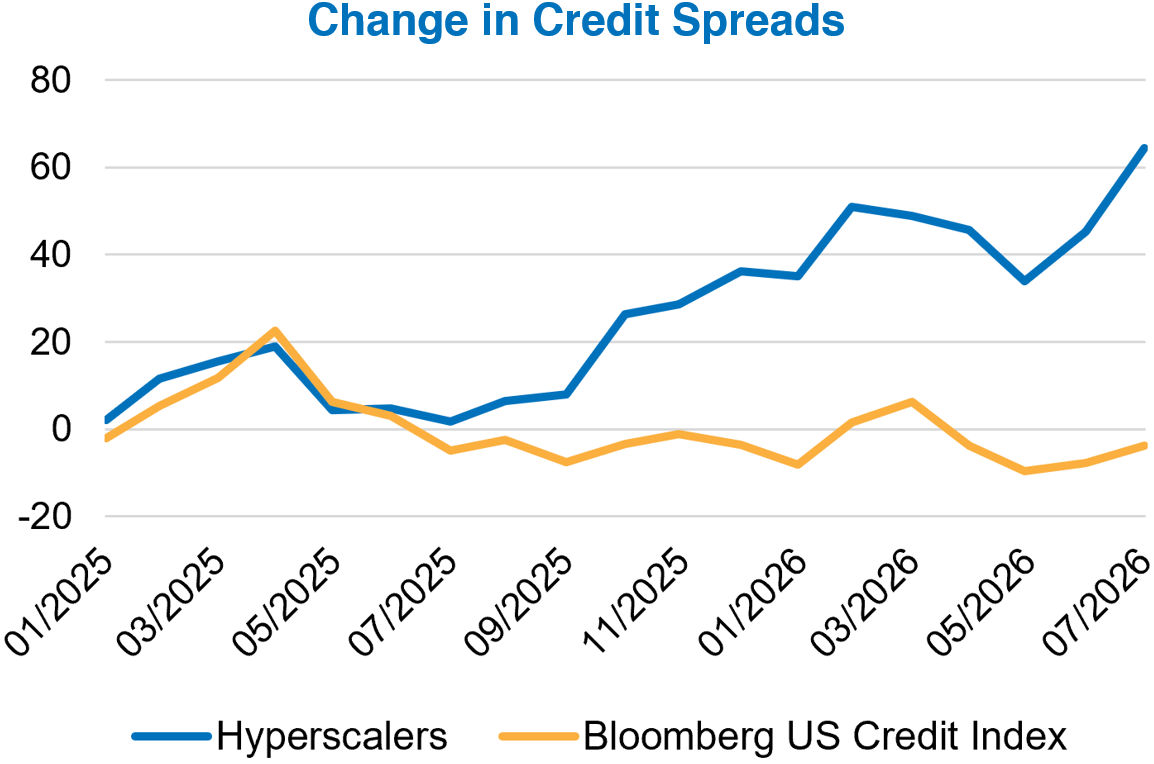
This has driven a notable divergence in issuer performance. Hyperscaler bonds have materially underperformed the broader IG market, although the magnitude of underperformance varies by issuer and maturity. This weakness does not primarily reflect broad concerns about near-term corporate solvency. Most hyperscalers continue to benefit from substantial earnings generation, modest leverage, and strong credit ratings. Instead, investors are being asked to absorb a dramatic increase in issuance as these companies fund the infrastructure required for AI. Goldman Sachs estimates that the five largest hyperscalers could issue roughly $250 billion of bonds this year and $400 billion in 2027. Additionally, issuance of data center and semiconductor project finance debt is expected to exceed $200 billion annually.
This represents a meaningful change for the credit market. Technology companies that were once relatively infrequent borrowers are becoming some of its largest issuers. As their debt outstanding grows, they are also becoming a larger component of corporate bond indices, increasing the exposure of benchmark-oriented portfolios to AI-related capital spending. The impact has been most pronounced at the long end of the curve, where hyperscalers account for roughly one-third of new issuance this year. Including data center financing, that share rises to nearly 60%. The result has been steeper credit curves and larger new-issue concessions. Because much of the debt is long dated, these issuers account for an even larger share of index risk when measured on a duration-times-spread basis.
This creates a difficult technical dynamic. Even when existing bonds appear attractive relative to the broader market and history, investors may hesitate to add exposure today when additional, potentially cheaper new debt is expected tomorrow. Importantly, wider spreads may not materially slow issuance. For many hyperscalers, credit spreads remain a relatively small component of all-in borrowing costs, while management teams continue to believe the returns on AI investment will exceed the cost of debt.
For investors, the opportunity is therefore more complicated than simply buying technology after spreads have widened. This is an environment in which security selection becomes especially important. Hyperscaler credit should not be viewed as a single trade. Some issuers primarily present supply, valuation, and duration risk, while others carry more meaningful leverage, execution, or rating risk. The analysis becomes even more nuanced in data center financings, where differences in structure, collateral, tenants, lease terms, construction risk, and residual value can materially alter the credit profile.
Chart source: Bloomberg.Download The Quiet Repricing Beneath the Investment Grade Market
Download The Quiet Repricing Beneath the Investment Grade Market