






Armed conflicts are notoriously difficult to predict, and the war with Iran is no exception. The most noticeable impact from restricted passage through the Strait of Hormuz (SoH) has been on energy markets, but many other vital commodities also pass through the waterway. The intensity of the resulting economic shock will depend on the duration of hostilities, and disruptions are likely to persist for some time even after fighting ceases. The fallout will produce relative winners and losers across industries and countries, with these distinctions likely to be particularly pronounced in emerging markets.
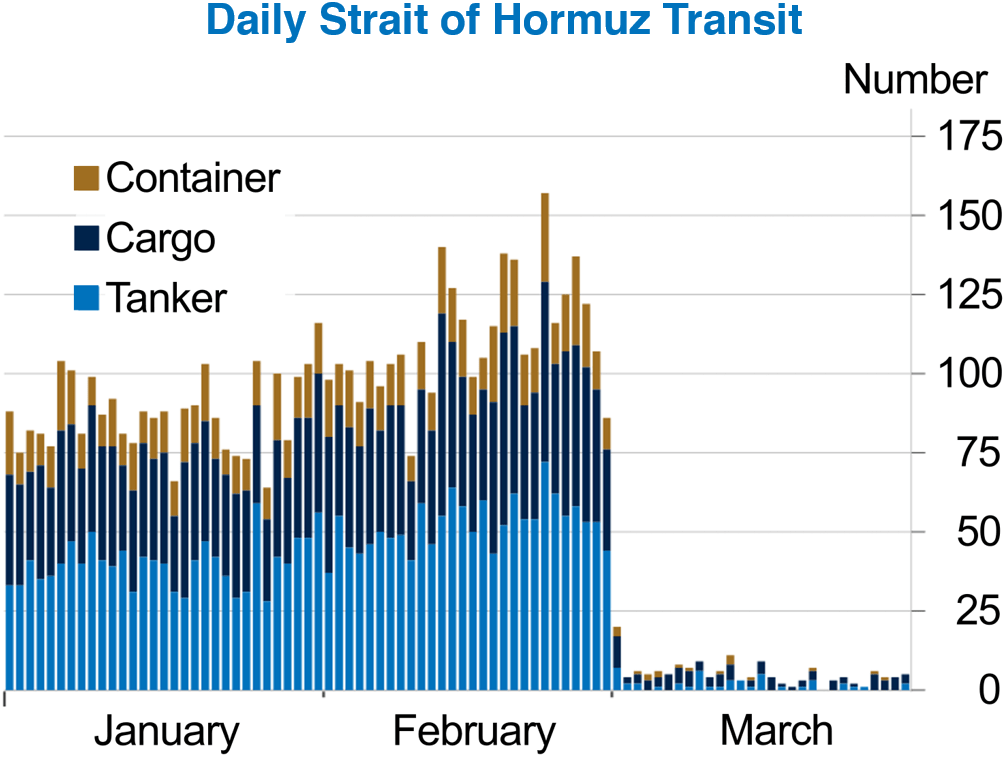
Iran continues to threaten vital shipping lanes and infrastructure across the region despite the degradation of its traditional military capabilities. The impact on energy markets is most acute, as roughly 20% of global crude oil and liquefied natural gas (LNG) flows through the SoH. Only a portion of this oil can be rerouted through pipelines that circumvent the SoH. Even once the Strait is fully reopened, restarting production and normalizing flows will take several weeks. Some critical infrastructure in the region has already been damaged, such as the world’s largest LNG complex at Ras Laffan in Qatar, and repairs could take years.
Energy disruptions are creating clear divergence across countries. Energy exporters not directly constrained by the conflict stand to benefit from improved fiscal balances and terms of trade. Exporters such as Angola, Ecuador, and Papua New Guinea are likely to see near-term tailwinds. Growing energy exporters in Latin America, such as Argentina, Brazil, and Suriname, are particularly well positioned and stand to attract accelerated foreign investment as buyers place an increased premium on the relative safety of the Western Hemisphere. Conversely, energy importers, such as the Philippines and Turkey, face headwinds. Governments that subsidize fuel, such as the Dominican Republic and Pakistan, will be forced to weigh the fiscal cost against the political consequences of passing higher prices on to vulnerable consumers. If the conflict persists, fuel shortages could become a reality. Asia is most at risk, as more than 80% of crude that passed through the SoH prior to the conflict was destined for the region.
Beyond energy, the conflict has implications for broader supply chains. The region is a key producer of fertilizer inputs such as ammonia and sulfur, as well as industrial products such as natural gas liquids and helium. Fertilizer prices, in particular, are critical given their downstream impact on global food prices. Net food importers with a higher weighting of food in their CPI baskets, such as Egypt and Indonesia, are therefore more vulnerable to renewed inflationary pressures. This dynamic complicates the policy backdrop for central banks. Supply chain disruptions extend as far as the semiconductor industry, which relies on helium and sulfur. Conversely, certain petrochemical producers, long suffering from Chinese overcapacity, stand to benefit as supply from the Persian Gulf is curtailed.
Ultimately, the uneven impact of the conflict reinforces the importance of selectivity across geography and industry. For investors, understanding how these crosscurrents affect trade, inflation, and fiscal accounts will be key when allocating capital globally.
Chart sources: IMF and Macrobond.Download The Lingering Impact of the Iran Conflict
Download The Lingering Impact of the Iran Conflict