





The Supreme Court recently struck down a key component of the Administration’s trade policy, ruling that the President does not have authority under the IEEPA to impose tariffs. The decision, issued in a 6–3 vote, represents a meaningful check on executive power; however, it is important to understand both what the Court did—and did not—do. The ruling applies only to tariffs enacted under IEEPA. Other trade authorities remain intact, and the Administration has already begun using alternative tools to offset the decision. With multiple moving pieces—including the potential for tariff refunds—the situation warrants a closer look.
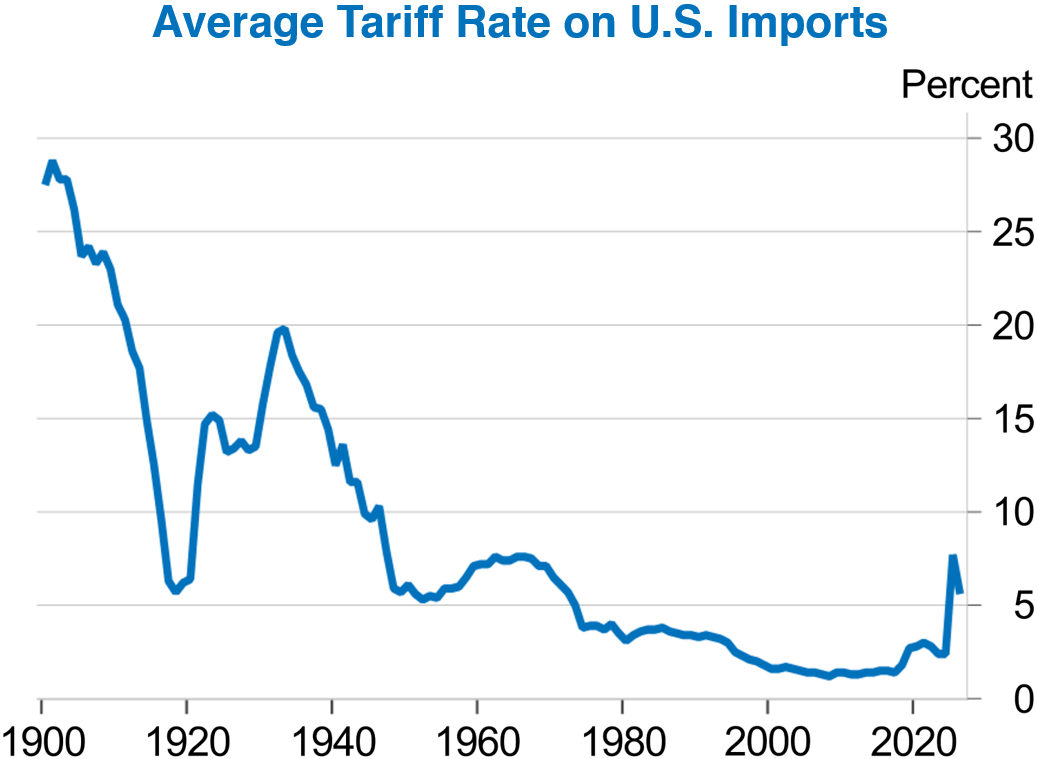
Prior to the ruling, the Administration relied on three primary statutes to raise tariffs: Section 232 of the Trade Expansion Act of 1962, which permits sector-specific tariffs on national security grounds; Section 301 of the Trade Act of 1974, which authorizes country-specific retaliation in response to unfair trade practices; and the IEEPA, which had been used to implement broad “reciprocal” tariffs under a declared national emergency. The IEEPA measures were a significant contributor to the sharp rise in the average effective tariff rate on U.S. imports. While the effective rate remained below 3% in the decades prior to 2025, it moved into the double digits following the combined expansion of Section 232 and 301 measures, as well as the subsequent IEEPA actions in 2025.
The Court concluded that, while IEEPA permits the President to regulate imports during a national emergency, it does not explicitly authorize the imposition of tariffs, which are constitutionally rooted in Congress’s taxing power. As a result, the IEEPA-based tariffs are invalid. However, tariffs enacted under Sections 232 and 301 were unaffected by the ruling and remain in place.
Market reaction was relatively muted, in part because legal observers had long viewed the use of IEEPA for tariffs as a vulnerable foundation for broad-based measures. Additionally, the Administration was prepared for this outcome. Within hours of the decision, the President invoked Section 122 of the Trade Act of 1974, which allows for temporary tariffs of up to 15% on countries with which the United States runs a trade deficit. A 10% across-the-board tariff was announced, with the possibility of increasing the rate to 15%. While Section 122 authority is limited to 150 days, it provides a bridge as the Administration considers more durable actions under Sections 232 and 301.
Looking ahead, the temporary nature of Section 122 suggests the Administration is likely to pursue additional Section 232 investigations and potentially expand Section 301 actions to replace part—though likely not all—of the invalidated IEEPA tariffs. Meanwhile, the question of refunds for duties already collected under IEEPA, as well as the timing of those refunds, remains unresolved and will likely be addressed in lower courts, as the Supreme Court did not rule on remedies. Given the implications for federal revenue, inflation dynamics, and monetary policy expectations, developments in trade policy remain a key variable for investors in the months ahead.
Chart sources: Tax Foundation and Macrobond.