






For much of this year, the market has treated artificial intelligence as a hardware-winner, software-loser trade. Although software has outperformed since the end of June, semiconductors remain well ahead year to date, with the Semiconductor ETF (SOXX) up 70%, compared with just 4% for the Tech-Software ETF (IGV). The divergence reflects a reasonable dynamic: the massive investment in AI infrastructure translates directly into demand for semiconductors, memory, networking equipment, and other components needed to build computing capacity. But as AI moves beyond the initial infrastructure buildout, an important question for investors is where the economic value ultimately accrues—and which companies are positioned to capture it.
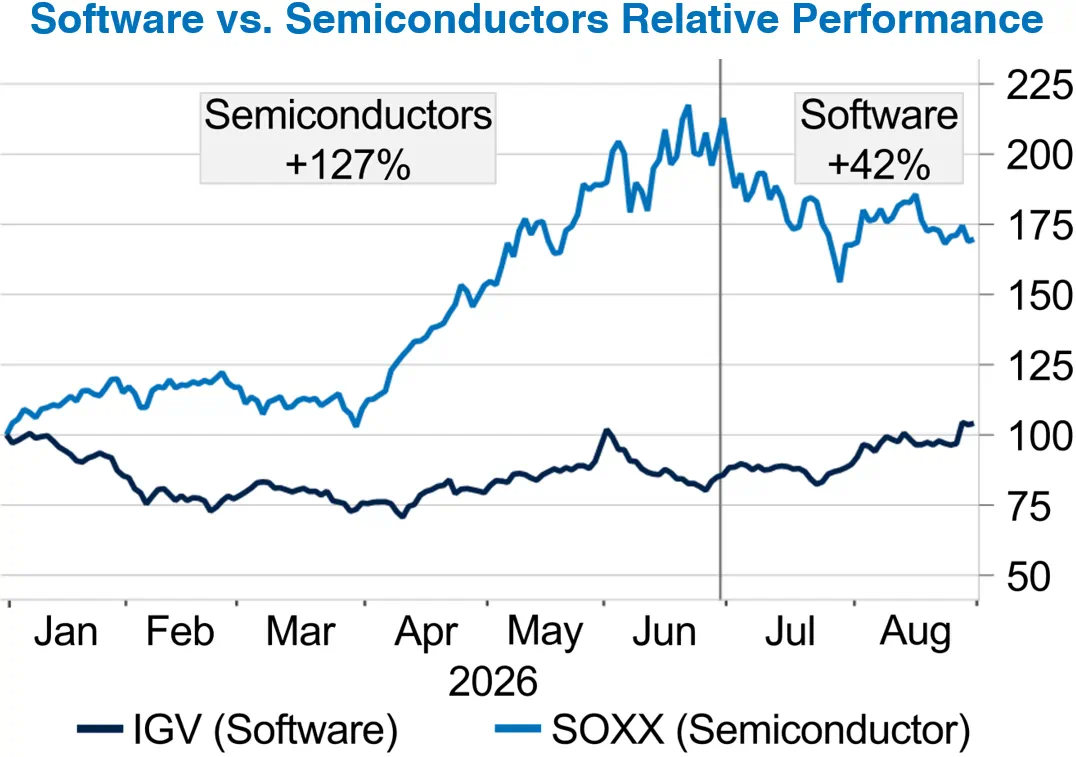
In our view, it is unlikely that semiconductor firms will capture a disproportionate share of the economics indefinitely. Instead, the AI opportunity should broaden as the technology moves from building the infrastructure to deploying it at scale and monetizing it through applications. Semiconductors have been the clearest beneficiaries of the build phase. Hyperscalers increasingly represent the deployment phase, owning the cloud infrastructure, distribution, data, and customer relationships through which AI is delivered. Importantly, there are early signs that the enormous capital commitment is producing attractive economics.
Amazon recently noted that its server and networking investments typically break even in less than three years, while the equipment has useful lives of at least five to six years and much of its AI capacity is contracted for five years or longer. While significant investment is still required up front, these economics illustrate why hyperscalers continue to aggressively build capacity.
Further down the value chain, we expect more of the focus to shift toward monetization, including the software applications that sit on top of that infrastructure. However, the implications for software are nuanced. AI will undoubtedly disrupt portions of the industry, particularly where it lowers barriers to entry or commoditizes existing capabilities. But software is not a homogeneous category. Deeply embedded, mission-critical applications with high switching costs, proprietary data, and important positions within customer workflows should be considerably more resilient. For these businesses, AI can become an enhancement rather than a disruption—making the product more valuable to customers and more difficult to replace.
Recent performance may offer an early glimpse of this broadening. Since June, IGV gained 21%, compared with a 20% decline in SOXX. Two months does not establish a lasting shift in leadership, and we do not believe the semiconductor opportunity is over. Rather, investors may be beginning to look beyond the infrastructure buildout toward the businesses positioned to capture the next phase of AI value creation.
AI is not one trade, and its long-term value will not be distributed evenly. As the technology matures, the investment question will likely shift from who builds the infrastructure to who controls the customer relationship, captures the productivity gains, and can use AI adoption to drive durable returns above the cost of capital. Ultimately, valuations will determine how much of that opportunity investors capture.
Chart sources: Bloomberg and Macrobond.