Table of Contents
Key Takeaways
- You'll need 70% to 90% of your pre-retirement income to maintain your lifestyle.
- Social Security replaces 40% of income, so plan to save more and consider spousal benefits.
- Couples often have double the retirement income of singles, improving your standard of living.
- Only 40% of Americans plan for retirement, so start early and consult a professional.
- Use retirement calculators to estimate your needs based on savings and inflation.
Retirement planning can feel daunting, especially now that fewer employers provide pensions that can help to fund your golden years. If you're married or committed to a partnership, planning for the future can result in twice the stress. You may be curious about the average retirement income for a couple and asking yourself, how much does a couple need to retire?
The amount you need as a couple depends on your (and your partner's) requirements and circumstances, but there's strength in numbers.
Keep in mind that there is no one-size-fits-all approach. You may have different visions for your golden years — for instance, not all married couples retire at the same time — but working together to align on similar goals and expectations for retirement can help set you both up for success.
How Much Do Couples Need?
Back to the original question: Just how much does a couple need to retire? In general, you will need roughly 70% to 90% of your pre-retirement income to continue your standard of living in retirement.1
As a couple, the good news is that, along with having to plan for the expenses of two people, you can plan on having two people's income and savings. This can help bolster your spending (and saving) power.
Social Security Has Limits
Social Security replaces only about 40% of a median wage earner's income in retirement. That can leave quite a gap to fill. Those benefits are due to anyone who has worked at least ten years and earned at least 40 work credits. There is no penalty for being married, and benefits will not be reduced. In fact, there's a chance one member could bump up his or her Social Security if it's substantially lower than the other person's.
That's because the lower-earning spouse can collect spousal benefits worth up to a half of the higher-earning spouse's benefits. The spouse could decide to collect whichever benefit is higher — the amount due as a result of their work history or their spousal benefit. And when the higher-earning spouse dies, the widow or widower is entitled to receive up to the full amount of the deceased person's benefit. The average monthly benefit from Social Security is $1,825, with 48.6 million beneficiaries.1
Figures Increase for Married Couples
Being a couple has some unexpected advantages. For instance, the average retirement income for a couple can be more than double the average retirement income for a single person. Yes — the amount is higher, even when accounting for the presence of two single incomes instead of one.
According to the U.S. Census, the average income for a household headed by a married couple aged 65 or over was a little less than $101,500 in 2020.3 The median income for these households was a little more than $72,800.
It's worth noting that some statisticians say the median is a better and more representative number when evaluating income levels because in accounting for all U.S. households, average income will almost always be higher than median income due to the impact of the small number of U.S. households with extremely high incomes.4 Census figures show that the median income for a woman aged 65 or older living alone was slightly less than $23,800 in 2020. The average income for that group was a little less than $35,100. For single men in that age group, the median was about $30,100, while the average was a little more than $49,200.
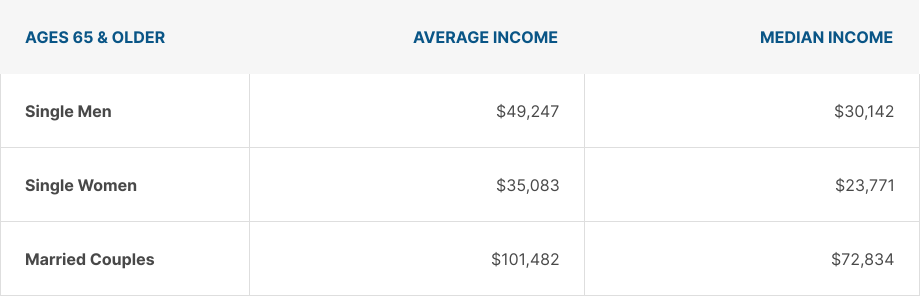
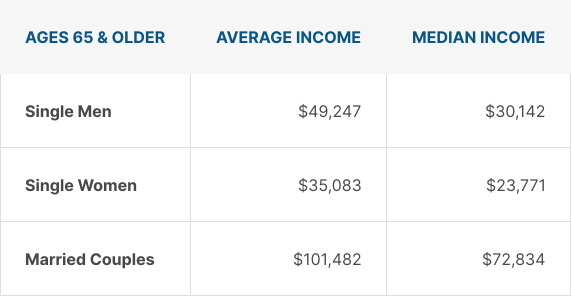
The average retirement income for a couple, according to these figures, is higher than the amount you get when you add the average income for a single man with the average for a single woman in the same age group. This is especially apparent when adding together the more useful median incomes of single men and single women, which equals $53,913 — or roughly $18,900 less than the median income for a married couple household.
Remember that Social Security was never intended to provide all of your income for retirement, although is it a major source of income for most of the elderly.5 Among elderly Social Security beneficiaries, 37% of men and 42% of women receive 50% or more of their income from Social Security. In addition, 12% of men and 15% of women rely on Social Security for at least 90% of their income.
Plan Ahead
According to the U.S. Department of Labor, just about 40% of Americans have calculated how much they need to save for retirement.1
Generally, getting ready for retirement requires planning ahead and saving up your money many years in advance. You may want to consult a financial professional to determine any adjustments that may benefit your retirement plans.
In addition, there are several tools you can use to estimate how much you may need for retirement. For example, a retirement calculator can help walk you through the considerations as you plan your retirement, including your investments, inflation and how much of your income you hope to replace.
Frequently Asked Questions
What are the average retirement savings by age?
Average retirement savings by age can help you gauge whether or not you are on track with your retirement goals, compared to the overall population. For example, how much money should someone in the 35-44 age group have already saved for retirement? Review these suggested retirement savings guidelines for when you’re in your 20s, 30s, 40s, 50s and beyond.
How much do you need to retire at 60?
To retire early at age 60 and enjoy a financially comfortable and fulfilling retirement will require some careful planning. Your current retirement savings, early retirement tax implications, potential Social Security benefits and future health care costs are crucial factors to assess. By taking these key considerations into account, you may be able to achieve your goal of retiring when you reach 60.
How much do you need to retire at 50?
Are you thinking about an early retirement when you turn 50? For effective planning, you should figure out a retirement budget, your income needs, ways to supplement Social Security, timelines for your retirement account withdrawals and how to pay for your health insurance until you’re eligible for Medicare. These considerations can help you determine how much savings you may need to retire at age 50.
Sources
- Top 10 Ways to Prepare for Retirement. https://www.dol.gov/sites/dolgov/files/ebsa/about-ebsa/our-activities/resource-center/publications/top-10-ways-to-prepare-for-retirement.pdf.
- Social Security Fact Sheet. https://www.ssa.gov/news/press/factsheets/basicfact-alt.pdf.
- HINC-02. Age of Householder-Households, by Total Money Income, Type of Household, Race and Hispanic Origin of Householder. https://www.census.gov/data/tables/time-series/demo/income-poverty/cps-hinc/hinc-02.html.
- Household Income: What It Is and How to Calculate It. https://www.investopedia.com/terms/h/household_income.asp.
- Fact Sheet SOCIAL SECURITY. https://www.ssa.gov/news/press/factsheets/basicfact-alt.pdf.