Understanding the difference between long-term and short-term investing can help you shape your overall strategy. Learning how each approach works is often the first step in choosing investments that align with your goals.
It is also important that your short-term and long-term strategies work well together. Before selecting investments, think about key factors such as your timeline and your comfort with risk. Once you define these, you can build strategies that support each other and move you toward your financial journey.
What Is Long-Term Investing?
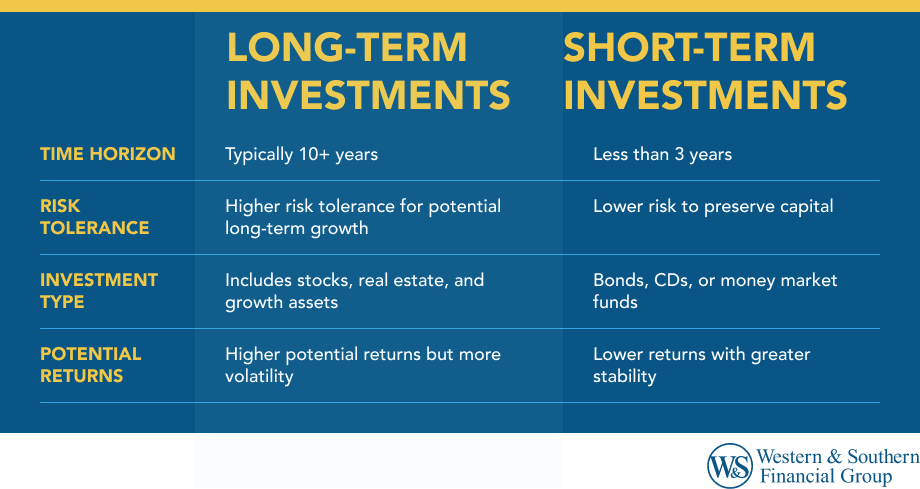
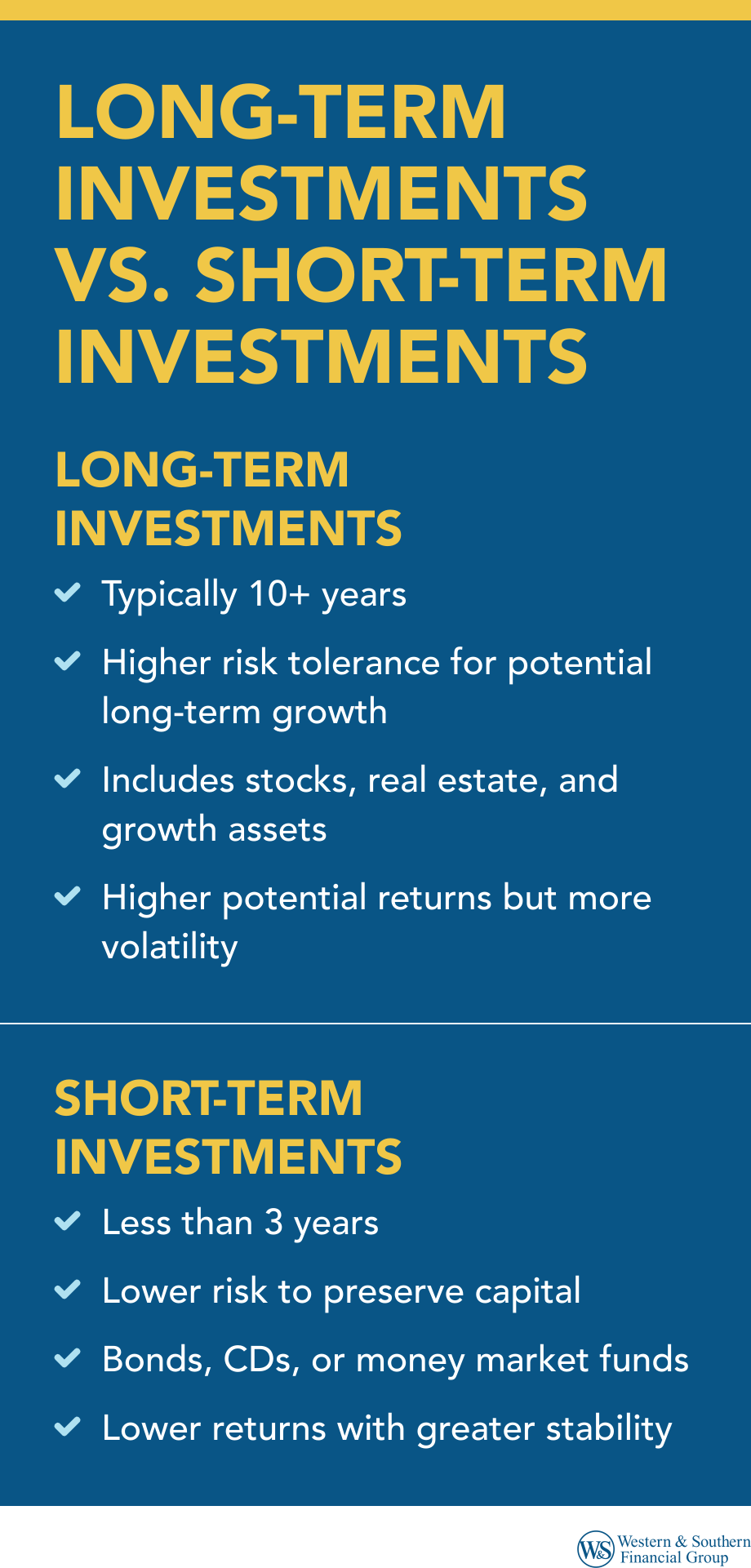
Long-term investing means buying investments and holding them for many years, often 10 years or more. This approach is often used for goals such as retirement or college savings. It may include stocks, mutual funds, and other growth-focused investments.
If you have many years before you need to withdraw money, you may feel more comfortable taking on market risk. A longer time frame can give your investments more time to recover from market declines. However, recovery is not guaranteed. All investments can gain or lose value, including the loss of principal.
What Is Short-Term Investing?
Short-term investing usually involves holding investments for three years or less. This approach is often used for near-term goals, such as buying a car.
With a shorter time frame, some investors choose investments with lower market risk. Even so, lower risk does not guarantee gains or protect your principal.
Examples of short-term investments include:
- Certificates of deposit (CDs)
- Money market accounts
- Government bonds
- Treasury bills
Differences Between Long-Term & Short-Term Investing
Here are some of the differences between long-term investing and short-term investing.
Time Horizon
Your time horizon is the length of time before you begin withdrawals. For each strategy, the length of time is:
- Long-term: 10 years or more
- Short-term: Three years or less
- Intermediate: Four to seven years
Market Risk
Market risk is the chance that an investment may lose value. Different investments carry different levels of risk. A financial professional can help you understand how risk fits into your strategy.
Investing Goals
Long-term investment goals typically take years or decades to reach, while short-term investing goals may take months or a few years. Here are a few examples of each.
| Long-Term Goals | Short-Term Goals |
|---|---|
| Retirement | Vacation |
| College savings | Wedding |
| Building long-term wealth | Home improvements |
Planning Long-Term & Short-Term Investment Strategies
Long-term strategies are often used for large life goals that require significant savings. Starting early can help give your investments more time to grow.
Short-term strategies are usually designed for smaller goals with a closer deadline. Because the time frame is shorter, the types of investments used may differ in planning from those used in long-term strategies.
Even though they may have different time horizons and different associated tactics, long-term investment strategies and short-term investment strategies both can be formed in part by answering some of the same questions.
Even though these strategies differ, they often begin with the same core questions.
Questions To Ask Before Investing
- How much money will you need? To answer this, you may need to make a few assumptions. If you are saving for retirement, for example, you may want to consider your life expectancy, desired lifestyle, and health care needs.
- How will taxes affect your investment strategy? Like inflation, taxes can significantly impact returns. You may want to use accounts with specific tax features, such as 529 college savings plans, which offer tax-deferred growth.
- When will withdrawals begin? This determines your investment timeline. If you are saving for a child’s education, withdrawals may start in the first year of college.
- How long will withdrawals last? Instead of taking one lump sum, you may spread withdrawals over time. For example, if you retire at 65 and expect to live until 85, you may plan for 20 years of withdrawals. For short-term goals, such as a vacation, a lump sum may make sense.
- Will you invest a lump sum or make recurring contributions? Estimate how often you will invest. Will you invest one amount upfront, contribute annually, or invest a fixed amount each month?
- Which investment types will you use? Your choices may depend on your target return, risk tolerance, and time horizon.
Who Might Consider Long-Term Investment Strategies?
Long-term investment strategies may make sense for anyone with a savings goal several years away. In personal finance, long-term goals are often defined as those at least seven to 10 years out.
Common Reasons To Invest for the Long-Term
- Save for Retirement: This is a common reason for a long-term investment strategy because retirement is often the largest lifetime goal and can take decades to reach.
- Save for College: Higher education costs continue to rise. Investing over time can help cover future education expenses.
- Help Build Wealth: Long-term investing can help your money grow through compounding and market growth.
Not all long-term investments are right for every investor. For example, stocks and stock mutual funds are often used for long-term goals. They may offer higher return potential, but they also come with greater market risk. Investors with a lower risk tolerance may want to consider other investment types and diversify with options that carry less risk.
Combine both investments to help meet your financial goals. Invest In My Future
Who Might Consider Short-Term Investment Strategies?
People saving for goals that are less than three years away may want to consider short-term investment strategies.
Short-term strategies are often used for goals such as:
- Vacations: You may prefer to pay for a trip with money you have set aside instead of using a credit card and taking on debt.
- Weddings: You might have several months to a few years to cover wedding expenses. A short-term approach can help you prepare for those costs.
- Gifts: Whether it's for birthdays or major holidays, you may choose to keep money in an interest-bearing account to cover purchases for family and friends.
- Home Improvements: Instead of using home equity, you may set aside money to pay for renovation projects or repairs.
Considerations for Forming Investment Strategies
There are a number of general considerations to keep in mind when forming your investment strategies.
Timeline to Invest
Your timeline is the time between now and when you plan to start withdrawing money from your account. This plays a key role in choosing investment types.
Think of it like planning a trip. The time you have helps determine the right vehicle to get you there.
| Timeline | Investor Type | General Approach |
|---|---|---|
| 3 years or less | Short-term | Should avoid volatile investments |
| 4 to 7 years | Intermediate | Balanced approach may be considered |
| Many years | Long-term | May take on more market risk |
Long-term investors often have more time to recover from market declines. Short-term investors may prefer to limit exposure to more volatile investments, such as certain stocks or stock mutual funds.
Risk Tolerance
Risk tolerance refers to how much market risk you are comfortable taking. Even if you have a long timeline, your personal comfort with market ups and downs matters.
A long-term investor with high risk tolerance may hold mostly stocks. However, a long-term investor with low to moderate risk tolerance may include more bonds to reduce volatility.
Risk Capacity
Risk capacity measures how much financial loss you can afford to handle.
For example:
- Investors who have exceeded their savings goals or do not expect to withdraw funds soon may have high risk capacity
- Investors who could fall short of their goals after a major downturn may have lower risk capacity
Risk capacity focuses on your financial situation, not just your comfort level.
Desired Rate of Return
Risk and return are closely connected. In general, higher return goals require accepting more market risk.
For example:
- Individual stocks tend to carry higher market risk and have historically produced higher average returns than bonds1
- Bonds generally involve lower market risk and lower historical returns
Your return goal should align with both your timeline and your risk profile.
Taxes
Taxes can influence your investment choices. For example, if reducing current taxes is a priority and you are saving for retirement, you may consider tax-deferred accounts such as an individual retirement account (IRA).
If you invest through a taxable brokerage account, you may consider tax-efficient options such as:
- Index funds
- ETFs exchange-traded funds (ETFs)
- Municipal bond funds
Keep in mind that each account type or investment product has its own unique features or requirements that you should fully understand before investing.
Do It Yourself or Hire a Financial Professional?
Your investment strategy should reflect your goals and risk profile. If you are comfortable managing investments on your own, you may choose and implement your own strategy. You may also consider working with an investment advisor or registered representative who can recommend investment types and help align your strategy with your needs.
Finally, keep in mind that planning for long-term goals, such as retirement or a child’s education, can be more complex than short-term goals. A retirement calculator or college savings calculator can help you estimate how much you may need to save.
Preparing to Move Forward With an Investment Strategy
Creating an investment strategy starts with a few key decisions. Your plan should reflect your time horizon, your risk tolerance and your desired rate of return. Once you define your investment objectives and comfort with risk, you can choose the types of investments that align with those goals.
Because strategies vary from person to person, working with a registered representative or financial advisor may help you develop and carry out a plan that fits your needs.
All investing involves risk, including the possible loss of principal.
Help build a portfolio that supports both short-term and long-term goals. Invest In My Future
Sources
- Investment portfolios: asset allocation models. https://investor.vanguard.com/investor-resources-education/education/model-portfolio-allocation.