
Annuities offer features that can support your retirement planning. For example, they can provide income guaranteed for life, and some contracts include growth guarantees that add predictability and help manage risk.
As you review your options, it’s important to understand an annuity’s tax status. This determines whether the annuity is qualified or non-qualified.
Qualified vs. Non-Qualified Annuity: What's the Difference?
You can fund an annuity with pre-tax or after-tax money. How and when you pay taxes depends on the type of annuity and how you take withdrawals.
Qualified Annuities
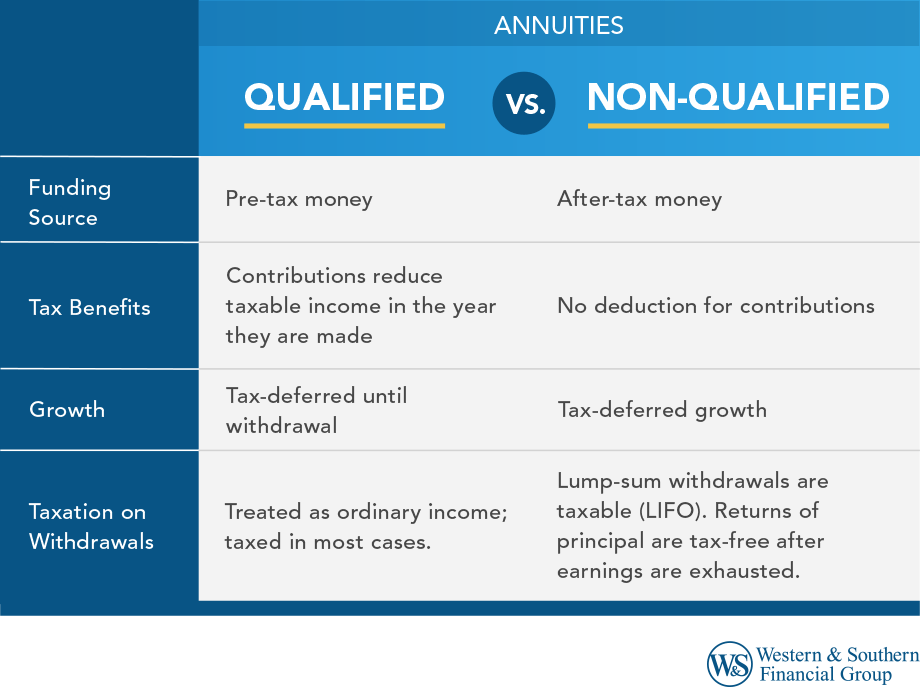
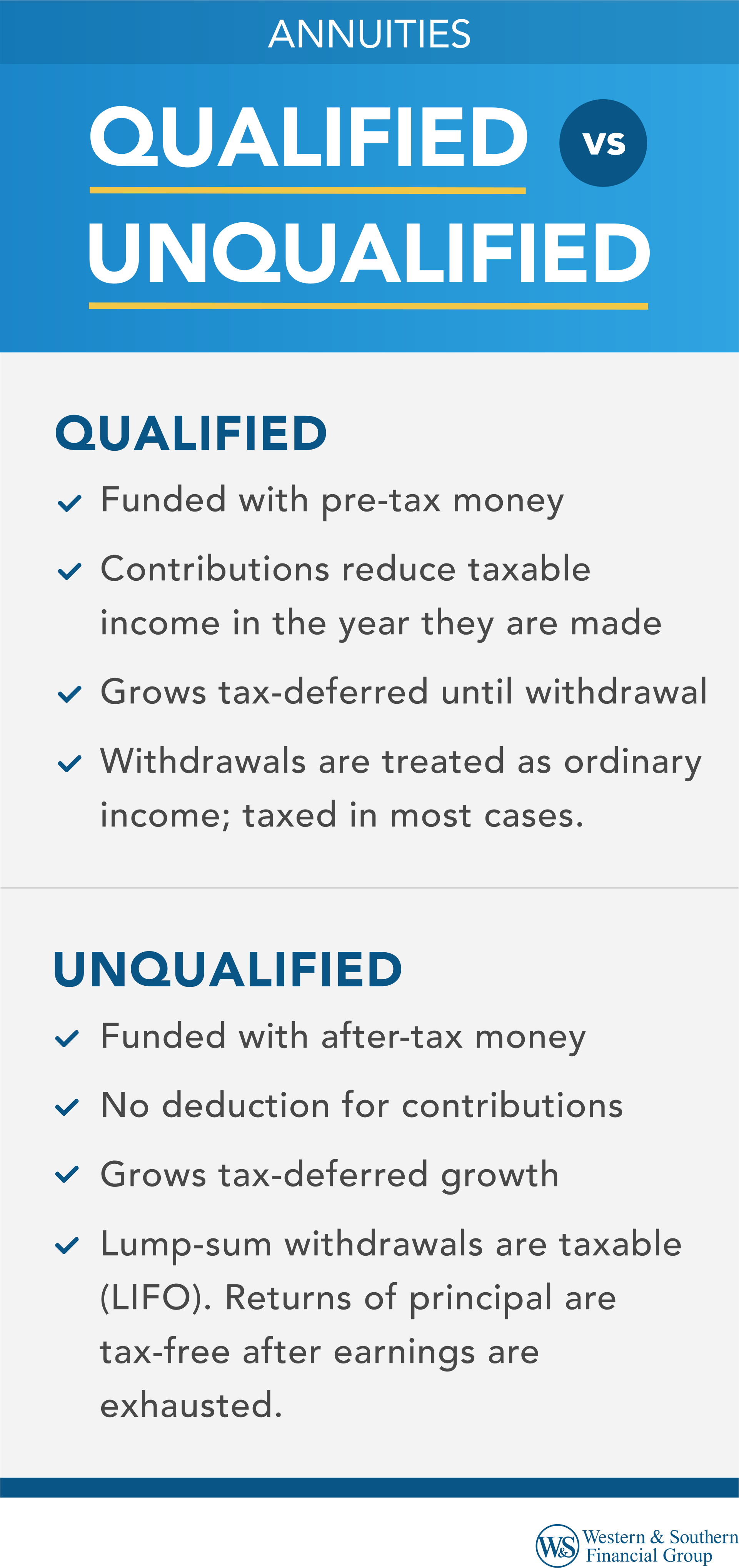
A qualified annuity is funded with pre-tax money.
- Contributions to a workplace retirement plan
- Deductible IRA contributions
These contributions may reduce your taxable income in the year you make them. In addition, growth in most retirement accounts and annuities is tax-deferred. You typically do not report earnings or pay taxes each year as long as the money stays in the account.
Non-Qualified Annuity
A non-qualified annuity is funded with after-tax money, such as money from an individual or joint account. The contributions are not tax-deductible, but the earnings grow tax-deferred inside the annuity.
When Do You Pay Taxes?
Tax treatment depends on whether the annuity is qualified or non-qualified and how you withdraw the money.
Qualified Annuities
Because the money has not been taxed before, withdrawals are generally taxed as ordinary income. Taxes typically apply when you take distributions, depending on your overall tax situation.
Non-Qualified Annuities
Tax treatment varies based on how you withdraw funds: lump-sum or annuitize.
For lump-sum withdrawals:
- The IRS requires last-in, first-out treatment.
- Earnings are withdrawn first and are taxable.
- Once earnings are exhausted, withdrawals of your original principal are generally tax-free.
If you "annuitize" the contract:
- Each payment may be partially taxable.
- Part of the payment may be a tax-free return of principal.
- The remaining portion is taxable earnings.
This calculation, known as the exclusion ratio, spreads taxes over time. Once all principal has been recovered, future payments may become fully taxable.
As you might imagine, things can get complicated quickly. Be sure to speak with a tax expert to avoid surprises and discuss the tax implications of using a qualified vs. non-qualified annuity.
Optimize your retirement plan with tax-efficient annuity options. Start Your Free Plan
When You May Want to Purchase an Annuity
An annuity can offer principal protection and a lifetime income stream. If you want guarantees backed by an insurance company, an annuity may be worth considering. However, keep in mind that an annuity guarantee is not a guarantee of investment performance; rather, it guarantees a set amount of income during the payout phase. The guarantee backed by the insurer's claims-paying ability.
Qualified Annuities
A qualified annuity may make sense if you are contributing pre-tax dollars to retirement savings.
You might consider a qualified annuity if:
- You expect to be in a lower tax bracket in retirement.
- You want to roll over existing pre-tax retirement accounts.
- You want insurance-backed guarantees within a retirement account.
You can roll pre-tax retirement accounts into a qualified annuity. Withdrawals are taxed as ordinary income, and those taken before age 59½ may incur a 10% penalty. Although these accounts are already tax-deferred, an annuity may offer guarantees from the insurer.
Non-Qualified Annuities
A non-qualified annuity is funded with after-tax dollars and allows assets to grow tax-deferred.
You might consider a non-qualified annuity if:
- You want to defer taxes on earnings.
- You want flexibility in how and when income is taxed.
- You want access to insurance-backed guarantees.
Only the earnings are taxed when you take a withdrawal from a non-qualified annuity. If you choose lifetime income payments, taxes may be spread out over time using the exclusion ratio. Withdrawals taken before age 59½ generally incur an additional 10% tax penalty.
The Bottom Line
Annuities can support long-term planning whether funded with pre-tax or after-tax dollars. Qualified contracts may offer an upfront tax break but are taxed at withdrawal, while non-qualified annuities allow flexible contributions and tax only the earnings. Reviewing how each income source is taxed can help you estimate your after-tax income in retirement.
Benefit from steady income streams through strategic annuity planning. Start Your Free Plan