
According to Worldmetrics' 2026 Retirement Readiness Statistics report, 40% of U.S. households with retirement savings have less than $10,000 saved, highlighting the challenges many Americans face in preparing for retirement.1 With the average retirement age at 65 for men and 63 for women, saving early can help you prepare for your retirement years.2
Here are just a handful of reasons why you should start preparing for retirement today.
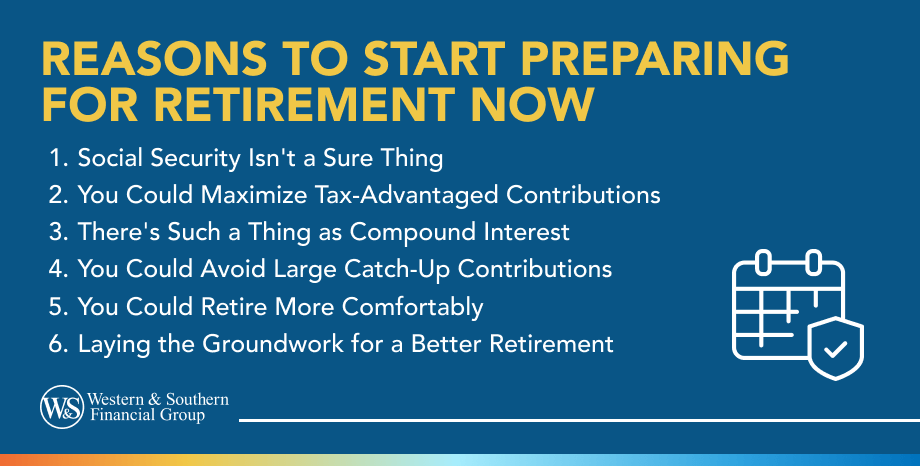
1. Social Security Isn't a Sure Thing
The average monthly Social Security benefit is $1,946.3 That may not be enough to cover your monthly expenses and support a comfortable retirement.
More importantly, Social Security faces funding challenges. According to the 2026 Trustees Report, the combined trust funds are projected to be depleted in 2034, when continuing income would cover about 83% of scheduled benefits unless Congress takes action.4
Social Security helps provide many people additional income, especially lower-income older Americans. However, a separate retirement income - whether it's from an employer-sponsored 401(k) or an individual retirement account (IRA) - could help bolster your financial security.
2. You Could Maximize Tax-Advantaged Contributions
One advantage of contributing to your retirement while you are still employed is that many of the contributions you make to your retirement accounts likely have tax benefits.
For example, with a 401(k) and traditional IRA, you can contribute your pre-tax income, and any gains you make on this money won't be taxed until you withdraw it. Another benefit is that contributions to these accounts are tax-deductible, which helps reduce your taxable income and the potential taxes you might pay when you file your return each year.
3. There's Such a Thing as Compound Interest
Thanks to compound interest, you'll have the potential to earn more interest if you start saving early. Compound interest means that the money you contribute today could earn interest, and that resulting sum could earn additional interest on top of this (earning interest on interest).
To be clear, the stock market doesn't guarantee returns. The market fluctuates, so sometimes your contributions will achieve gains and other times they may suffer losses.
4. You Could Avoid Large Catch-Up Contributions
Someone who contributes over a 30-year period could likely accumulate more retirement income than another retiree who only begins to make regular contributions a decade before he or she plans to retire.
You can grow your retirement accounts quickly by making large catch-up contributions. For 2026, you can contribute up to $1,100 of catch-up contributions to a traditional IRA or Roth IRA.5 You may be able to contribute up to $4,000 of catch-up contributions to a SIMPLE IRA or SIMPLE 401(k) plan, or $8,500 of catch-up contributions to a 401(k), 403(b), SARSEP or governmental 457(b).5
But for most people, it's likely easier to set aside a smaller amount over a number of years rather than having to catch up over a short time frame. Compound interest also plays a role here because the earlier you contribute, the longer the period for potential growth will be.
5. You Could Retire More Comfortably
No one wants to struggle in retirement, especially when it comes to your health care. An average, healthy 65-year-old couple who retires in 2027 can spend over $371,000 on health care costs during their retirement.6 Even if you plan to retire at 65, you may not be able to afford it, so your only options may be to either keep working or to reconsider the retirement lifestyle you envisioned.
Starting early with the right retirement plan could help give you runway to help build your retirement savings so that you may have more options and more flexibility in your retirement.
Laying the Groundwork for a Better Retirement
One way to begin preparing for retirement is to start early. It's never too early to start thinking about retirement, and devising a plan today could help give you more financial security in your golden years.
We all hope to enjoy a comfortable retirement one day, but whether you're 25, 38 or 52, the moves you make now can help bring you closer to realizing this goal and safeguarding your financial future.
Sources
- World Metrics. "Retirement Readiness Statistics." https://worldmetrics.org/retirement-readiness-statistics/
- The Motley Fool. "What Is the Average Retirement Age in the U.S.?" https://www.fool.com/research/average-retirement-age/
- Social Security. "Monthly Statistical Snapshot." https://www.ssa.gov/policy/docs/quickfacts/stat_snapshot/
- Social Security. "Status of the Social Security and Medicare Programs." https://www.ssa.gov/oact/TRSUM/
- IRS. "401(k) limit increases to $25,500 for 2027, IRA limit remains $7,500." https://www.irs.gov/newsroom/401k-limit-increases-to-25500-for-2027-ira-limit-remains-7500
- Fidelity Investments. "Fidelity Investments® Shares 25th Annual Retiree Health Care Cost Estimate, Highlighting the Importance of Incorporating Potential Health Expenses in Retirement Planning." https://newsroom.fidelity.com/pressreleases/fidelity-investments--shares-25th-annual-retiree-health-care-cost-estimate--highlighting-the-importa/s/0dd560b4-98cb-492e-bdec-f7168f97aede