Retiring from work is a major life transition that goes far beyond your last day on the job. The financial decisions you make now can shape your income, health coverage, and lifestyle for years to come. This guide walks through what to expect, what to plan, and how to move forward with confidence.
What to Do Before Retiring From Work
Retiring from work begins before your final paycheck. It includes reviewing your retirement plans, understanding your benefits, and coordinating with your employer’s human resources and payroll teams. While savings matter, timing decisions, paperwork, and lifestyle changes can also affect your long-term income.
Start by defining your retirement timeline. Will you retire at 62, at your full retirement age, or later? Each option affects your Social Security benefits and access to health coverage. For example, retiring at 62 may reduce monthly payments and require coverage before Medicare begins at 65.
Before retiring, consider these steps:
- Review unused vacation days and sick leave policies
- Request a benefits summary from HR
- Confirm retirement application requirements
- Plan your announcement and transition of responsibilities
Some employees also consider phased retirement or bridge employment. This may include reduced hours or consulting work to help ease the transition.
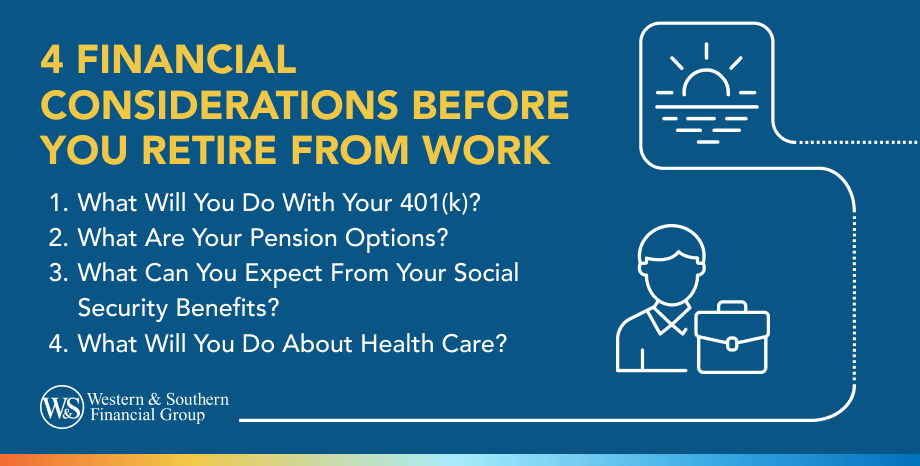
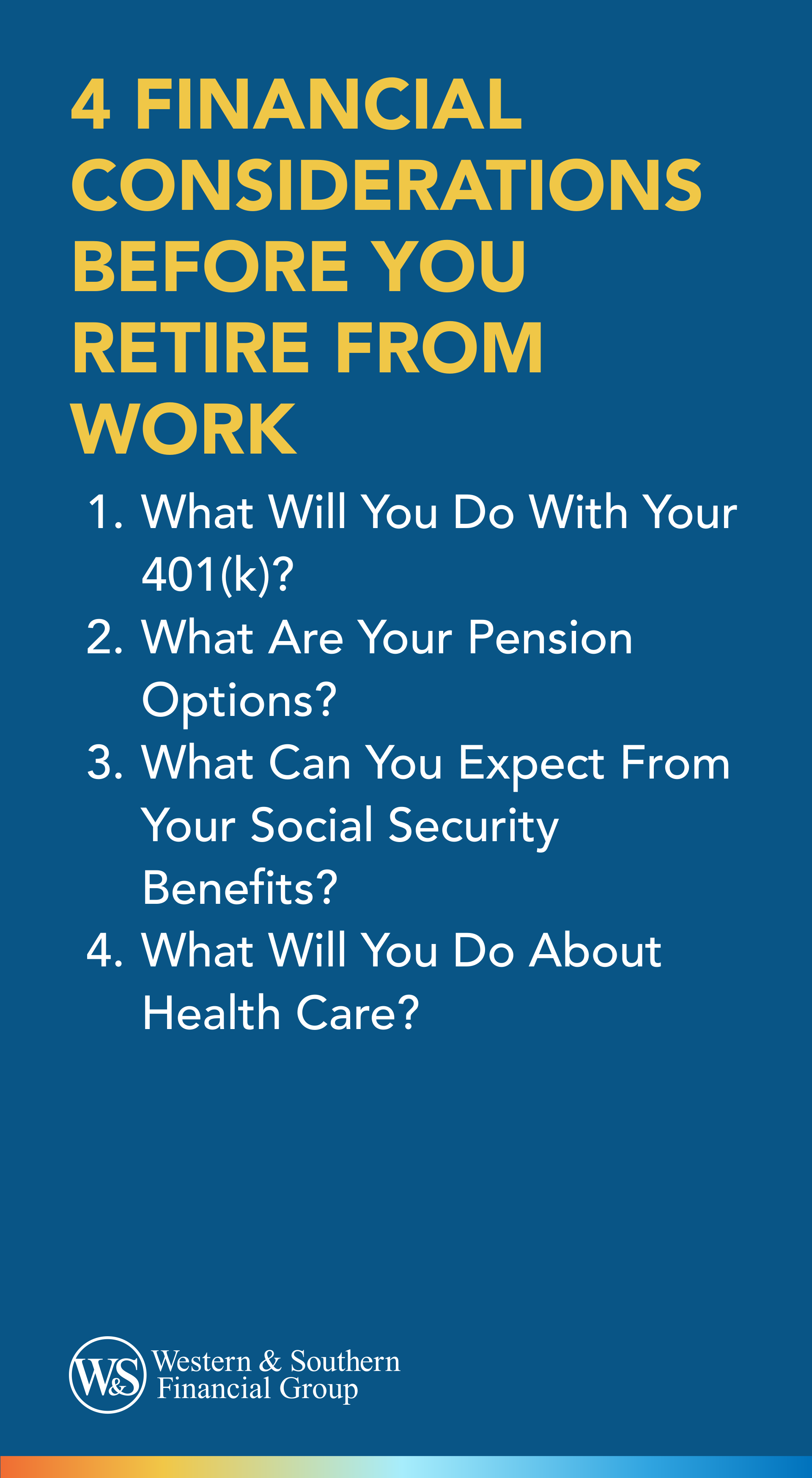
Here are four financial questions to ask yourself before you make any final decisions.
Question 1: What Will You Do With Your 401(k)?
Your 401(k) is often one of your largest retirement assets, so how you manage it after leaving a job can affect taxes, flexibility, and long-term growth.
Leave It With Your Employer or Roll It Over
When you leave your job, you typically can:
- Leave your funds in your employer’s plan
- Roll them into an IRA
- Move them into a new employer’s plan
Keeping your 401(k) where it is may be the simplest choice if the plan offers strong investment options. Rolling it into an IRA can provide more control, with broader investment choices and greater flexibility.
Consider Taxes and Withdrawals
Withdrawals before age 59½ may come with a 10% penalty, and most distributions are taxed as income.1 Large or lump-sum withdrawals can push you into a higher tax bracket.
Some plans limit how and when you can take distributions, while others offer installment options. If flexibility is limited, rolling into an IRA may give you more control over timing and frequency. Roth accounts differ, as qualified withdrawals are typically tax-free.
Understand RMDs and Fees
Starting at age 73, Required Minimum Distributions (RMDs) apply to most tax-deferred accounts.2 These withdrawals increase taxable income and can affect other costs like Medicare.
Fees also play a role in long-term performance. Employer plans may include administrative costs and fund expense ratios that reduce returns over time. If fees are high or investment options are limited, an IRA may offer more cost-efficient choices.
Question 2: What Are Your Pension Options?
If you have a defined benefit plan, understanding your pension options is an important part of retiring from work. Consider these options:
- Lump sum vs. monthly income: A lump sum gives you immediate access to funds, which you can roll into an IRA. Monthly payments, on the other hand, provide predictable income for life.
- Survivor benefits: You can choose to continue payments to a spouse after your death, though this usually lowers your monthly amount.
- Taxes: Pension income is generally taxable, and lump sums may trigger taxes unless rolled into a qualified account.
While pensions can provide steady income, it is important to understand how you receive that income. Consult with a financial professional if you are unsure about your options.
Question 3: What Can You Expect From Social Security Benefits?
Social Security is a key source of retirement income for many Americans. According to the Social Security Administration, about 40% of retirees rely on it for at least half of their income.3
How Claiming Age Can Affect Benefits
You can start receiving benefits as early as age 62, but your monthly payment will be lower. However:
- Waiting until your full retirement age increases your monthly benefit.
- Delaying benefits beyond that age can increase your payments even more.
Creating a Social Security account can help you estimate your benefit amount and compare different start dates.4 If you are married, coordinating when each spouse claims benefits may help increase total household income.
How Benefits May Be Taxed
Social Security benefits are not always tax-free. Depending on your total income, up to 85% of your benefits may be subject to taxes.5 This can catch some retirees off guard.
How Working in Retirement Can Impact Benefits
If you continue working before reaching full retirement age, your benefits may be temporarily reduced. These reductions are not permanent. Your benefit is recalculated later, which can increase your future monthly payments.
Question 4: What Will You Do About Health Care?
Health care is one of the most significant expenses when retiring from work. Planning ahead can help you avoid coverage gaps and unexpected costs.
- Employer-sponsored retiree health benefits: Some employers offer retiree health care benefits. If available, these plans can extend coverage beyond your employment. Check with your Human Resources department to understand eligibility and costs.
- Consider ACA coverage if COBRA is not an option: If COBRA coverage is unavailable or too expensive, the Affordable Care Act marketplace offers alternatives. These plans can bridge the gap until Medicare eligibility at 65.
- Learn about Medicare coverage and costs: Medicare includes several parts, each covering different services. Premiums, deductibles, and coverage limits vary, so it’s important to understand your options.
- Prepare your Medicare enrollment documents: Missing your enrollment window can result in penalties. Gather required documents early to avoid delays.
A study by Fidelity estimates that a 65-year-old couple may need over $345,000 ($172,500 per individual) for health care expenses in retirement.6 This highlights the importance of planning ahead.
How to Estimate & Create Your Retirement Income Plan
Estimating your retirement income starts with understanding your actual spending, not just replacing a percentage of your pre-retirement income.
Step 1: Estimate Your Expenses
Begin by mapping out your monthly costs for a clearer picture. Focus on:
- Housing (mortgage, rent, property taxes)
- Health insurance and medical expenses
- Food and transportation
- Travel, subscriptions, and leisure
Group these into fixed costs (housing, insurance, utilities) and variable costs (travel, dining, entertainment). Expenses often shift in retirement, so adjusting for lifestyle changes helps improve accuracy.
Step 2: Identify Your Income Sources
Next, compare your expenses with your expected income. Common sources include:
- Social Security monthly payments
- Pension income from a defined benefit plan
- Withdrawals from a workplace savings plan or IRA
- Income from part-time or contract work
Income sources can vary by situation. Someone retiring at full retirement age may rely more on Social Security, while someone retiring earlier may depend more on savings or part-time income.
Step 3: Plan Your Withdrawal Strategy
Your withdrawal strategy plays a key role in how long your savings last. The 4% rule is a common guideline, but it does not work for everyone. Factors like market performance, life expectancy, and spending habits all affect how much you can withdraw.
A flexible approach may include:
- Reducing withdrawals during market downturns
- Increasing withdrawals in strong market years
- Keeping a cash reserve for short-term needs
Step 4: Start Building Your Plan
Start by organizing your income and expenses, then build a plan that fills any gaps:
- List guaranteed income sources such as Social Security and pensions
- Calculate your baseline monthly expenses
- Identify any gaps between income and expenses
- Assign withdrawal strategies to cover those gaps
- Set aside a reserve fund for unexpected costs
- Review your plan each year and adjust as needed
This approach helps match your income to your actual needs rather than relying only on estimates.
Step 5: Account for Inflation and Taxes
Inflation can reduce purchasing power over time, especially over long retirements. At the same time, taxes still apply:
- Traditional account withdrawals are typically taxed as income
- Roth withdrawals may be tax-free if qualified
Spreading withdrawals across account types can help manage your tax impact over time.
Common Mistakes When Retiring From Work
Even with careful planning, certain financial decisions can affect your retirement income and lifestyle over time. Try to avoid these common mistakes before retiring:
- Claiming Social Security too early: Starting Social Security at age 62 can seem appealing, especially if you leave work earlier than expected. However, this choice permanently reduces your monthly benefit.
- Underestimating health care costs: Health care expenses often increase in retirement. Even with Medicare, retirees may still pay for premiums, prescriptions, deductibles, and other out-of-pocket costs.
- Not planning for taxes: Taxes can affect how much retirement income you keep. Large withdrawals from retirement accounts in a single year could increase your tax burden, while spreading withdrawals out may help reduce the impact.
- Overlooking Required Minimum Distributions: RMDs begin at age 73 for most retirement accounts.2 Missing these withdrawals can lead to significant penalties.
- Not working with a financial professional to weigh options: Retirement decisions often involve pension options, taxes, and income planning. Working with a financial professional may help you compare choices and make more informed decisions.
The Bottom Line
Retiring from work is more than a milestone. It’s a process that involves planning your income, benefits, and lifestyle. Taking the time to understand your options can help you make informed decisions that support your long-term goals.
Sources
- Retirement topics - Exceptions to tax on early distributions. https://www.irs.gov/retirement-plans/plan-participant-employee/retirement-topics-exceptions-to-tax-on-early-distributions.
- Retirement plan and IRA required minimum distributions FAQs. https://www.irs.gov/retirement-plans/retirement-plan-and-ira-required-minimum-distributions-faqs.
- The Importance of Social Security Benefits to the Income of the Aged Population. https://www.ssa.gov/policy/docs/ssb/v77n2/v77n2p1.html.
- my Social Security | SSA. https://www.ssa.gov/myaccount/.
- Must I pay taxes on Social Security benefits? https://www.ssa.gov/faqs/en/questions/KA-02471.html.
- Fidelity Investments® Releases 2025 Retiree Health Care Cost Estimate, a Timely Reminder for All Generations to Begin Planning. https://newsroom.fidelity.com/pressreleases/fidelity-investments--releases-2025-retiree-health-care-cost-estimate--a-timely-reminder-for-all-gen/s/3c62e988-12e2-4dc8-afb4-f44b06c6d52e.