It's important to understand key mutual fund terms and concepts to become an informed investor. While there are many terms you can research, starting with the basics can help build a strong foundation. Here's a brief overview of mutual fund terms.
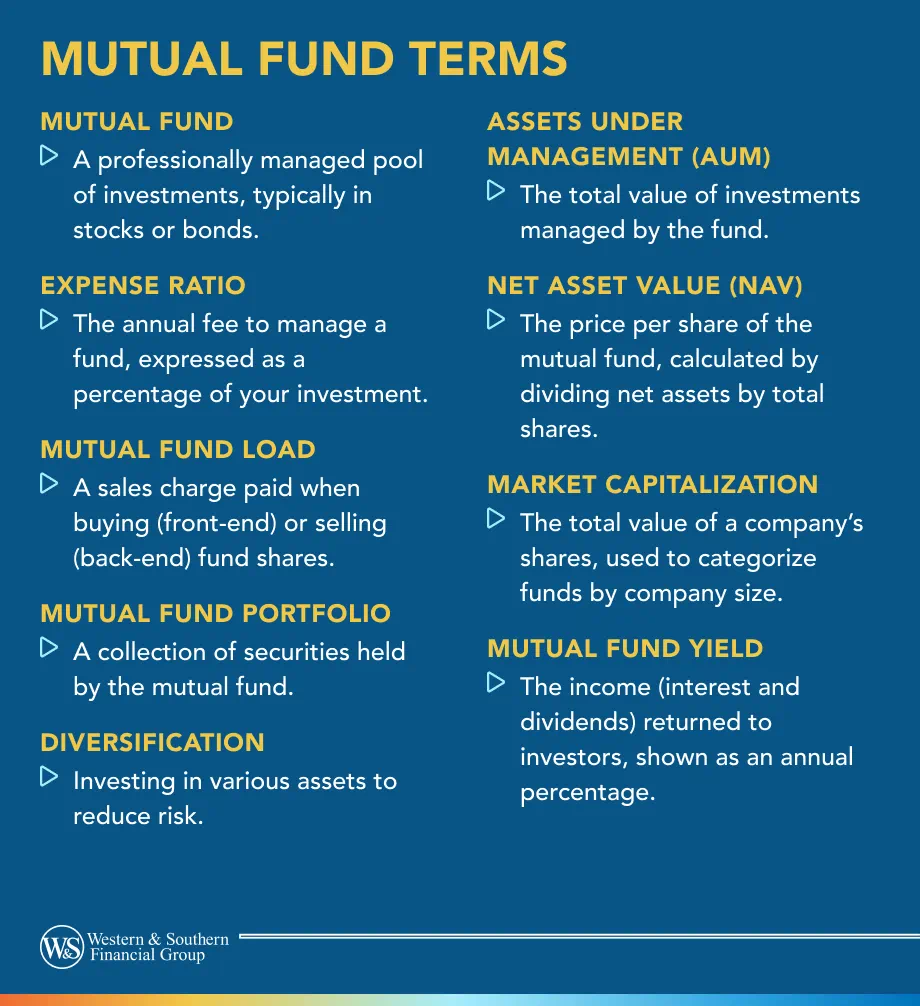
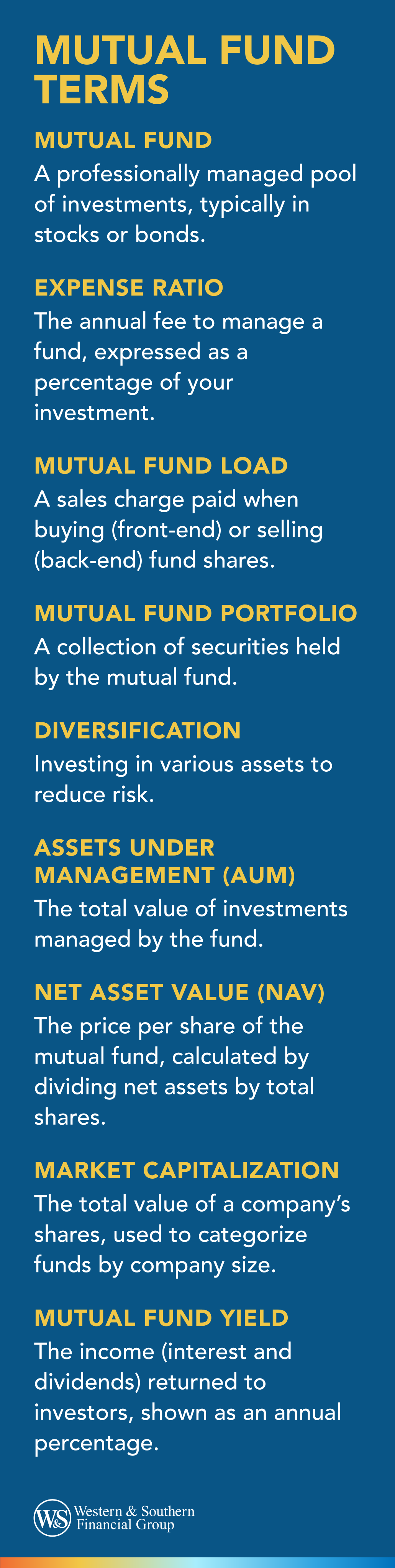
Mutual Fund
A mutual fund is a pool of investments funded by investors and professionally managed. Instead of investing in individual securities, such as a stock or a bond, investors buy shares in a collection of securities. A mutual fund typically invests in stocks, bonds, or a combination of these and other types of securities.
Expense Ratio
The expense ratio is the annual fee charged by a mutual fund, expressed as a percentage of your investment. It is usually shown as a number with two decimal places. For example, if a fund’s expenses are 1.5% of its assets under management, the expense ratio would be 1.50.
Mutual Fund Load
A mutual fund load is a fee or sales charge paid by the investor. The load is calculated as a percentage of the purchase or sale amount. It is typically charged at the time of purchase, known as a front-end load, or at the time of sale, known as a back-end load.
Investors pay front-end loads when purchasing Class A shares. They may pay a back-end load on Class B or Class C shares. A contingent deferred sales charge, or CDSC, is a type of back-end load that depends on how long the shares are held.
Mutual Fund Portfolio
A mutual fund portfolio is a group of funds held by an individual or organization. For example, someone who owns five mutual funds in an individual retirement account, or IRA, may refer to all of those investments together as one portfolio.
In some cases, the term portfolio also refers to the underlying holdings within a mutual fund, such as the stocks or bonds the fund owns.
Diversification
Diversification is the practice of investing in a variety of assets to reduce market risk. The goal is to limit exposure to any single investment or asset type.
For example, a diversified portfolio may include different types of stocks and bonds. This idea is often summed up in the phrase, “Don’t put all your eggs in one basket.” Keep in mind that diversification does not guarantee a profit or prevent losses.
Assets Under Management
Assets under management, or AUM, represent the total market value of the investments managed by a mutual fund. In simple terms, AUM reflects the total value of the assets held in the fund.
If a mutual fund offers multiple share classes, the AUM figure may include the combined value of all share classes.
Net Asset Value
A mutual fund’s value is expressed as net asset value, or NAV, rather than a stock price. NAV is calculated by subtracting the fund’s liabilities from its assets and dividing the result by the total number of shares outstanding.
NAV is the price at which fund shares are bought or redeemed.
Market Capitalization
Market capitalization, often called market cap, represents the total value of a company’s outstanding shares of stock. It is calculated by multiplying the total number of shares outstanding by the stock’s share price.
Mutual funds are often categorized by market capitalization, including mega-cap, large-cap, mid-cap, and small-cap. These categories indicate the size of the companies in which the fund invests.
Mutual Fund Yield
A mutual fund’s yield refers to the income distributed to investors. This income may include interest and dividends generated by the fund’s investments. Yield is typically expressed as an annual percentage rate.
Additional Terms to Keep-In-Mind
- Share Class: Mutual funds often offer different share classes, such as Class A, Class B, and Class C shares. Each class has a different fee structure, expense ratio, and sales charge. The underlying investments are the same, but the cost structure varies.
- No-Load Fund: A no-load fund does not charge a sales commission when you buy or sell shares. However, investors still pay operating expenses reflected in the expense ratio.
- Turnover Ratio: The turnover ratio measures how frequently a fund buys and sells its holdings during a year. A higher turnover ratio may lead to higher transaction costs and potentially higher taxable distributions.
- Capital Gains Distribution: When a mutual fund sells securities for a profit, those gains may be passed on to shareholders. These are called capital gains distributions and may be taxable in a non-retirement account.
- Dividend Distribution: Many mutual funds distribute dividends earned from stocks or interest earned from bonds. These payments are typically made monthly, quarterly, or annually.
- Fund Manager: The fund manager is the professional responsible for selecting the fund’s investments and making buy and sell decisions. Their strategy and experience can influence performance.
- Prospectus: A prospectus is a legal document that provides detailed information about a mutual fund. It includes investment objectives, risks, fees, performance history, and management details. Investors should review this document before investing.
- Benchmark: A benchmark is a standard used to measure a fund’s performance. For example, a large-cap stock fund may be compared to the S&P 500 Index. Comparing performance to a benchmark helps investors evaluate how the fund is performing relative to the broader market.
- Minimum Investment: Many mutual funds require a minimum initial investment. This amount varies by fund and may be lower for retirement accounts or automatic investment plans.
The Bottom Line
Investing in a mutual fund allows investors to access a range of investments through a single product. By learning a handful of basic mutual fund definitions, you can make more informed investment decisions.
Mutual funds help provide professional management and broad investment exposure. Start Investing