Tax laws can change often, and your personal finances are constantly evolving. For this reason, focusing on annual planning at the end of each calendar year can be a smart practice. Doing so allows you to get a jump-start on year-end tax planning and get a better idea of what tax breaks for 2025 you may be able to utilize.
Certain tax laws and IRS rules affect personal finance changes annually - but despite the chance for change, many year-end tax planning tips remain the same. To be sure you're on track to finish the year and begin a new one in good financial shape, consider this year-end tax planning checklist and eight strategies for potentially earning tax breaks for 2025.
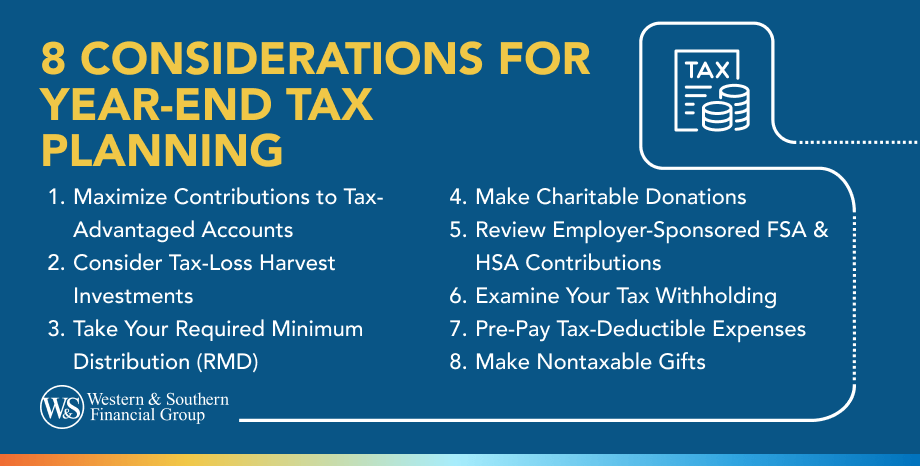
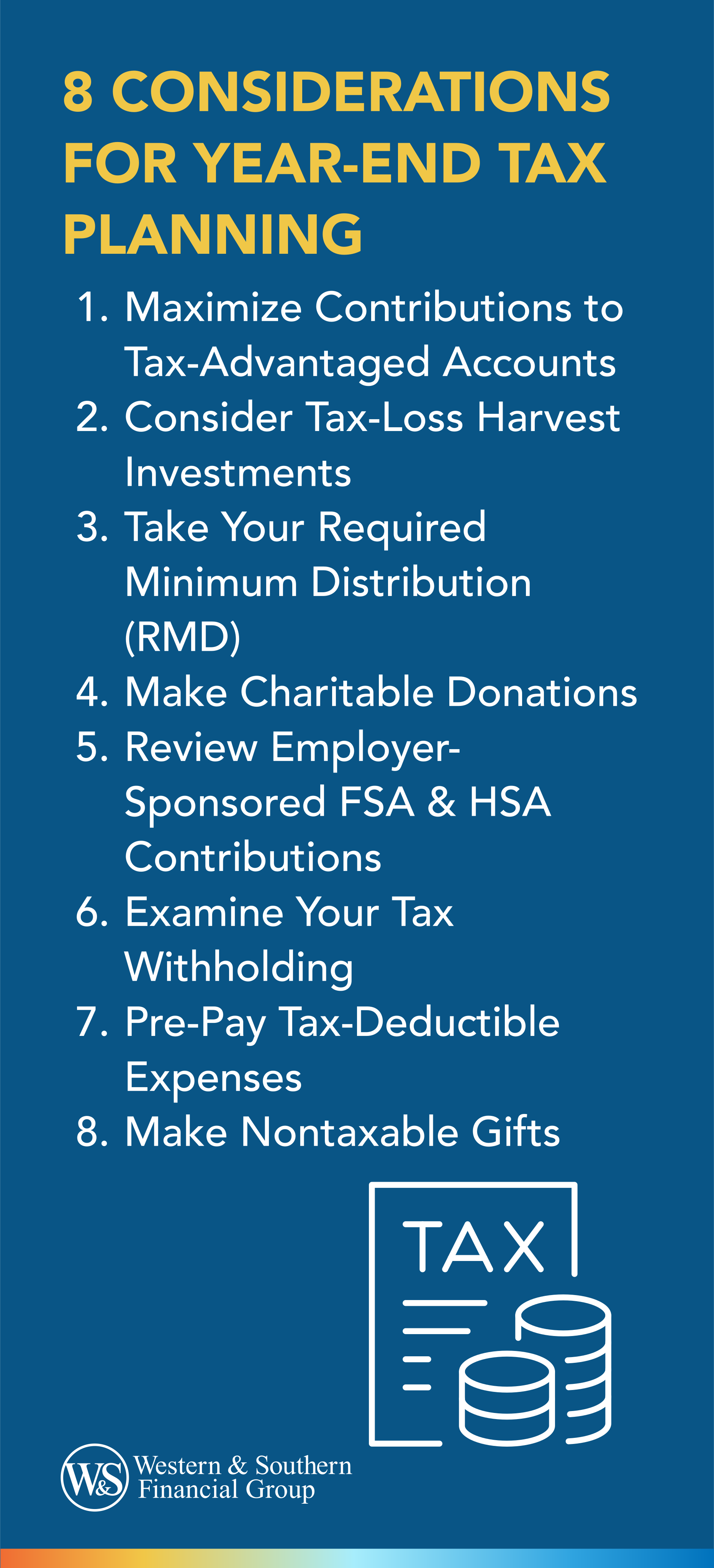
1. Maximize Contributions to Tax-Advantaged Accounts
You have until the tax filing deadline in 2026 to make the maximum individual retirement account (IRA) contribution for 2025, which is $7,000 (or $8,000 if you're 50 or older).1
2. Consider Tax-Loss Harvest Investments
If you have a taxable brokerage account and you sold some investments during the year at a gain, you may want to try to offset those gains by selling another investment with a loss. This can help reduce the total amount of investment income you received during the year.
To see the rules, be sure to check the IRS tax topic on capital gains and losses.2
3. Take Your Required Minimum Distribution
If you are age 73 or older and have a traditional IRA or 401(k), you must take your required minimum distribution (RMD) before year's end. If you fail to do so, the amount not withdrawn is taxed at 25%, according to the IRS.3 The RMD amount you would take is based on your age at the end of the current year and the total value of your traditional IRAs and 401(k)s as of the end of the previous year.
For help with calculating your distribution amount, you can use this RMD calculator on the U.S. Securities and Exchange Commission's website.4
4. Make Charitable Donations
If you have enough deductions to itemize - meaning the total amount is higher than the standard tax deduction - tax-deductible charitable donations can make sense. An example would be giving money to a qualified organization under IRS tax rules for charitable contribution deductions.5 Individuals can deduct qualified contributions of up to 100% of their adjusted gross income, so this could be an advantageous strategy to consider at the end of the year.
5. Review Employer-Sponsored FSA & HSA Contributions
Flexible spending accounts (FSAs) and health savings account (HSAs) allow you to make pre-tax contributions to pay for health care expenses. The FSA may be a "use it or lose it" account, meaning that you must use most or all of the money in the account during the year, whereas HSA money can roll over into the next year. In these final weeks, it might be a good idea to check in on these accounts and consider how the money should be used.
6. Examine Your Tax Withholding
If you received a tax refund last year, it may indicate that too much money is being withheld from your pay. Instead of giving the government an interest-free loan for a year, you can use that money to pay off high-interest debt or invest for retirement, potentially increasing other tax benefits. Depending on your preferences, you may want to adjust your withholding by changing your allowances on your W-4 form with your employer.
The more allowances you claim, the less money is withheld.
7. Pre-Pay Tax-Deductible Expenses
You can pay your mortgage payments, property taxes, medical bills or estimated state or local income taxes before tax season. This may give you additional deductions to itemize, if applicable, which could reduce your taxable income.
8. Make Nontaxable Gifts
In 2025, each person may give up to $19,000 without being taxed.6 For example, if you are married, you and your spouse could give $19,000 each (for a total of $38,000) to a family member or friend. Keep in mind that you cannot deduct the value of gifts you make (other than gifts that are deductible charitable contributions) from your taxes. If you exceed the $19,000 limit, you would likely have to file a gift tax return.
Conclusion
Just like an annual physical exam is wise for your physical health, year-end tax planning is a good habit for your financial health. By reviewing items, such as pre-tax contributions to retirement accounts, charitable donation options and tax withholding on your W-4, you can be sure to maintain good financial health.
If you are interested in getting a customized look at your taxes, consider contacting a qualified tax professional. A financial professional can help answer other money-related questions you may have, but does not offer tax or legal advice.
Review and adjust your financial plans to better meet your objectives. Get My Free Financial Review
Sources
- 401(k) limit increases to $24,500 for 2026, IRA limit increases to $7,500. https://www.irs.gov/newsroom/401k-limit-increases-to-24500-for-2026-ira-limit-increases-to-7500.
- Topic No. 409, Capital Gains and Losses. https://www.irs.gov/taxtopics/tc409.
- Retirement Plan and IRA Required Minimum Distributions FAQs. https://www.irs.gov/retirement-plans/retirement-plan-and-ira-required-minimum-distributions-faqs.
- Required Minimum Distribution Calculator. https://www.investor.gov/financial-tools-calculators/calculators/required-minimum-distribution-calculator.
- Charitable Contribution Deductions. https://www.irs.gov/charities-non-profits/charitable-organizations/charitable-contribution-deductions.
- Frequently Asked Questions on Gift Taxes. https://www.irs.gov/businesses/small-businesses-self-employed/frequently-asked-questions-on-gift-taxes.