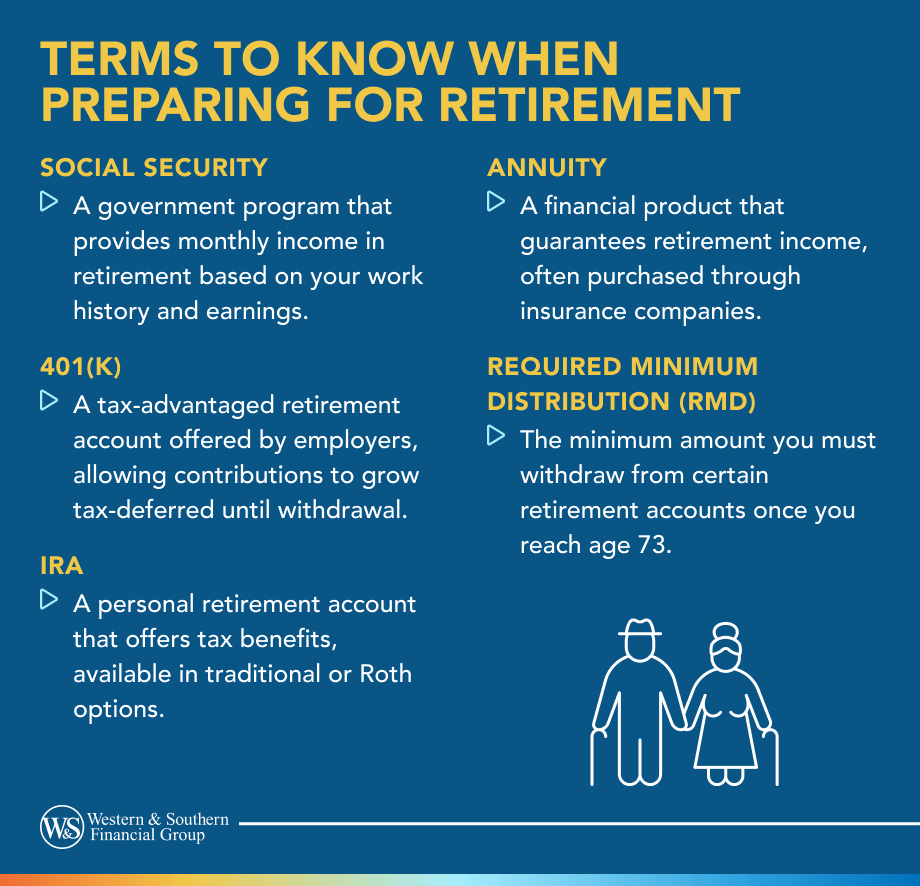

Retirement terms can be confusing, but understanding common vocabulary can help as you prepare for your later years. Here are some terms and their meanings to know.
Annuities
An annuity can help cover living expenses in retirement. Annuities have two phases:
- Accumulation phase, when you make payments and your money has the potential to earn interest
- Payout phase, when you receive payments from the annuity
There are several different types of annuities. The one you choose depends on whether you are still saving or already retired. Here are two common types.
Fixed Annuity
With a fixed annuity, you receive a set interest rate for a specific period. When that period ends, the insurer sets a new interest rate and time frame. Interest grows tax-deferred, which means you do not pay taxes until you begin taking distributions.
Variable Annuity
Variable annuities let you place your money into different investment options called subaccounts. These options range from conservative to aggressive. Your return depends on how the investments perform, which means there is more risk but also greater growth potential. Earnings are typically tax-deferred until you take distributions.
Rollover IRA
When you change jobs, you have several options for handling the funds in your 401(k). One option is a rollover individual retirement account (IRA). This allows you to move funds from a 401(k) into a new or existing traditional IRA.
You may not have to pay taxes on the rollover if it is completed within 60 days of the initial distribution. Another benefit is continued tax-deferred growth. Since the transfer is not treated as a contribution, there is no limit on how much you can roll over.
Compound Interest
Compound interest refers to earning interest on both your original amount and the interest it generates over time. The earlier you start saving, the more time your money has to grow.
Consider these two examples:
- If you deposit $5,000 into an account with a 6 percent compound interest rate, compounded twice a year, and leave it for 25 years, your balance could grow to nearly $22,000.
- If you deposit $5,000 into an account with a 6 percent simple interest rate, you would earn interest only on the original amount. After 25 years, you would have $12,500 total.
Beneficiary
A beneficiary is a person or organization you name to receive assets or funds after your death. This could be a spouse, child, charity, or business.
You can name multiple beneficiaries and divide your assets among them. You can also name a primary and a contingent beneficiary. The primary beneficiary receives the assets first. If they pass away before you, the contingent beneficiary receives them instead.
Trust
When creating an estate plan, you may choose to set up a trust. A trust is a legal arrangement where a third party, called a trustee, holds assets for one or more beneficiaries. There are many different types of trusts, and each is designed with a specific goal in mind.
The Bottom Line
Understanding these basic retirement terms can help you make informed decisions as you prepare for the future. If you have questions, consider speaking with a financial representative. For questions about trusts, you may want to speak with an estate attorney.