Stock market headlines often use bull and bear language to describe broad shifts in market direction. For newer investors, those terms can sound dramatic, especially when stock prices are rising or falling quickly. Understanding the bull vs. bear market difference can help you read market news with more context, recognize common market phases, and make more measured decisions about your investment plan.
Bull vs. Bear Market: What Do These Terms Mean?
A bull market and a bear market describe broad stock market trends. They usually refer to movement across a wide group of stocks or a major market index, which tracks a basket of stocks used to represent part of the market. These terms generally do not describe the performance of one company’s stock.
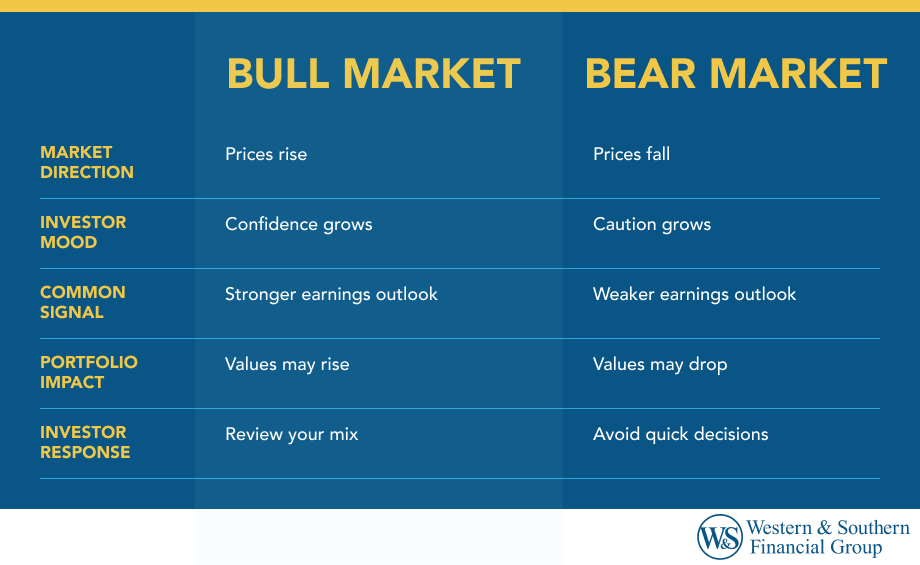
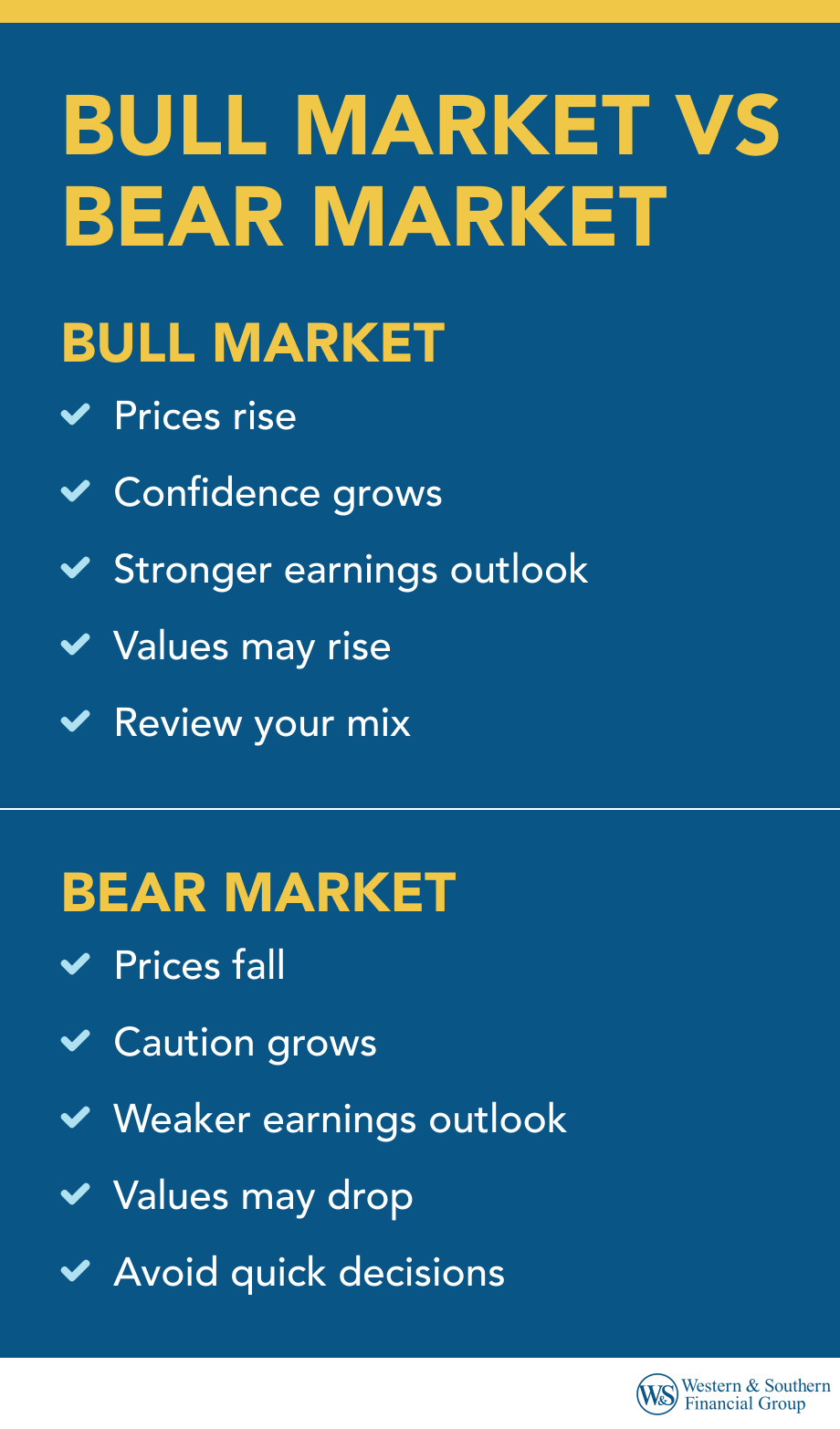
- A bull market is generally a period when stock prices are rising and market sentiment is optimistic.1
- A bear market is generally a period when stock prices are declining and market sentiment is pessimistic.2
The simplest difference is direction. Bull markets move upward, while bear markets move downward. Both are normal parts of market cycles, and each needs context.
What Is a Bull Market?
A bull market is a sustained period when stock prices generally rise. It often reflects confidence that companies, consumers, and the broader economy are moving in a positive direction.
Bull markets can last for months or years, but they are not smooth. Even when the broader market trend is positive, stock prices can fall because of inflation data, interest rate expectations, corporate earnings, global events, or investor concerns.
Common Signs of a Bull Market
Common signs of a bull market may include:
Rising stock prices across a broad stock market index
Higher investor confidence
Stronger corporate earnings expectations
Increased consumer spending
Positive market momentum
More interest in stocks and growth-oriented asset classes
A bull market does not mean every stock rises. Some companies, sectors, or asset classes may lag even when the broader market index is improving.
What Is a Bear Market?
A bear market is a sustained period when stock prices fall sharply from recent highs. It is often tied to weaker investor confidence, lower earnings expectations, and concerns about an economic slowdown.
A bear market can happen during a recession, but the two are not the same. A bear market refers to investment prices, while a recession refers to broader economic weakness. A bear market can happen before a recession, during one, or without one.
Common Signs of a Bear Market
Common signs of a bear market may include:
Falling stock prices across a major market index
Lower investor confidence
Higher volatility
Weaker corporate earnings expectations
Slower consumer spending
Concerns about inflation, interest rates, or economic output
Bear markets can feel intense because portfolio values may decline quickly. Still, not every decline becomes a bear market. Markets can also experience shorter pullbacks or corrections that do not meet the usual bear market threshold.
What Causes Bull & Bear Markets?
Bull and bear markets are rarely caused by one factor. They usually reflect a mix of economic data, interest rates, inflation, corporate earnings, policy decisions, and investor expectations.
Economic Growth and Consumer Spending
Economic growth can support a bull market when companies earn more, households continue spending, and investors expect stronger future profits. Gross domestic product, or GDP, is one way to measure economic output.
When growth weakens, investors may lower expectations for future earnings. If consumer spending slows or businesses reduce forecasts, stock prices may come under pressure.
Interest Rates and Inflation
Interest rates and inflation can affect the stock market by changing borrowing costs, business investment, and household spending. When rates rise, loans often become more expensive for companies and consumers, which can slow growth and pressure stock prices.
Investor Confidence and Market Psychology
Markets move on expectations as well as current data. If investors expect profits, consumer spending, or economic output to improve, prices may rise before the data fully confirms it.
The reverse can also happen. If investors expect an economic slowdown, they may sell before conditions weaken further. Investor psychology can influence short-term market movement, especially when expectations change faster than the underlying data.
What Market History Shows About Bull and Bear Cycles
Past market cycles show that bull and bear markets can start for different reasons and unfold at different speeds. Looking at history can help investors understand how market sentiment, economic conditions, and stock prices often interact.
A few market cycles show how these phases can look in practice:
- The 2009 to 2020 bull market: After the financial crisis, stocks entered a long recovery supported by improving economic conditions, stronger earnings expectations, and rising investor confidence. The period is considered a bull market because major stock indexes moved higher over an extended stretch.
- The 2020 COVID-19 bear market: Stocks fell quickly as investors reacted to shutdowns, economic uncertainty, and public health concerns. The downturn was brief, but it showed how quickly market sentiment can shift during a major global event.
- The 2022 bear market: Inflation and rising interest rates changed how investors viewed future growth and borrowing costs. As those concerns pressured stock prices, markets moved lower and investor confidence weakened.
These examples show that market labels depend on the size, direction, and context of the move. History can help investors recognize patterns, but it cannot predict when the next bull or bear market will begin.
How Corrections & Crashes Differ From Bear Markets
Market volatility can make short-term declines feel more serious than they are. Not every stock market decline is a bear market. Investors may also hear terms such as market pullback, market correction, or market crash.
| Term | What it means | How it differs from a bear market |
|---|---|---|
| Market pullback | A smaller decline from a recent high | Pullbacks are common during normal market fluctuations and are usually less severe. |
| Market correction | A decline of at least 10% from a recent high3 | Corrections are meaningful declines, but they do not always turn into a deeper market downturn. |
| Market crash | A sudden, sharp decline over a short period | Crashes happen quickly and often reflect panic selling, surprise events, or sudden shifts in confidence. |
These distinctions can help investors avoid treating every decline the same way. A short-term drop may call for patience and review, while a deeper or longer downturn may be a reason to revisit risk tolerance, asset allocations, and time horizon.
How Bull & Bear Markets Can Affect Investors
Market phases can affect portfolio values, asset classes, and investor behavior. The impact depends on how a portfolio is built, when the investor expects to use the money, and how much risk they are prepared to take.
- Stock exposure can increase both gains and losses. A stock-heavy portfolio may rise more during a bull market, but it may also fall more during a bear market if stock prices decline broadly.
- Mutual funds reflect what they own. Investors who own mutual funds may feel the effects of bull and bear markets because many funds hold stocks, bonds, or a mix of asset classes. The impact depends on the fund’s holdings, management style, and market exposure.
- Asset allocation can shift over time. During a bull market, stock gains may cause a portfolio to become more aggressive than intended. During a bear market, the same portfolio may feel riskier than it looked during rising markets. Asset allocation does not ensure a profit and does not protect against a loss in declining markets.
- Investor behavior matters. Bull markets can lead investors to underestimate risk, while bear markets can push investors toward selling after losses. Both reactions can move a portfolio away from the original investment plan.
How Investors May Respond During Bull & Bear Markets
Investors do not need to predict every turn in the stock market to make thoughtful decisions. A clear investment plan can help connect decisions to goals instead of headlines, especially during market fluctuations.
During a Bull Market
During a bull market, investors may want to review whether gains have changed their portfolio mix. If stocks rise faster than bonds or cash, the portfolio may become more aggressive than intended. It may also help to avoid assuming recent gains will continue at the same pace. Rising markets can be encouraging, but they can also lead investors to underestimate risk.
During a Bear Market
During a bear market, investors may want to pause before making major changes. Selling after a steep decline can lock in losses and may make it harder to participate if markets recover. A bear market can also reveal whether a portfolio matches an investor’s risk tolerance. A strategy that felt comfortable during rising markets may feel different during a sharp downturn.
Step-by-Step: Reviewing Your Investment Approach
Use these steps to review whether your portfolio still matches your goals during changing market conditions.
- Review your goals and time horizon.
- Compare your current portfolio with your target asset allocations.
- Check whether your risk level still matches your risk tolerance.
- Look for concentration in one stock, sector, or asset class.
- Consider whether rebalancing or another adjustment fits your investment plan.
This process does not require guessing when the next bull market or bear market will begin. It focuses on whether your portfolio still matches your needs.
When to Talk With a Financial Advisor About Market Cycles
While many investors can navigate normal market cycles on their own, some situations may warrant professional guidance. Investors may consider speaking with a financial advisor when market conditions raise questions about risk tolerance, concentration, retirement timing, income needs, or portfolio balance. This may include reviewing asset classes, comparing risk levels, or deciding whether recent market changes require an adjustment.
A financial advisor can also help investors separate short-term market noise from longer-term objectives. That can be useful during both strong markets and downturns, especially when emotion makes investment choices harder to evaluate.
Final Thoughts
Understanding the bull vs. bear market difference can help investors read stock market headlines with more context. A bull market generally points to rising stock prices and stronger sentiment, while a bear market signals a deeper downturn and more caution.
Building financial literacy around stock prices, market indexes, asset allocation, risk tolerance, and long-term growth can help investors respond more thoughtfully as market conditions change.
Sources
- Bull Market. https://www.investor.gov/introduction-investing/investing-basics/glossary/bull-market
- Bear Market. https://www.investor.gov/introduction-investing/investing-basics/glossary/bear-market
- Key Terms for Tough Times: The Vocabulary of Stressed Markets. https://www.finra.org/investors/insights/key-terms-tough-times-vocabulary-stressed-markets