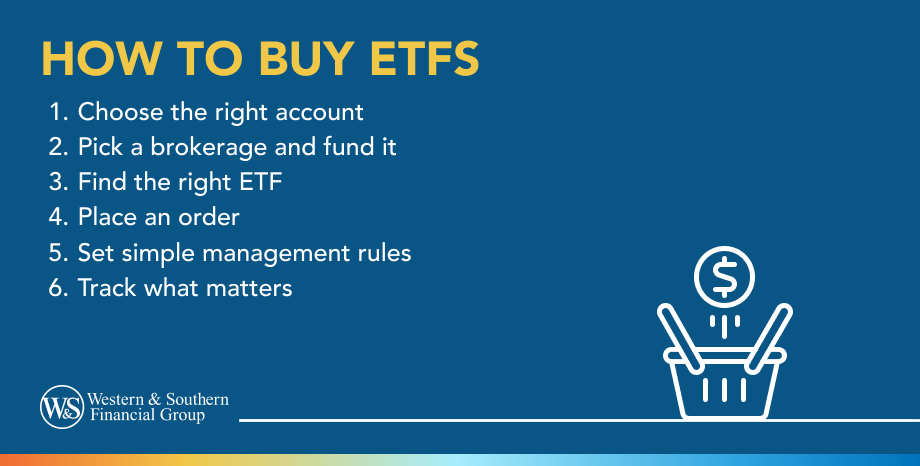
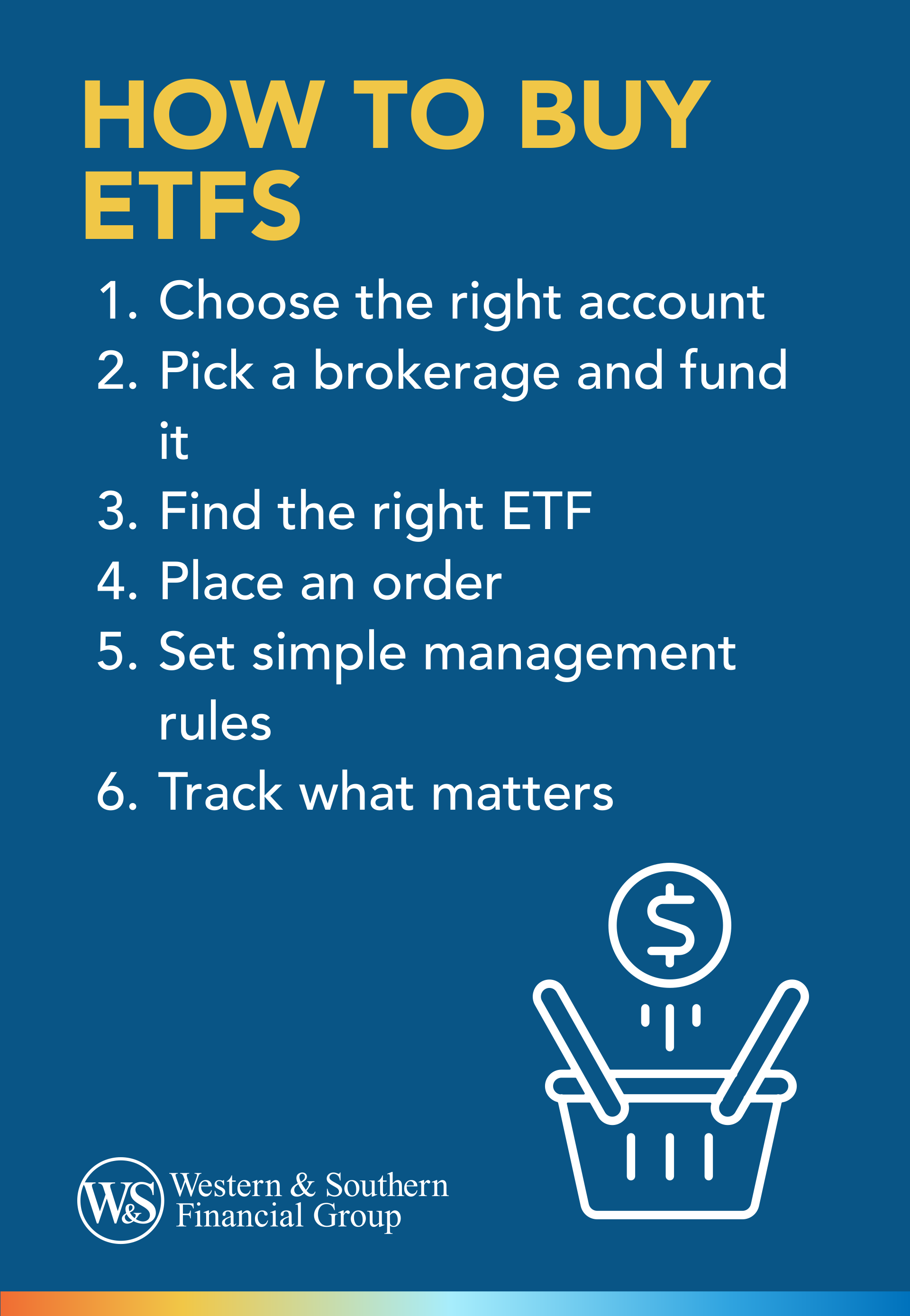
How to Buy ETFs Step-by-Step
Buying ETFs is straightforward once you know the sequence and what to check at each step. An ETF is a fund that holds a basket of investments (stocks, bonds, or both) and trades on an exchange like a stock.1 Here is a step-by-step process you can follow from account setup to placing the trade and monitoring it over time.
Step 1: Choose The Right Account
Before you pick any ETF, choose the right account. In many cases, it makes sense to prioritize tax-advantaged accounts (401(k), Roth IRA, Traditional IRA) before investing in a taxable brokerage account.
- 401(k): Contribute at least enough to your 401(k) to receive the full employer match, as most plans offer mutual funds rather than ETFs, and the match can be one of the strongest returns available.
- Roth IRA vs. Traditional IRA: With a Roth IRA, you can generally withdraw contributions at any time without tax or penalty (subject to IRS rules). Withdrawals of earnings have stricter requirements and may be taxed or penalized if they are not qualified. Traditional IRAs may offer a tax deduction today, with taxes due on withdrawals later.
- Taxable brokerage: Taxable brokerage: Offers flexibility and fewer withdrawal restrictions, but expect ongoing taxes on dividends, interest, and realized gains.1
Step 2: Pick a Brokerage & Fund The Account
Link your bank account, set up transfers, and choose your funding approach:
- Monthly contributions: Steady, automated, and easier to stick with.
- Lump sum: May appeal to investors who prefer to put their money to work all at once, but it can feel uncomfortable to invest a large amount in the market at a single point in time.
Step 3: Find the ETF
Start with the outcome you want, then work backward to the ticker.
3A. Define the Objective of the ETF
Define the ETF’s objective by stating the specific exposure it should provide in your portfolio (asset class, region, style, and role such as growth, income, stability or diversification).
Examples:
- “I need broad U.S. stock exposure for retirement in 20+ years.”
- “I need high-quality bonds to reduce volatility and fund a house down payment in 3 years.”
If you cannot describe the investment objective clearly, you are likely choosing based on instinct rath than a plan.
3B. Pick the Exposure First (Asset Class, Then Index)
A clean framework:
- U.S. stocks: broad market exposure (for example, S&P 500 index or total market).
- International stocks: developed markets (optionally add emerging markets)
- Bonds: Treasuries, aggregate bonds, or short-term bonds based on your time horizon
- Optional: inflation protection (TIPS) if it supports your plan
Index providers matter. Firms like S&P Dow Jones Indices, MSCI, and FTSE Russell set the rules for what is included and how it is weighted. Different rules can produce meaningfully different results, even when two ETFs appear similar on the surface.
3C. Compare ETFs
Use sources you can trust, including the issuer’s website, the prospectus, and the fund’s fact sheet, to research what you are buying.4 Then use this quick screen before you place a trade:
- Performance: Use long-term returns as context, but prioritize tracking difference and risk fit over recent spikes.
- Expense ratio: Lower is generally better, all else equal.
- Holdings and concentration: Review the top 10 holdings as a sanity check, and watch for heavy concentration.
- Trading volume and bid-ask spread: Higher volume and tighter spreads typically reduce trading costs.
- Tracking difference: Check whether the fund has consistently lagged its index after fees.
- Distributions: Review dividend yield and the fund’s history of capital gains distributions.
3D. Read the Right Document
Yes, the prospectus is long, and you do not need to read every page. You do need to confirm:2
- Investment objectives: What the ETF is designed to deliver.
- Principal risks: The main ways it can lose value.
- Fees and expenses: Ongoing costs that reduce returns over time.
- Investment strategy and permitted holdings: How the fund invests and what it is allowed to own.
Step 4: Place an Order
Before you click “buy,” choose an order type and timing that help control price and reduce unnecessary trading costs.
- Use a limit order for most ETF buys. Set your limit at (or slightly below) the current ask, or within the bid-ask spread. This defines the maximum price you will pay, and the order will only fill at your limit price or better. During market fluctuations, limit orders can help prevent unexpected fill prices.3
- Be cautious with market orders. In fast-moving markets or thinly traded ETFs, market orders can fill at an unexpectedly worse price. They execute immediately at the next available market price, but you will not know the exact fill price until the trade is completed.
- Trade during normal market hours. Spreads are often wider near the open (and sometimes near the close) and are frequently tighter once the market settles. When possible, avoid the open and consider trading mid-session for more stable pricing.
Step 5: Decide How You’ll Manage It
Once your ETFs are in place, the next priority is managing them with a simple, repeatable routine that keeps you aligned with your plan. Set rules now so your default actions are repeatable, not emotional.
- Rebalance once or twice per year to keep your allocation on target.
- Keep contributions steady and consistent to build momentum and reduce market-timing mistakes.
- Tune out headlines unless your goals, time horizon, or risk tolerance has changed.
Step 6: Track What Matters
Tracking should reinforce good habits and long-term progress, not trigger short-term reactions.
| Good Tracking | Bad Tracking |
|---|---|
| Contributions made: Confirm you are funding the account on schedule, and increase contributions when income rises. | Daily gains and losses: Mostly noise, and often leads to unnecessary changes and poor timing decisions. |
| Asset allocation (stocks vs. bonds): Ensure your mix still matches your risk tolerance and time horizon, and that drift stays within your target range. | Social media predictions: Often designed for attention rather than accuracy, and encourages reactive decision-making. |
| Fees and taxes: Monitor expense ratios, trading costs, and tax impact so avoidable costs do not compound over time. | “Hot ETF” lists: Promotes trend-chasing, adds complexity, and can pull you away from your long-term allocation. |
| Stayed invested through volatility: Track behavior and discipline, since staying invested is a key driver of long-term results. | Constant checking: Reinforces short-term thinking and increases the odds of emotional, unplanned trades. |
Where to Buy ETFs
Most trading platforms offer commission-free ETF trades through their website and mobile app, but confirm fees and fine print. Commission-free does not eliminate costs like bid-ask spreads.3 The real differences are less about access and more about day-to-day friction, costs, and the guardrails that help you stay disciplined.
What Happens When You Click “Buy”
You are not buying directly from Touchstone, Vanguard, iShares, or another issuer. You are buying ETF shares on the exchange, typically from other market participants (often including market makers). That is why the market price matters. It can differ slightly from the ETF’s net asset value (NAV), which reflects the value of the underlying holdings per share.2,3
Key terms that affect your real-world results:
- Expense ratio: The annual fund fee (bundled into daily pricing). You do not get a bill, but you do pay it.
- Bid-ask spread: The gap between what buyers bid and sellers ask. This is a trading cost, especially in thinly traded ETFs.
- Premium/discount to NAV: When the market price is slightly above or below NAV. Usually small for liquid ETFs, but it matters.
- Tracking difference: How closely the ETF matches its index after fees and trading frictions.
- Capital gains distributions: Taxable payouts that can happen when a fund sells holdings at a profit. Many broad ETFs minimize these, but it is not guaranteed.
Who Offers ETFs, and Who Regulates Them
- ETF sponsors/issuers: Firms like Touchstone, BlackRock (iShares), Vanguard, State Street, Schwab, Invesco, and others.
- Where ETFs trade: Major exchanges (NYSE Arca, Nasdaq, etc.) throughout the trading day.
- Regulation: In the U.S., ETFs are regulated under federal securities laws and overseen by the SEC. Broker-dealers executing trades are typically overseen by the SEC and FINRA.2,3
What To Look for When Choosing a Brokerage Platform
- $0 online ETF commissions: Common, but confirm there are no account maintenance fees, inactivity fees, or trading restrictions.
- Fractional shares: Useful if you are investing smaller amounts and the ETF trades at $200 to $500 per share.
- Order types and automation: Look for limit orders, stop orders, recurring investments, and, if available, automatic rebalancing. Features vary widely by provider.
- Cash sweep yield: Idle cash matters. If the sweep pays near zero, it quietly drags on returns while you wait to invest.
- Support and tools: A clear interface, solid research tools, and reliable tax reporting can be worth paying attention to, especially if you are newer.
Brokerage vs. Financial Advisor
- A brokerage executes trades.
- A financial advisor can help you choose ETFs and build a plan aligned with your goals, time horizon, and risk tolerance
The Financial Reality: Costs & Break-Even
ETFs are often low-cost, but they are not free. Your all-in cost is usually a mix of:
Expense ratio (ongoing): Broad index ETFs commonly run about 0.03% to 0.25% (varies by provider). On a $10,000 holding, that is roughly:
- 0.03% = $3/year
- 0.25% = $25/year
Bid-ask spread (when you buy and sell): Liquid ETFs may trade with penny-wide spreads, while niche or thinly traded ETFs can be much wider. Example: a $0.04 spread on a $100 ETF is about 0.04% per trade, before considering any price movement.
Premium or discount to NAV (usually small, sometimes not): For large index ETFs, premiums and discounts are typically minor, but they can widen during volatile markets or periods of reduced liquidity.
Taxes (especially in taxable accounts):1,2
- Dividends and interest can be taxable each year in a brokerage account.
- ETFs often reduce capital gains distributions versus mutual funds, but it still depends on the fund and market activity.
- Selling at a profit can trigger capital gains taxes in taxable accounts.
Expense Ratio vs Trading Friction
If you invest monthly for years, a slightly higher expense ratio can be less costly than repeatedly paying wide spreads in a niche ETF.
Example: You invest $500/month.
- ETF A (broad, liquid): expense ratio 0.05%, typical spread cost about $0.05% per trade
- Annual expense cost: $6,000 × 0.0005 = $3.00
- Annual spread cost: $6,000 × 0.0005 = $3.00
- Total estimated cost: $6.00/year
- ETF B (niche, thin): expense ratio 0.25%, typical spread cost about 0.50% per trade
- Annual expense cost: $6,000 × 0.0025 = $15.00
- Annual spread cost: $6,000 × 0.0050 = $30.00
- Total estimated cost: $45.00/year
Even though ETF B’s expense ratio is only 0.20% higher, the wide spread you pay every month can cost more than the fee difference over time. Investment returns will fluctuate and are subject to market volatility, so that an investor’s shares, when redeemed or sold, may be worth more or less than their original cost.
The Bottom Line
Buying ETFs is not complicated, but doing it well requires a clear goal, the right account, and a few simple checks before you place the trade. Follow this step-by-step process to reduce costs, avoid common mistakes, and stay invested through market volatility.
Provided for informational purposes only. Not all products and services discussed are available through member of Western & Southern Financial Group.
Sources
- Characteristics of Mutual Funds and Exchange-Traded Funds (ETFs) - Investor.gov (SEC Office of Investor Education and Advocacy). https://www.investor.gov/introduction-investing/general-resources/news-alerts/alerts-bulletins/characteristics-mutual-funds-exchange-traded-funds.
- Updated Investor Bulletin: Exchange-Traded Funds (ETFs) – SEC Office of Investor Education and Advocacy. https://www.investor.gov/introduction-investing/general-resources/news-alerts/alerts-bulletins/investor-bulletins-24.
- Exchange-Traded Funds and Products – FINRA. https://www.finra.org/investors/investing/investment-products/exchange-traded-funds-and-products.
- Mutual Funds and Exchange-Traded Funds (ETFs): A Guide for Investors - U.S. Securities and Exchange Commission (SEC). https://www.sec.gov/investor/pubs/sec-guide-to-mutual-funds.pdf.


