Life insurance for blended families is using an insurance policy’s death benefit and beneficiary rules to protect a surviving spouse while still providing for children from a prior marriage. It matters because remarriage, intestacy laws, elective share rules, and outdated beneficiary forms can unintentionally disinherit someone you care about.
Why Traditional Life Insurance Fails Blended Families
Standard life insurance assumes a simple family structure: you die, your spouse gets the money, your mutual children eventually inherit what's left. Blended families break every part of this assumption.
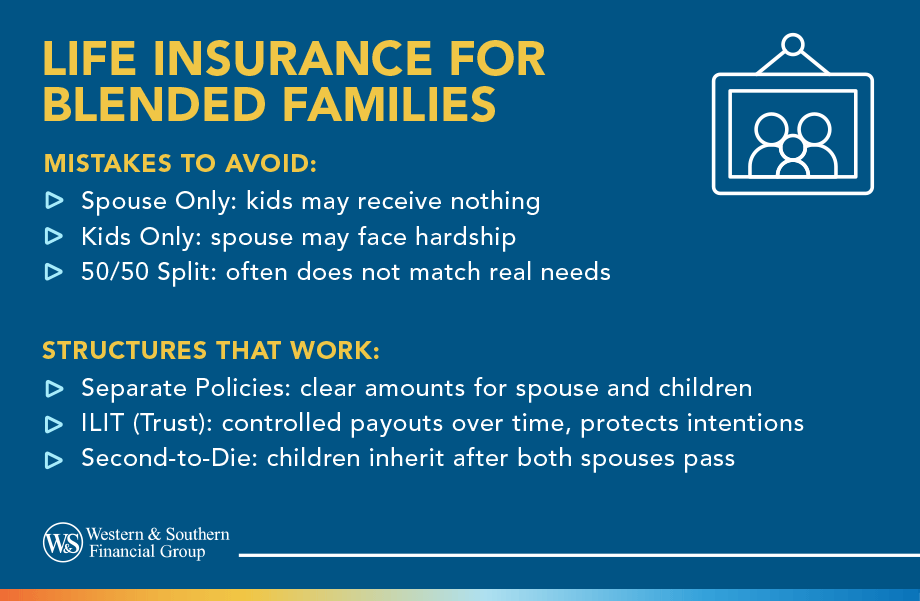
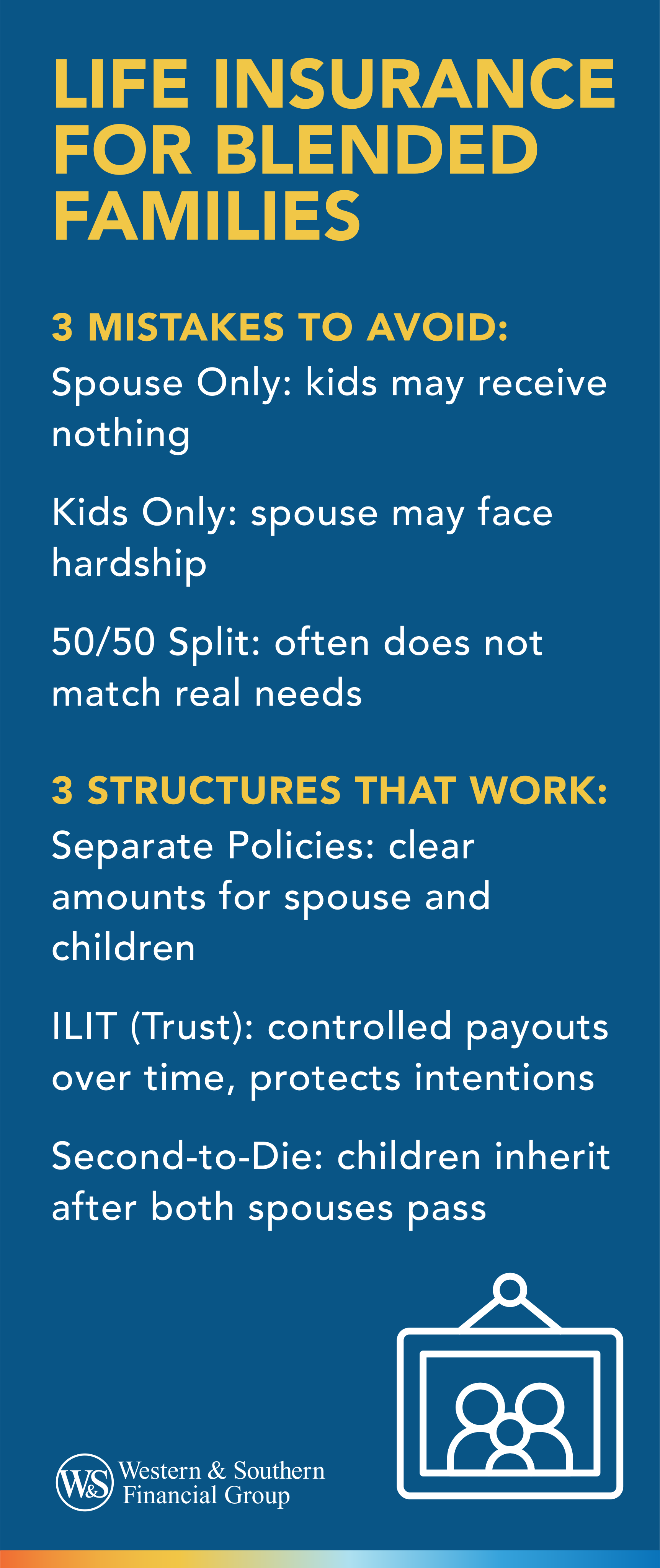
Name your spouse as beneficiary, and your children from a prior marriage get nothing. Name your children, and your spouse could face financial hardship. Split it 50/50, and you've created a patchwork that satisfies no one and may not cover actual needs.
The bigger problem: Your will cannot change a life insurance beneficiary designation, so mismatches can undermine your broader estate plan.1 Generally, life insurance proceeds are paid to the named beneficiary, regardless of what a will states.
The Elective Share Trap
Many states provide an elective share, often around one-third but it varies by state and may be based on an augmented estate.4 Life insurance often pays outside probate, but whether it is counted toward a spouse’s elective share depends on your state’s elective-share and augmented-estate rules. Your new spouse could receive your entire death benefit while your children from a prior marriage receive their elective share of your other assets (which may be minimal).
Conversely, if you name your children as beneficiaries, your spouse might elect against your will and claim their statutory share anyway, creating legal battles and fractured relationships.
Life Insurance Structures That Actually Work
Three approaches solve the blended family problem. Each has tradeoffs.
Option 1: Separate Policies for Separate Obligations
Purchase distinct policies for different beneficiaries. A $500,000 policy naming your spouse provides for their needs. A separate $300,000 policy names your children. Each party receives their designated amount directly, with no conflict.
Advantages: Simple and clear, which can reduce the risk of disputes. Each beneficiary knows exactly what they'll receive.
Disadvantages: Higher total premiums. No flexibility if circumstances change. Your spouse might blow through their policy while your kids sit on theirs.
Option 2: Irrevocable Life Insurance Trust (ILIT)
An ILIT owns your policy and distributes proceeds according to trust instructions.2 You control timing, conditions, and amounts. Your surviving spouse could receive income for life, with the principal passing to your children at their death or a specified date.
Advantages: Maximum control. Potential estate tax benefits for larger estates. Creditor protection. Your intentions are legally binding. Your chosen trustee follows the trust instructions and manages distributions to your spouse and children.
Disadvantages: Setup costs. Annual administration. You cannot change the trust terms easily once established. Premium payments require careful "Crummey letter" procedures to qualify for gift tax exclusions.3
Option 3: Second-to-Die Policy with Trust
A survivorship policy pays out only when both you and your spouse die. This guarantees your children receive the full death benefit eventually while your spouse has access to other assets during their lifetime.
Advantages: Lower premiums than two individual policies. Eliminates the "spouse vs. children" tension entirely. Ideal when your spouse has sufficient assets or income to live comfortably.
Disadvantages: No payout at first death. Your spouse gets nothing from this policy. Works only if other resources cover the surviving spouse's needs.
| Structure | Best For | Typical Cost | Control Level | Complexity |
|---|---|---|---|---|
| Separate Policies | Clear-cut obligations, modest estates | Higher (2x premiums) | Low | Simple |
| ILIT | Larger estates, complex families | Medium + $2-5K setup | High | Complex |
| Second-to-Die | Wealthy spouses, estate tax concerns | Lower | Medium | Moderate |
Who Should Prioritize Life Insurance for Blended Families
Best Candidates
If you have children from a prior marriage and a current spouse, you need structured life insurance. Structured planning is typically important in these situations.
If your net worth exceeds $500,000, an ILIT can be a strong fit when you need maximum control, allowing you to support your spouse while ensuring the remaining proceeds ultimately go to your children, with possible estate tax benefits in higher-tax situations.
If you've promised specific inheritances to your children, properly structured life insurance can help ensure proceeds are paid according to the beneficiary designation.
If your spouse has limited earning capacity or retirement savings, you owe them protection. But you also owe your children what you've built. Life insurance can help you address both obligations when properly structured.
Who Should Consider Alternatives
If all your children are from your current marriage, standard beneficiary designations may work fine. Your spouse and children share aligned interests.
If you have minimal assets and young children, maximum term coverage with your spouse as beneficiary probably makes most sense. Estate equalization matters less when there's no estate to equalize.
If both spouses brought substantial assets into the marriage, you might protect separate property through pre-marital agreements rather than insurance. Each spouse's existing assets pass to their own children; life insurance becomes supplemental rather than essential.
Step-by-Step: Structuring Your Blended Family Coverage
Step 1: Calculate Your Obligations
List each person you want to protect and their financial need. Your spouse might need $500,000 to maintain their lifestyle for 20 years. Your children might need $200,000 each for inheritance equalization. Total those figures.
Step 2: Inventory Existing Coverage
Review employer provided group life, existing policies, and retirement accounts with beneficiary designations. You may already have $200,000 in coverage that simply needs restructuring.
Step 3: Consult an Estate Planning Attorney
Before purchasing new coverage, understand how it interacts with your will, any pre-marital agreement, and state intestacy laws.5 This is not just an insurance decision, it is coordinated financial strategy tied to your estate plan. An hour of legal advice prevents years of family litigation.
Step 4: Choose Your Structure
Based on your obligations, assets, and complexity tolerance, select separate policies, an ILIT, or second-to-die coverage. Get quotes from at least three carriers.
Step 5: Coordinate Beneficiary Designations
If using an ILIT, the trust owns the policy, and the trust is the beneficiary. If using direct ownership, ensure beneficiary designations align with your overall estate plan. Review these annually.
Step 6: Document Your Intentions
Write a letter explaining why you structured things as you did. This won't be legally binding, but it helps family members understand your reasoning and reduces the "why did Dad do that?" conflicts.
The Bottom Line
Life insurance for blended families isn't just a financial product decision, it's a promise you make legally enforceable.
The right structure ensures your surviving spouse is protected, your children receive what you intended, and your family avoids the courtroom battles and fractured relationships that poor planning leaves behind.
Whether a simple separate-policy approach or a full ILIT fits your situation, the worst option is doing nothing and leaving these decisions to chance.
Explore life insurance options designed for blended families. Request a Free Life Insurance Quote
Sources
- Finance Strategists - Beneficiary Designations. https://www.financestrategists.com/estate-planning-lawyer/beneficiary-designations/.
- Irrevocable Life Insurance Trusts – Cornell Law School Legal Information Institute. https://www.law.cornell.edu/wex/irrevocable_life_insurance_trust_(ilit).
- Estate and Gift Tax FAQs – Internal Revenue Service. https://www.irs.gov/businesses/small-businesses-self-employed/estate-and-gift-taxes.
- Elective Share – Cornell Law School Legal Information Institute. https://www.law.cornell.edu/wex/elective_share.
- American Bar Association – Introduction to Wills and Estate Planning. https://www.americanbar.org/groups/real_property_trust_estate/resources/estate_planning/.
- Publication 555, Community Property – Internal Revenue Service. https://www.irs.gov/publications/p555.
- Employee Retirement Income Security Act (ERISA) – U.S. Department of Labor. https://www.dol.gov/general/topic/retirement/erisa.
- What are the principal types of life insurance? – Insurance Information Institute. https://www.iii.org/article/what-are-principal-types-life-insurance.