How Do ETFs Actually Work?
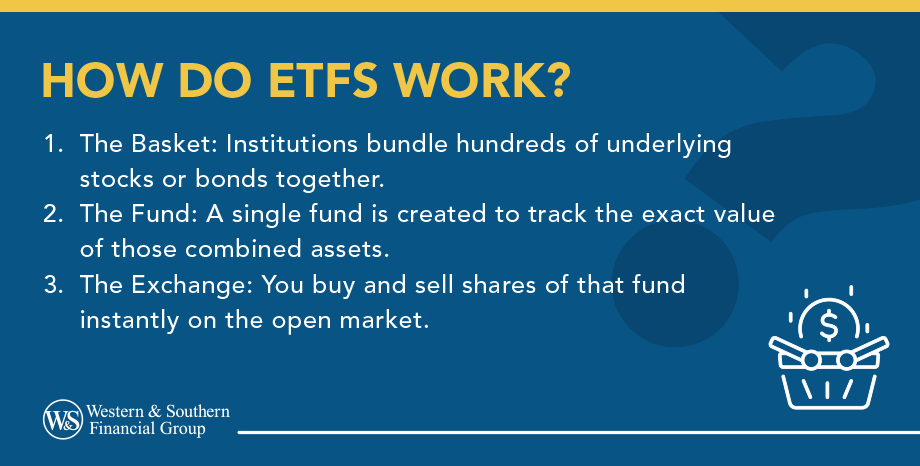
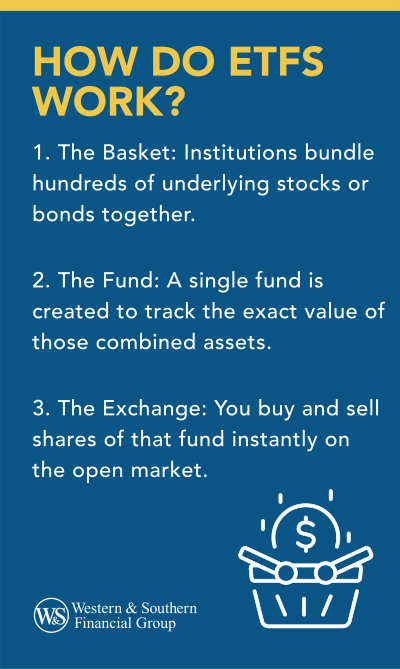
To understand how an ETF works, you have to look past the ticker symbol on your brokerage screen. While an ETF trades like a stock for you, behind the scenes it relies on a unique "double-layered" market structure that keeps its price accurate and its taxes low.
It’s important to distinguish between an ETF’s structure and its investment strategy. An exchange-traded fund is simply a vehicle, a wrapper that can hold many different types of investments. Some ETFs are designed to passively track an index, while others are actively managed by portfolio managers who select securities with the goal of outperforming a benchmark or managing risk in a specific way. The creation and redemption mechanism described below applies to both types.
The Two-Tiered Market
ETFs operate in two different "worlds" simultaneously:
- The Secondary Market (You): This is where individual investors buy and sell existing shares of the ETF on an exchange (like the NYSE). If you buy 10 shares, you are buying them from another party (like a fellow investor or a market maker), not the fund itself.
- The Primary Market (The Pros): This is where new ETF shares are actually created or destroyed. Only a few large institutions, known as Authorized Participants (APs), have access to this market.2
The Creation & Redemption Process
This is the "engine" driving the ETF's daily operation. Unlike a mutual fund, where the fund company must sell stocks to give you cash when you leave, ETFs use "In-Kind" transfers.
Creation (When demand is high)
- The AP buys a "basket" of all the underlying stocks in the index (e.g., all 500 stocks in the S&P 500).
- The AP delivers that basket of stocks to the ETF issuer (like Vanguard or BlackRock).
- The Issuer gives the AP a large block of ETF shares (often 50,000 shares, called a Creation Unit) in exchange.3
- The AP then sells those individual ETF shares to the public on the secondary market.
Redemption (When people are selling)
- The AP buys up a huge block of ETF shares from the open market.
- The AP hands those shares back to the ETF issuer.
- The Issuer hands back the original "basket" of underlying stocks to the AP.
Most ETFs operate under SEC Rule 6c-11, which standardized creation and redemption procedures, portfolio transparency, and operational requirements for exchange-traded funds.7,8
The Arbitrage Mechanism: Keeping the Price Fair
You might wonder: What stops an ETF's price from drifting away from the value of its stocks? The answer is Arbitrage.
- If the ETF price is too high (Premium): The AP sees that the ETF is trading for $101, but the underlying stocks are only worth $100. The AP will buy the stocks for $100, create new ETF shares, and sell them for $101, pocketing a $1 profit. This selling pressure brings the ETF price back down to $100.2
- If the ETF price is too low (Discount): The AP buys the "cheap" ETF shares at $99, redeems them for the $100 worth of underlying stocks, and sells the stocks for $100. This buying pressure pushes the ETF price back up.
How ETFs Implement Different Investment Strategies
While many investors associate ETFs with index tracking, the ETF structure can support both passive and active strategies. Historically, most ETFs were designed to mirror a specific benchmark. In recent years, however, actively managed ETFs have grown significantly and now represent a meaningful and expanding segment of the market.6
For traditional passive funds, the manager uses one of three strategies to make sure the ETF actually matches its target index:
| Strategy | How It Works | When It's Used |
|---|---|---|
| Full Replication | The fund buys every single stock in the index at the exact weight. | Large, liquid indices (S&P 500). |
| Sampling | The fund buys a representative sample of stocks to "mimic" the index. | Massive or illiquid indices (Total Bond Market). |
| Optimization | Uses complex math to find the smallest number of stocks needed to get the same return. | Niche or hard-to-access markets. |
Actively Managed ETFs
Actively managed ETFs do not seek to replicate an index. Instead, professional portfolio managers make ongoing investment decisions based on research, market conditions, valuation, or specific income or risk objectives.
These funds may aim to outperform a benchmark, reduce downside risk during market volatility, generate income, or pursue specialized strategies not easily captured by a traditional index.
Because active ETFs often involve research teams, security selection, and more frequent trading, their expense ratios are typically higher than those of broad index ETFs. However, some investors are willing to accept higher costs in exchange for the potential benefits of active decision-making.
As with any strategy, results vary by manager, market cycle, and execution.
Physical ETFs vs. Synthetic ETFs
Most U.S. ETFs are physical ETFs. They own the actual underlying securities. If an ETF tracks the S&P 500, it holds shares of Apple, Microsoft, Amazon, and 497 other companies.
Synthetic ETFs don't own the underlying assets directly. Instead, they use derivatives (typically swaps) with counterparties (usually investment banks) who promise to deliver the index return. These are more common in Europe and for commodity exposure.
Synthetic ETF risks:
- Counterparty default could cause losses
- Complexity makes true costs harder to identify
- Regulatory treatment varies by jurisdiction5
For most individual investors, physical ETFs offer simpler, more transparent exposure. Synthetic structures make sense primarily for asset classes difficult to hold directly, like certain commodities.
What Are ETF Fees & Costs?
The Internal Fee: The Expense Ratio
The most common cost is the Expense Ratio, which represents the annual fee an ETF provider charges to manage the fund.
- How it’s paid: It is not a bill you receive. Instead, it is deducted daily from the fund's Net Asset Value (NAV). If a fund has a 0.10% expense ratio, the fund’s performance will lag the actual market index by roughly that amount.2
- What it covers: Portfolio management, administrative services, compliance, marketing, and auditing.
- Active vs. Passive: Passive index ETFs (e.g., S&P 500 trackers) often have very low ratios (0.03% to 0.10%), while actively managed ETFs can range from 0.25% to 1.00%+.
While cost differences can meaningfully affect long-term returns, expense ratios are only one part of the equation. Actively managed ETFs may seek to offset higher fees through security selection, tactical allocation, income generation, or risk management strategies. Whether higher costs are justified depends on the fund’s objectives, performance, and the investor’s goals.
External Trading Costs
Because ETFs trade like stocks on an exchange, there are costs associated with the act of buying and selling them.
- Trading Commissions: Most major U.S. brokers (Schwab, Fidelity, Vanguard) now offer commission-free ETF trading. However, some boutique or international brokers still charge a flat fee per trade.
- Bid-Ask Spread: This is the difference between the highest price a buyer is willing to pay (Bid) and the lowest price a seller is willing to accept (Ask).
- Under normal market conditions, high-volume ETFs have tiny spreads (often $0.01).
- Low-volume or niche ETFs can have wider spreads, meaning you "lose" a small percentage of your investment value the moment you buy. This introduces liquidity risk, the danger that it will be expensive or difficult to enter or exit your position quickly at a fair price.5
- Market Impact: For very large trades, the act of buying can actually push the price up (or selling can push it down), increasing the effective cost.
"Hidden" or Indirect Costs
These don't appear on a fee table but still impact your total return.
- Tracking Error: This refers to the difference between an index ETF’s performance and that of its benchmark. If the index returns 10% but the ETF returns 9.8%, and the expense ratio was only 0.1%, the remaining 0.1% may be due to transaction costs, cash holdings, or imperfect replication.2For actively managed ETFs, deviations from a benchmark are intentional rather than considered “error,” since the goal is often to outperform the index or manage risk differently.
- Premium/Discount to NAV: Since ETFs trade on an open market, the price may be slightly higher (Premium) or lower (Discount) than the value of the underlying assets. Buying at a high premium is an added cost.
- Tax-Cost Ratio: While ETFs are generally more tax-efficient than mutual funds due to the "in-kind" redemption process, they can still generate capital gains taxes if the fund rebalances frequently.
Comparison at a Glance
| Cost Type | Paid To | Frequency | Visibility |
|---|---|---|---|
| Expense Ratio | Fund Provider | Ongoing (Daily) | High (in Prospectus) |
| Bid-Ask Spread | Market Makers | At Trade | Low (Embedded in price) |
| Commissions | Broker | At Trade | High (on Statement) |
| Tax Drag | Government | Annually/At Sale | Variable |
How Are ETFs Taxed?
When you invest in ETFs, you are generally taxed in two ways: while you hold the fund (through distributions) and when you eventually sell your shares (through capital gains).
Because of their structure, many ETFs can be more tax-efficient than traditional mutual funds in taxable brokerage accounts. However, tax efficiency can vary depending on the fund’s investment strategy, turnover, and asset class.
Taxes on Dividends and Interest
If the stocks or bonds inside the ETF pay out income, the ETF must pass that money to you in the form of distributions. How that money is taxed depends on what’s inside the fund.
- Qualified Dividends: Most dividends from U.S. companies are "qualified." These are taxed at the more favorable long-term capital gains rates, provided you hold the ETF for a specific period (generally more than 60 days around the dividend date).
- Ordinary (Non-Qualified) Dividends: These are taxed at your standard income tax rate (up to 37%). This usually applies to dividends from REITs (Real Estate Investment Trusts) or stocks held for a very short time.
- Interest Income: Municipal bond ETF interest is generally federal tax-free, but state taxes or AMT may apply depending on holdings. Treasury ETF interest is generally exempt from state and local taxes, but only for the Treasury-interest portion.
Capital Gains: Selling Your Shares
When you sell your ETF shares for more than you paid for them, you trigger a capital gain.
- Short-Term (Held 1 year or less): Taxed as ordinary income.
- Long-Term (Held more than 1 year): Taxed at the lower capital gains rates.3
The "Tax Magic" of ETFs: Internal Capital Gains
This structural feature can provide a tax advantage relative to many traditional mutual funds. In a mutual fund, if the manager sells a stock for a profit to meet redemptions, shareholder in the fund has to pay a "capital gains distribution" tax at the end of the year, even if they didn't sell a single share.
ETFs rarely do this. Because of the "in-kind" creation/redemption process, ETF managers can move appreciated stocks out of the fund without technically "selling" them. By avoiding a taxable event inside the fund, the ETF prevents triggering surprise capital gains taxes for its ongoing shareholders.4
That said, actively managed ETFs with higher portfolio turnover may still generate taxable gains, and some mutual funds use tax-aware strategies designed to reduce distributions.
Taxes on Specialized ETFs
Not all ETFs follow the standard rules. Niche products may have unique tax treatment.
| ETF Type | Tax Treatment |
|---|---|
| Precious Metals (Gold/Silver) | Often taxed at the Collectibles Rate (a maximum of 28%) for long-term gains, rather than standard capital gains rates. |
| Futures-Based (Commodities) | Often follows the 60/40 Rule: 60% is taxed as long-term and 40% as short-term, regardless of how long you held it. |
| Currency ETFs | Most gains are taxed as Ordinary Income. |
ETF Taxation Across Different Account Types
Understanding the tax implications of ETFs across taxable, tax-deferred, and tax-exempt accounts is essential for maximizing long-term returns and optimizing your overall asset location strategy.
In taxable brokerage accounts, ETFs are highly advantageous because their "in-kind" redemption process avoids the internal capital gains distributions common in mutual funds, meaning you only pay taxes on dividends or when you choose to sell.
In tax-deferred accounts like a Traditional IRA or 401(k), this structural efficiency is less critical because all growth is shielded from annual taxation; however, all withdrawals are eventually taxed as ordinary income at your current bracket.
For tax-exempt accounts like a Roth IRA, ETFs can serve as effective long-term growth vehicles, since both appreciation and qualified distributions may be withdrawn tax-free. The choice between active and passive strategies within these accounts depends on risk tolerance, time horizon, and overall portfolio design.
While ETFs offer significant tax advantages, individual tax situations can vary based on income, location, and specific financial goals. You should always consult with a qualified tax professional or financial advisor before making significant investment decisions to ensure compliance with the most current tax laws and regulations.
The Bottom Line
ETFs are a flexible investment structure that can house both index-based and actively managed strategies. Their creation and redemption process helps support liquidity and, in many cases, tax efficiency.
Whether an investor chooses a passive ETF focused on broad market exposure or an actively managed ETF designed to pursue differentiated returns depends on individual objectives, risk tolerance, and beliefs about market efficiency.
Understanding how ETFs function, including their pricing mechanics, costs, and tax considerations, allows investors to evaluate how different strategies may fit within a diversified portfolio.
Provided for informational purposes only. Not all products and services discussed are available through member of Western & Southern Financial Group.
Sources
- The US ETF Market: FAQs. https://www.ici.org/faqs/faqs_etfs_market.
- Updated Investor Bulletin: Exchange-Traded Funds (ETFs) – SEC Office of Investor Education and Advocacy. https://www.investor.gov/introduction-investing/general-resources/news-alerts/alerts-bulletins/investor-bulletins-24.
- Mutual Funds and Exchange-Traded Funds (ETFs): A Guide for Investors - U.S. Securities and Exchange Commission (SEC). https://www.sec.gov/investor/pubs/sec-guide-to-mutual-funds.pdf.
- Characteristics of Mutual Funds and Exchange-Traded Funds (ETFs) - Investor.gov (SEC Office of Investor Education and Advocacy). https://www.investor.gov/introduction-investing/general-resources/news-alerts/alerts-bulletins/characteristics-mutual-funds-exchange-traded-funds.
- Exchange-Traded Funds and Products – FINRA. https://www.finra.org/investors/investing/investment-products/exchange-traded-funds-and-products.
- Investment Company Fact Book 2025 – Investment Company Institute. https://www.icifactbook.org/.
- Exchange-Traded Funds (e-CFR: 17 CFR § 270.6c-11) - eCFR (U.S. Government). https://www.ecfr.gov/current/title-17/chapter-II/part-270/section-270.6c-11.
- Exchange-Traded Funds (Final Rule, Release No. 33-10695) - U.S. Securities and Exchange Commission (SEC). https://www.sec.gov/files/rules/final/2019/33-10695.pdf.


