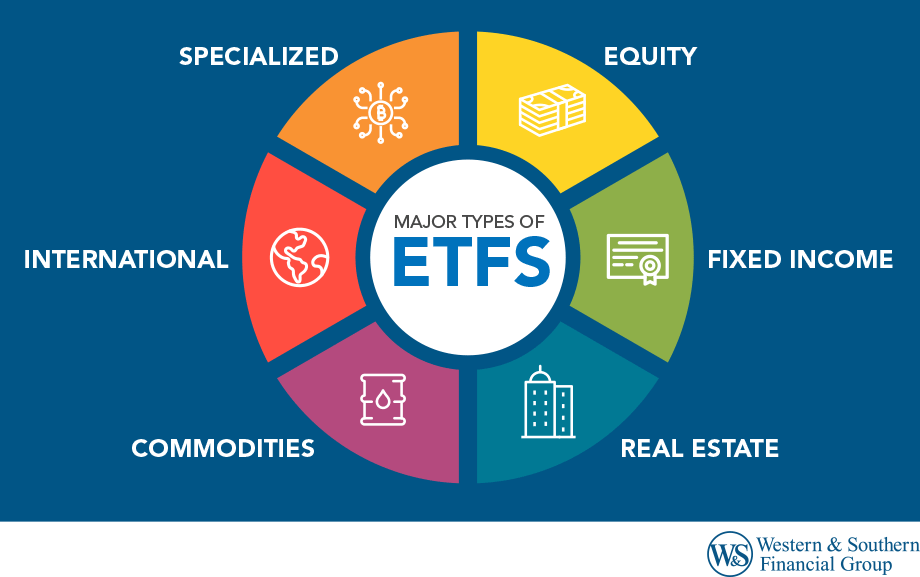
The Major Types of ETFs
From broad equity markets and fixed income to specialized commodities and international regions, understanding the various types of ETFs is essential for building a diversified and resilient investment portfolio. ETFs can follow different management approaches. Many ETFs track indexes using rules-based strategies, but a growing number are actively managed, meaning portfolio managers select investments based on research, market outlook, or specific objectives.
ETF Market Growth
Equity ETFs (Stock Funds)
These ETFs are the most common and consist of a collection of stocks, offering access to a specific market segment.
- Broad Market Index Fund ETFs: These funds track a published index such as the S&P 500, NASDAQ 100, Russell 3000, or Total Stock Market. They typically rely on full replication or sampling, aiming to mirror the performance of a specific stock market index as closely as possible. They are commonly used as core holdings in long-term portfolios because they provide broad diversification and market exposure.
- Sector ETFs: These isolate particular industries, such as Technology, Healthcare, or Financials. If you believe artificial intelligence (AI) will boom, you buy a Technology Sector ETF rather than picking one winner.
- Market Capitalization ETFs: These filter stocks by size. You can buy Small-Cap (high growth potential, high risk) or Large-Cap (stability, dividends).
- Style ETFs: These focus on investment strategy. Growth ETFs hold companies expected to grow sales fast, while Value ETFs hold undervalued companies with steady cash flows.
Fixed Income ETFs (Bond Funds)
Bonds are difficult for individuals to trade. Bond ETFs solve this by packaging bonds into a liquid ticker. Because ETFs trade on stock exchanges, their market price can occasionally differ from NAV (premiums/discounts), particularly in fast markets.2
- Government Bond ETFs: Hold U.S. government debt. Low credit risk, but rate-sensitive, lower yield.
- Corporate Bond ETFs: Hold debt issued by companies. Higher risk, with the potential for higher interest income (yields) compared to government debt.
- High-Yield (Junk) ETFs: Hold debt from companies with lower credit ratings. High risk, high income potential.
Commodity & Real Estate ETFs
These provide exposure to physical assets or raw materials without requiring you to store gold bars or manage tenants.
- Commodity ETFs: Track prices of gold, oil, corn, or natural gas.
- Warning: Some use futures contracts rather than physical holdings, which can lead to performance drag.
- REIT ETFs: Invest in Real Estate Investment Trusts. They generate income through rent and mortgages.
International & Region ETFs
These funds allow you to invest outside the US.
- Region ETFs: Target specific regions, such as the Eurozone or Emerging Markets.
- Country Specific: Track a single economy, such as the FTSE 100 (UK) or the Nikkei 225 (Japan).
Specialized & Niche ETFs
- Currency ETFs: Track the value of the Euro, Yen, or Dollar. Used chiefly for hedging.
- Smart Beta ETFs: These are hybrids. They track an index but use rules to screen for factors like low volatility or high dividends. These strategies fall between traditional index tracking and fully active management, using rules-based methodologies to target specific factors.
- Active ETFs: Managed by investment professionals who select securities based on research or strategy rather than tracking an index. While costs may be higher than index-based funds, they offer flexibility, tactical positioning, and potential for outperformance in certain market environments.
- Cryptocurrency ETFs: Funds include spot Bitcoin products approved in the U.S. in January 2024, and spot Ether ETFs that began trading in July 2024, as well as futures-based structures.
- Synthetic ETFs: Instead of holding the actual stock, these use derivatives to mimic returns. These carry "counterparty risk", if the bank backing the derivative fails, the fund suffers.2
- Leveraged ETFs: Use derivatives and borrowing to target a multiple (or the inverse) of an index’s daily return, which can amplify gains and losses and may produce results that diverge significantly from the stated multiple over longer holding periods.2
Comparing Types of ETFs: Risk, Costs & Investment Objectives
| ETF Category | Typical Risk Level | Common Expense Ratio (can vary widely) | Primary Investment Objective |
|---|---|---|---|
| Broad Market Index | Moderate to High | 0.02% – 0.10% | Long-term growth & diversification |
| Government Bonds | Low credit risk | 0.03% – 0.15% | Capital preservation & steady income |
| Corporate Bonds | Moderate | 0.06% – 0.40% | Higher income than government debt |
| Sector/Industry | High | 0.10% – 0.60% | Targeted growth in specific themes |
| International/Region | Moderate to High | 0.05% – 0.50% | Geographic diversification |
| Commodities | High | 0.25% – 0.90% | Inflation hedge & non-correlation |
| Smart Beta/Factor | Moderate to High | 0.15% – 0.60% | Risk-adjusted returns (e.g., low volatility) |
| Active/Specialized | High | 0.35% – 1.00%+ | Actively managed; flexible strategy with outperformance potential |
Data Sources: Morningstar and the Investment Company Institute (ICI) 2025 Fact Book.4,5
Footnote: Actual fees vary by issuer, index, strategy, and share class.
Conclusion
Understanding the diverse Types of ETFs is a critical step in aligning your portfolio with your specific investment objectives. Whether you are seeking aggressive growth through tech-heavy sector funds, capital preservation via government bonds, or exposure to specialized strategies such as crypto and smart beta, each category serves a distinct role in a diversified strategy. Both index-based and actively managed ETFs can play a role in portfolio construction, depending on whether an investor prioritizes cost efficiency, broad market exposure, tactical flexibility, or manager-driven strategies.
Because the risks, fees, and tax implications vary significantly across these asset classes, it is highly recommended to speak with a financial advisor to determine which combination of ETFs most closely aligns with your long-term wealth goals and risk tolerance.
Provided for informational purposes only. Not all products and services discussed are available through member of Western & Southern Financial Group.
Sources
- ETFGI reports ETFs Industry in the US reaches record US$13.96 trillion in Assets and Highest Ever Monthly Inflows at the end of January - ETFGI. https://etfgi.com/news/press-releases/2026/02/etfgi-reports-etfs-industry-us-reaches-record-us1396-trillion-assets.
- Updated Investor Bulletin: Exchange-Traded Funds (ETFs) – U.S. Securities and Exchange Commission (SEC). https://www.investor.gov/introduction-investing/general-resources/news-alerts/alerts-bulletins/investor-bulletins-24.
- Exchange-Traded Funds (ETFs) – U.S. Securities and Exchange Commission (SEC). https://www.investor.gov/introduction-investing/investing-basics/investment-products/mutual-funds-and-exchange-traded-2.
- U.S. Fund Fee Study - Morningstar. https://www.morningstar.com/business/insights/research/annual-us-fund-fee-study.
- 2025 Investment Company Fact Book – Investment Company Institute. https://www.icifactbook.org/pdf/2025-factbook-ch4.pdf.


