Economic downturns can make even experienced investors uneasy. Falling stock prices and uncertainty often cause people to question their strategy. However, recessions are a normal part of the economic cycle, and markets have historically recovered over time. Understanding how to invest during a recession can help you make informed decisions during market volatility.
What Does It Mean to Invest During a Recession?
A recession is a significant decline in economic activity that affects businesses, consumers, and financial markets.1 In the United States, the National Bureau of Economic Research (NBER) determines when recessions begin and end by evaluating factors such as:
- Employment levels
- Personal income
- Industrial production
- Retail sales
- Gross domestic product (GDP)
Investing During Economic Slowdowns
Investing during a recession means making investment decisions while the economy is experiencing slower growth, rising unemployment, and increased uncertainty within the broader business cycle. Market volatility often increases as investors respond to economic news and changing business conditions.
Rather than taking on more risk, many investors focus on long-term goals by:
- Continuing contributions to retirement accounts
- Maintaining a diversified portfolio
- Following their investment strategy
- Avoiding decisions based on short-term market swings
Although recessions can be challenging, they have historically been temporary. Every recession in modern U.S. history has been followed by economic expansion and market recovery. Understanding this broader context can help investors stay focused during market downturns.
What Happens to Investments During a Recession?
Recessions often increase market volatility as investors react to concerns about:
- Corporate earnings
- Consumer spending
- Economic growth
As uncertainty rises, stock prices and other asset values may decline.2 Fear and uncertainty can also lead some investors to sell during downturns, which may contribute to further market losses. Selling during periods of panic can lock in losses and reduce the opportunity to benefit from a future recovery.
Investments That May Be Affected
Lower asset prices can affect several investment types, including:
- Stocks
- Real estate
- Mutual funds and ETFs
- Other growth-focused investments
While declining prices can be challenging, they may also create opportunities for long-term investors who continue investing during market downturns.
Examples From Past Recessions
History shows that markets have recovered from past recessions. For example:
- Great Recession (2007-2009): The S&P 500 lost more than half its value before eventually recovering and reaching new highs.2
- COVID-19 Recession (2020): Markets declined sharply before rebounding faster than many experts expected.2
How Different Asset Classes May Perform
Different asset classes may perform differently during economic downturns:
| Asset Class | Typical Recession Performance |
|---|---|
| Stocks | Often decline initially |
| Treasury Bonds | May provide stability |
| Investment-Grade Bonds | Generally less volatile than stocks |
| Real Estate | Performance varies by sector |
| Money Market Funds | Typically maintain value |
| Cash Reserves | Provide liquidity |
Although no investment is free from risk, market downturns have historically been followed by periods of recovery. Maintaining a long-term perspective may help investors navigate periods of economic uncertainty.
Should You Invest During a Recession?
For many investors, the answer may be yes. However, the right choice depends on your financial situation, risk tolerance, and investing timeline.
Market downturns can create opportunities for long-term investors.3 Potential benefits include:
- Lower Share Prices: Recessions often cause stock prices to decline, allowing investors to buy shares at lower costs.
- Future Growth Potential: Investments purchased during a downturn may benefit if markets recover over time.
- Continued Retirement Contributions: Regular contributions to retirement accounts may allow investors to accumulate more shares when prices are lower.
When Investing May Not Be the Right Move
Before increasing investments, consider whether you have a strong financial foundation. You may want to focus on other priorities if you:
- Do not have an emergency fund.
- Carry significant credit card debt.
- Face job or income uncertainty.
Consider Your Time Horizon
Your investing timeline can influence how much risk you may be able to take.
- Long-Term Investors: Someone saving for retirement decades away may have more time to recover from market declines.
- Near-Retirees: Those planning to retire within a few years may prefer a more conservative approach focused on income and portfolio stability.
Focus on Long-Term Goals
Rather than reacting to short-term stock market headlines, base investment decisions on your long-term goals and overall investment strategy. Staying disciplined during market downturns may help investors participate in future market recoveries.
How Different Investors May Approach a Recession
Different investors may respond to a recession in different ways based on their age, goals, and time horizon. The table below highlights some common priorities and considerations for investors at various stages of life.
| Investor Type | Typical Focus During a Recession | Common Considerations |
|---|---|---|
| Young Investors | Staying invested for potential long-term growth | May continue investing through market declines |
| Mid-Career Investors | Balancing growth and risk management | Diversification, retirement savings, and asset allocation |
| Investors Near Retirement | Preserving assets and generating income | Capital preservation and lower-volatility investments |
Ultimately, the most appropriate recession strategy depends on an investor’s individual financial goals, risk tolerance, and time horizon.
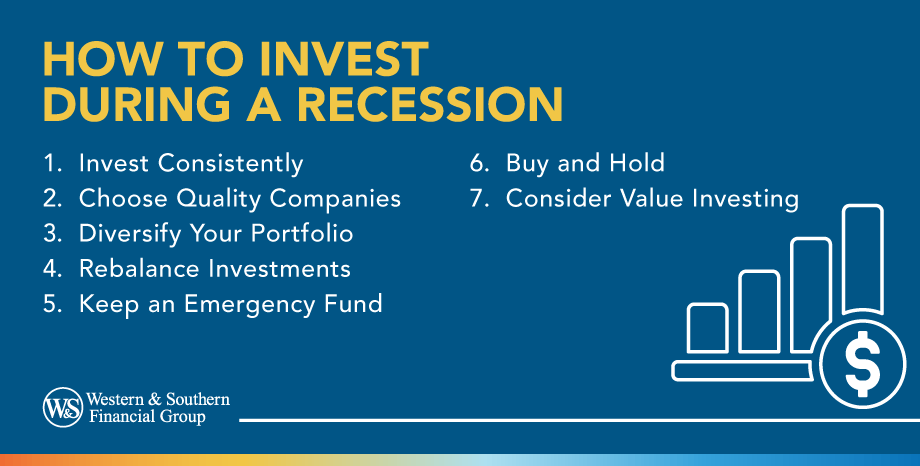
Strategies for Investing During a Recession
Continue Investing Consistently (Dollar-Cost Averaging)
One commonly used strategy during market downturns is dollar-cost averaging.4 This approach involves investing a set amount of money at regular intervals, regardless of market conditions.
When prices fall, your contribution buys more shares. When prices rise, it buys fewer shares. Over time, this strategy can reduce the effects of market volatility and remove the pressure of trying to time the market perfectly.
For example, someone investing $500 each month continues buying investments regardless of market conditions. During a recession, lower prices may allow them to accumulate more shares.
Focus on High-Quality Companies
Businesses do not all respond to recessions in the same way. Companies with strong balance sheets, steady cash flow, manageable debt, and established market positions may be better prepared to withstand economic downturns.
Many investors look for companies with:
- Reliable operations
- Consistent profitability
- Products and services consumers continue to need
Healthcare, consumer staples, and utilities are often cited as examples because demand tends to remain steady during economic slowdowns.
Dividend-paying stocks may also appeal to investors during recessions because they can provide a source of income while markets recover.
Diversify Your Portfolio
Diversification remains one of the ways to help manage investment risk and spreads investments across multiple asset types, including:
- Stocks
- Bonds
- Real estate
- Exchange-traded funds (ETFs)
- Mutual funds
- Cash reserves
While diversification cannot prevent losses, it may reduce the impact of declines in any single investment category.
Rebalance Your Portfolio
Market declines can cause your portfolio to drift from its target asset allocation. For example, a 70/30 stock-bond portfolio could become 60/40 after a market decline. Rebalancing involves adjusting your holdings to return to the intended allocation.
This process encourages investors to purchase assets that have declined in value and reduce positions in assets that have performed better. Over time, it can help maintain a consistent level of investment risk.
Maintain an Emergency Fund
Before investing more aggressively during a recession, it is important to maintain adequate liquidity.
An emergency fund can help cover unexpected expenses, including:
- Medical bills
- Job loss
- Major home or vehicle repairs
Accessible cash reserves may reduce the need to sell investments during market downturns.
Many professionals recommend keeping several months of living expenses in readily accessible accounts, such as high-yield savings accounts or money market funds.
Take a Buy-and-Hold Approach
A buy-and-hold strategy involves investing in quality assets and holding them through market ups and downs rather than trying to predict short-term movements.5 Recessions can create volatility, but markets have historically recovered over time. By remaining invested and focusing on long-term goals, investors may avoid the risks associated with frequent trading and market timing.
Consider Value Investing
Value investing focuses on identifying companies that appear to be trading below their perceived worth. During a recession, market declines may cause some stocks to become undervalued as investors react to economic uncertainty. Value investors often look for financially stable companies with strong fundamentals and long-term growth potential, with the goal of benefiting if the market eventually recognizes their value.
Investment Types Often Considered During a Recession
No investment is guaranteed to perform well during every recession. However, some asset types have historically attracted investors during economic downturns.
Broad Market Index Funds
Index funds and exchange-traded funds (ETFs) provide exposure to many companies through a single investment. This approach offers diversification without requiring investors to select individual stocks.
Defensive Stocks
Defensive sectors tend to see steady demand regardless of economic conditions, including:
- Healthcare
- Consumer staples
- Utilities
People continue buying groceries, prescription medications, and electricity whether the economy is growing or slowing.
Dividend-Paying Stocks
Dividend-paying stocks can provide income while keeping investors in the market. Companies with a long history of paying and increasing dividends are often considered financially stable.
Investment-Grade Bonds
Issued by financially strong corporations, investment-grade bonds may provide income with less volatility than stocks. They can also help diversify a portfolio during market downturns.
Treasury Securities
Treasury bonds are backed by the U.S. government and have historically been viewed as lower-risk fixed-income investments.6 Investors often turn to them during periods of economic uncertainty.
REITs
Real Estate Investment Trusts (REITs) provide exposure to real estate without direct property ownership.7 Although real estate can be affected by recessions, some REITs may continue generating rental income during economic downturns.
Common Mistakes Investors Make During a Recession
Investors can improve their chances of long-term success by recognizing and avoiding several common mistakes during a recession. Here are some mistakes to try to avoid:
- Trying to time the market: Predicting market bottoms and recoveries consistently is extremely difficult, even for professional investors.
- Panic selling: Investors who sell during steep declines often miss portions of the recovery that follows.
- Holding excessive amounts of cash: While maintaining a cash reserve is important, keeping too much money out of the market for extended periods may reduce long-term growth potential.
- Losing sight of long-term goals: Recessions can create emotional reactions that lead to decisions based on fear rather than strategy. Maintaining focus on long-term objectives may help investors avoid costly mistakes.
- Ignoring Portfolio Diversification: Concentrating too much of your portfolio in a single stock, sector, or asset class can increase risk during a recession. Spreading investments across different asset types may help reduce the impact of losses in any one area of the market.
By staying disciplined and avoiding these pitfalls, investors may be better positioned to navigate market downturns and remain focused on their financial objectives.
The Bottom Line
Investing during a recession starts with recognizing that downturns are a normal part of the economic cycle. Many investors focus on diversification, consistent contributions, cash reserves, and long-term goals. While risk cannot be eliminated, a disciplined approach may help investors benefit when markets recover.
Some of the products mentioned in the article are not offered through W&S Brokerage Services. Please consult with you Registered Representatives for product availability.
Sources
- Business Cycle Dating | NBER. https://www.nber.org/research/business-cycle-dating
- Overview: The History of the Federal Reserve. https://www.federalreservehistory.org/essays/federal-reserve-history
- Don’t Panic, Plan It! - Investor.gov. https://www.investor.gov/additional-resources/spotlight/formerdirectorlorischock-directors-take/dont-panic-plan-it
- The Benefits and Limitations of Dollar-Cost Averaging. https://www.finra.org/investors/insights/dollar-cost-averaging
- Buy-and-Hold Investment Strategy Explained. https://www.sofi.com/learn/content/buy-and-hold-strategy/
- Treasury Securities. https://www.investor.gov/introduction-investing/investing-basics/glossary/treasury-securities
- Real Estate Investment Trusts (REITs). https://www.investor.gov/introduction-investing/investing-basics/investment-products/real-estate-investment-trusts-reits