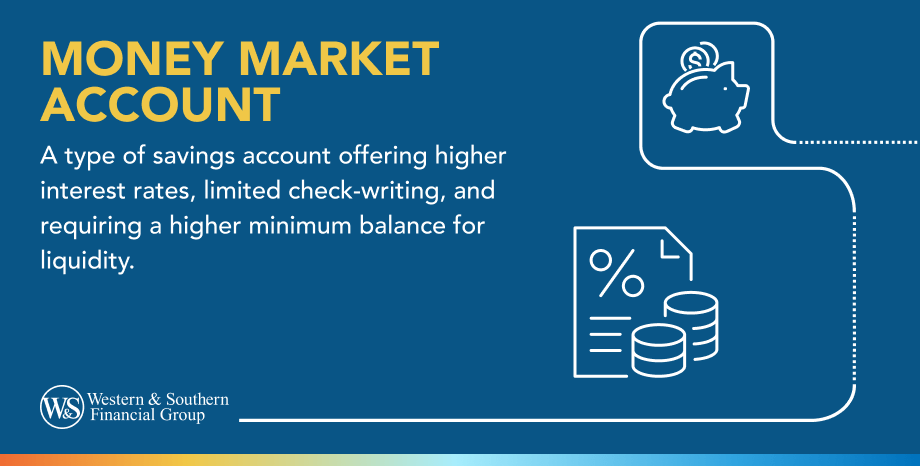
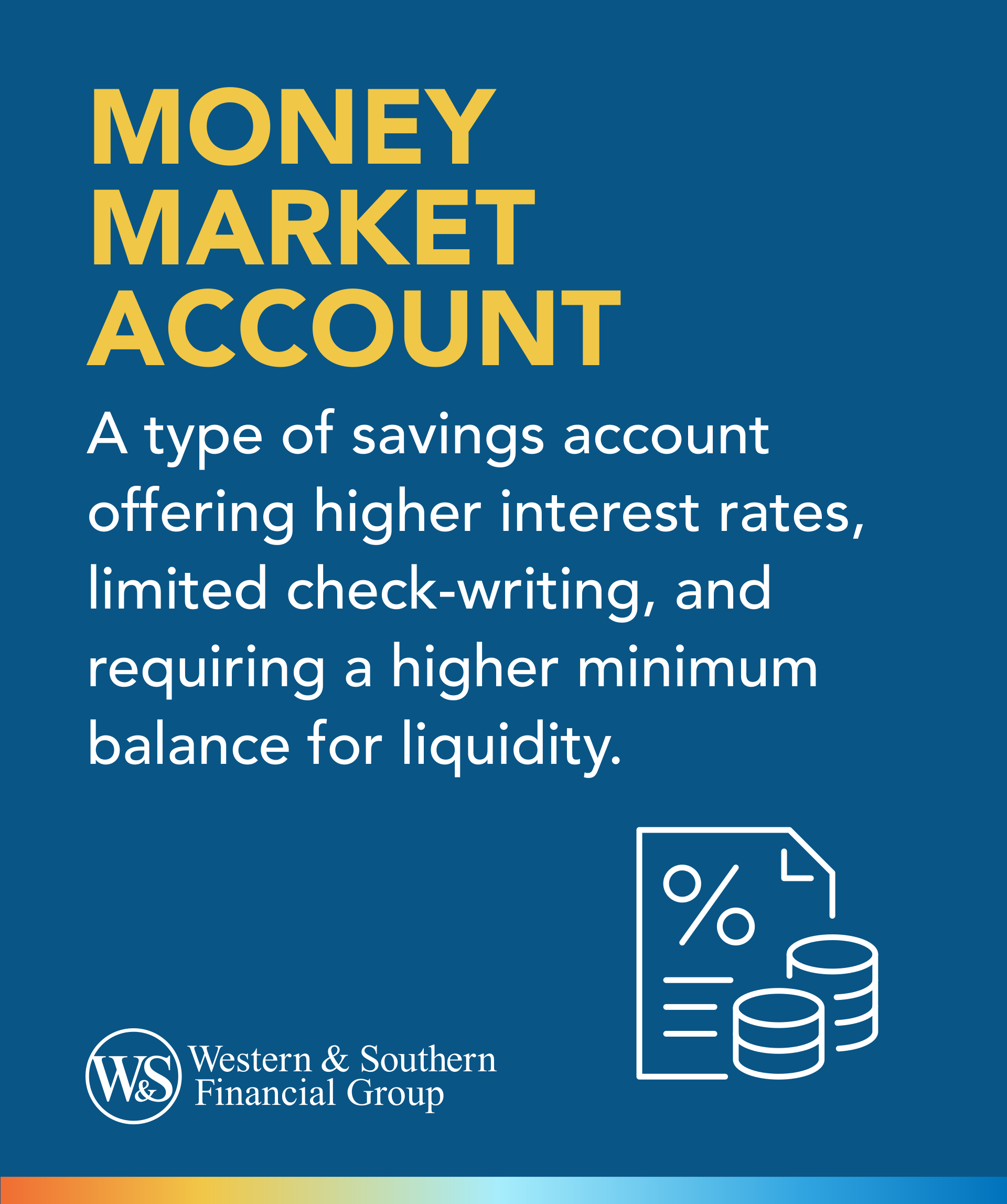
A money market account allows you to earn interest on your savings while maintaining access to your money. Offered by banks and credit unions, these accounts blend features of both savings and checking accounts. Understanding how they work can help you decide whether they fit your savings goals, emergency fund strategy, or short-term financial needs.
What Is a Money Market Account?
A money market account (MMA) is a deposit account offered by banks and credit unions that allows account holders to earn interest while maintaining access to their funds.1 Unlike many traditional savings accounts, money market accounts often include check-writing privileges, debit card access, and electronic transfers.
These accounts are federally insured by the Federal Deposit Insurance Corporation (FDIC) at banks and the National Credit Union Administration (NCUA) at credit unions up to applicable limits.2,3 This protection makes them popular among conservative savers who prioritize preserving principal while earning a return.
Many consumers use money market accounts for emergency savings, home down payment funds, and large planned purchases. Because the funds remain relatively liquid, account holders can access money when needed without locking it away for a specific term.
How Does a Money Market Account Work?
When you deposit money into a money market account, the financial institution uses those deposits within its broader lending and investment activities. In return, the institution pays interest to account holders.4
The amount earned is often expressed as Annual Percentage Yield (APY). APY reflects the total amount earned over a year, including compounding. Higher APYs generally result in faster account growth.
Here are steps on how it works:
- Open a money market account and provide the required information, such as your Social Security number.
- Make an initial deposit and fund the account.
- Interest begins accruing based on the account's APY.
- Interest is added to your balance according to the account's compounding schedule.
- Continue growing your savings while maintaining access to your funds through available banking features.
For example, a $20,000 deposit can earn interest while remaining accessible for unexpected expenses.
Accessing Your Money
Depending on the financial institution, you may be able to access your money through:
- Online transfers
- Mobile banking apps
- Check-writing privileges
- Debit card purchases
- ATM withdrawals
- Online Bill Pay services
This flexibility makes money market accounts a practical option for emergency funds, short-term savings goals, and other situations where you may need access to your cash.
Who Should Consider a Money Market Account?
A money market account may be a good fit for people who want to earn interest while keeping their savings accessible.
Emergency Fund and Short-Term Goal Savers
Money market accounts can be a good choice for building an emergency fund or saving for short-term goals. They provide a place to keep money accessible for unexpected expenses, such as medical bills, home repairs, or job loss, while earning interest. They can also work well for goals like a vacation, vehicle purchase, wedding, or major home project within the next few years.
Homebuyers Saving for a Down Payment
If you're saving for a future home purchase, a money market account may provide a place to keep your down payment funds while earning interest. Since homebuyers often need access to their savings on a specific timeline, many prefer the liquidity and stability of a money market account over investments that may fluctuate in value.
Conservative Savers
Some individuals prioritize preserving their savings over pursuing higher returns. Because money market accounts are generally protected by FDIC insurance or NCUA insurance up to applicable limits, they can appeal to savers who want a lower-risk option for holding cash while still earning interest.
Individuals Seeking Flexibility
Money market accounts may also appeal to those who want more flexibility than a traditional savings account can offer. Features such as debit card access, check-writing privileges, online banking, and mobile banking can make it easier to manage savings while maintaining convenient access to funds.
A money market account may be worth considering if accessibility and interest earnings are both priorities.
Pros & Cons of Money Market Accounts
Money market accounts have both benefits and drawbacks. Reviewing both can help you decide whether an MMA fits your savings needs.
| Pros | Cons |
|---|---|
| Higher Interest Rates: Often earn more interest than traditional savings accounts. | Higher Minimum Balance Requirements: May require larger balances to open or maintain the account. |
| FDIC or NCUA Insurance: Deposits are typically protected up to federal limits. | Potential Monthly Fees: Fees may apply if your balance falls below requirements. |
| Easy Access to Funds: May include debit cards, checks, ATM access, and transfers. | Variable Interest Rates: APYs can rise or fall over time. |
| Suitable for Emergency Funds: Keeps savings accessible for unexpected expenses. | Lower Returns Than Long-Term Investments: Growth potential is usually lower than stocks. |
| Liquidity: Access funds without locking them into a fixed term. | Rate Tiers May Favor Larger Balances: Best rates often require higher balances. |
| Low-Risk Savings Option: Designed to preserve principal while earning interest. | Transaction Restrictions May Apply: Some withdrawals or transfers may be limited. |
Money market accounts can be a good fit for savers who want to earn interest while keeping funds accessible. Before opening one, compare APYs, fees, minimum balance requirements, and account features to see if it meets your savings needs.
Common Risks of Money Market Accounts
While money market accounts are generally considered a lower-risk savings option, there are a few potential drawbacks to keep in mind before opening an account.
Interest Rate Fluctuations
Money market accounts typically have variable interest rates, meaning the APY can rise or fall as market conditions change. If rates decline, your account may earn less interest over time.
Fees for Low Balances
Many money market accounts require a minimum balance to avoid monthly maintenance fees or qualify for the highest APY. Falling below the required balance could reduce your overall earnings.
Limited Withdrawals
Although the federal six-withdrawal limit was removed in 2020, some financial institutions still impose their own restrictions on certain transactions. Be sure to review your account terms to understand any withdrawal limits or fees.
Inflation Risk
A money market account may not always keep pace with inflation. If inflation rises faster than your account's interest rate, the purchasing power of your savings can decrease over time.
Opportunity Cost
Money market accounts offer stability and liquidity, but they generally provide lower returns than long-term investments such as stocks or mutual funds. Keeping too much money in an MMA for long periods may mean missing opportunities for greater growth.
Understanding these risks can help you determine whether a money market account is the right fit for your savings goals and how it compares with other savings and investment options.
Money Market Account vs. Other Savings and Investment Options
A money market account can help you earn interest on cash, but it’s important to compare it with other investment options, such as savings accounts, CDs, and money market funds, to find the best fit for your goals.
Money Market Account vs. Savings Account
Both money market accounts and savings accounts are deposit accounts offered by banks and credit unions. They earn interest and are generally protected by FDIC insurance or NCUA insurance up to applicable limits. However, money market accounts often provide additional account features and may offer higher yields.
| Feature | Money Market Account | Savings Account |
|---|---|---|
| APY | Often higher | Often lower |
| Check-Writing | Often available | Rare |
| Debit Card Access | Often available | Rare |
| ATM Access | Common | Varies by institution |
| Minimum Balance | Often higher | Often lower |
| Monthly Fees | May apply if balance requirements aren't met | Typically lower or easier to avoid |
A money market account may be a better fit if you want convenient access to your savings through checks, debit cards, or ATM withdrawals. A traditional savings account may work well for individuals focused primarily on saving and maintaining lower account balances.
Money Market Account vs. Certificate of Deposit (CD)
A certificate of deposit (CD) is another savings product offered by banks and credit unions. Unlike a money market account, a CD requires you to keep your money deposited for a specific term, such as six months, one year, or five years.
| Feature | Money Market Account | Certificate of Deposit (CD) |
|---|---|---|
| Access to Funds | Readily accessible | Restricted until maturity |
| Interest Rate | Variable | Usually fixed |
| Liquidity | High | Low |
| Early Withdrawal Penalty | Typically none | Usually applies |
| Suitable For | Emergency funds and short-term savings | Funds not needed for a set period |
A money market account may be preferable if you need flexibility and access to your funds. A CD may appeal to savers willing to lock up their money in exchange for a predictable rate of return.
Money Market Account vs. Money Market Fund
Despite their similar names, a money market account and a money market fund are very different products. A money market account is a deposit account offered by a bank or credit union, while a money market fund is an investment product typically offered through a brokerage account.
| Feature | Money Market Account | Money Market Fund |
|---|---|---|
| Type of Product | Deposit Account | Investment Product |
| Provider | Banks and Credit Unions | Brokerages and Investment Firms |
| Federal Insurance | FDIC or NCUA insured (within limits) | Not FDIC insured |
| Risk Level | Lower risk | Investment risk exists |
| Returns | Interest earnings | Investment income |
| Primary Purpose | Saving and liquidity | Cash management and investing |
How to Choose a Money Market Account
Compare money market accounts based on rates, fees, and features to find the right fit. When evaluating a money market account, consider the following factors:
- Annual Percentage Yield (APY): Compare APYs across financial institutions to maximize interest earnings.
- Minimum Deposit Requirements: Some accounts require an initial deposit to open the account. Make sure the minimum deposit fits your budget and savings strategy.
- Minimum Balance Requirements: Review balance requirements to avoid fees or qualify for the highest APY.
- Fees: Check the account's fee schedule for maintenance fees, transaction fees, overdraft fees, and other charges that could reduce your earnings.
- Rate Tiers: Some accounts offer higher APYs for larger balances. If you plan to maintain a substantial balance, compare rate tiers to maximize potential earnings.
- ATM and Debit Card Access: If convenient access to your money is important, look for accounts that offer ATM withdrawals and debit card privileges.
- Online and Mobile Banking: Look for online and mobile banking tools that make it easy to manage your account and transfer funds.
- Transfer and Payment Options: Consider features such as online transfers, direct deposit, wire transfers, and online bill pay.
- FDIC or NCUA Insurance: Verify that the account is protected by FDIC insurance or NCUA insurance up to applicable federal limits.
- Customer Service and Account Access: Check whether the institution offers convenient support through branches, a call center, or digital channels.
Taking time to compare rates, fees, account features, and accessibility can help you find a money market account that meets your needs. The right account should support your savings goals while providing the level of access and flexibility you want.
Conclusion
A money market account offers a combination of interest earnings and easy access to cash. Whether you're building an emergency fund, saving for a down payment, or setting aside money for a short-term goal, comparing available options can help you find the right account for your needs.
Sources
- What is a Money Market Account? - Raisin. https://www.raisin.com/en-us/banking/what-is-a-money-market-account/
- Deposit Insurance - FDIC.gov. https://www.fdic.gov/resources/deposit-insurance
- Share Insurance Coverage - NCUA.gov. https://ncua.gov/consumers/share-insurance-coverage
- What is a Money Market Account and How Does it Work. https://www.synchrony.com/blog/bank/how-does-a-money-market-account-work