What Is a Stock Split?
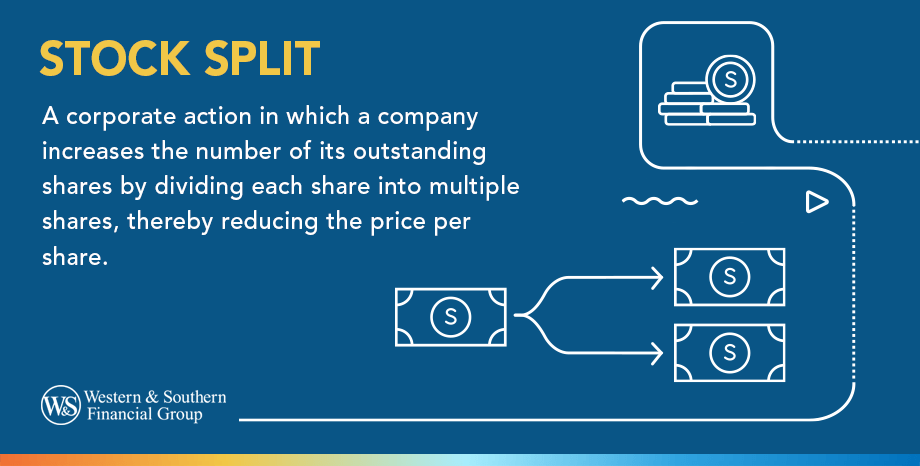
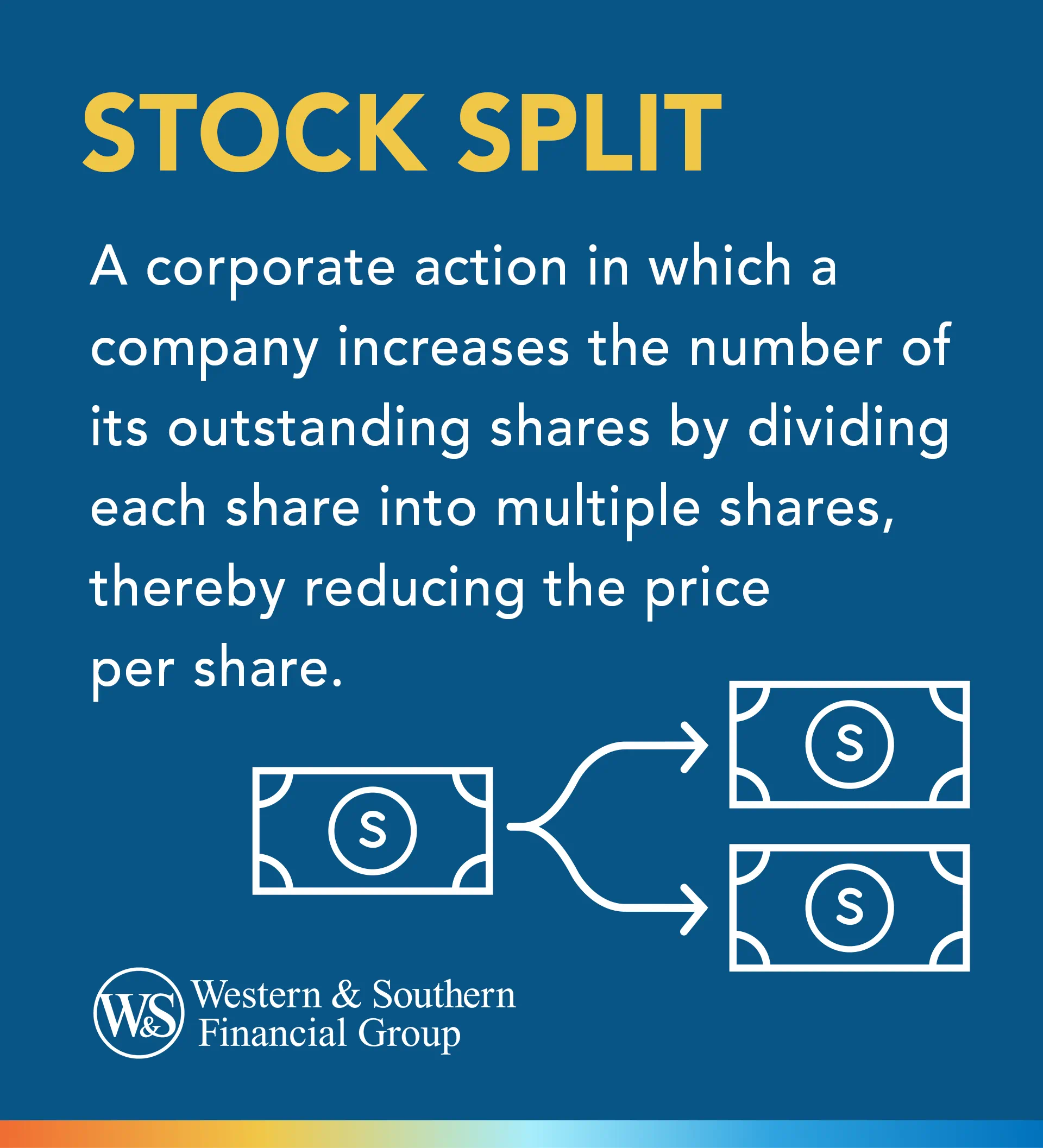
A stock split occurs when a company increases its number of outstanding shares while proportionally lowering the share price. The goal is often to make shares more accessible to investors without changing the company's overall value.1
Think of it like exchanging one large bill for several smaller bills. The number of pieces changes, but the total value stays the same. Likewise, a stock split changes the number of shares an investor owns without affecting the total value of their investment.
Companies typically announce stock splits through SEC filings, annual reports, Form 10-K and Form 10-Q reports, and investor relations updates. Depending on the company's governing documents and corporate structure, regulatory or shareholder approval may be required before the split takes effect.
How Does a Stock Split Work?
When a company announces a stock split, shareholders automatically receive additional shares based on the split ratio.1 Brokerage firms update investor accounts automatically, so no action is required.
It doesn't change the underlying value of the company, including market capitalization, ownership percentage, voting rights, earnings power and company assets and liabilities. Only the number of shares outstanding and the share price change. The investor's ownership percentage and total investment value remain the same as well.
Companies often adjust employee equity programs after a stock split, including:
- Stock options
- Equity incentive plans
- Restricted stock units (RSUs)2
- Employee Stock Purchase Plans (ESPPs)3
These adjustments help employees maintain the same economic interest in the company after the split.
What Are Common Stock Split Ratios?
Stock splits can occur in several different ratios. The ratio determines how many new shares investors receive for each share they already own.
The most common ratios include 2-for-1, 3-for-1, and 4-for-1 stock splits.1 While the mechanics vary slightly, the outcome remains the same: more shares at a lower price while preserving the company's market capitalization.
| Split Ratio | Description | Before Split | After Split |
|---|---|---|---|
| 2-for-1 | Investors receive one additional share | 100 shares @ $100 | 200 shares @ $50 |
| 3-for-1 | Triples the number of shares while reducing the share price by two-thirds | 100 shares @ $90 | 300 shares @ $30 |
| 4-for-1 | Quadruples the share count while lowering the share price to one-quarter of its pre-split level | 100 shares @ $80 | 400 shares @ $20 |
Historically, companies often choose ratios based on the trading range management wants to achieve. For example, a company trading at $1,200 per share might choose a 10-for-1 split to bring the post-split price closer to $120.
The selected ratio does not indicate whether management is more or less optimistic about future performance. Instead, it primarily reflects how the company wants its shares to trade in the marketplace.
What Happens to Investors During a Stock Split?
For most investors, a stock split requires little or no action.1 Brokerage firms automatically update account balances to reflect the new share count.
After a stock split:
- The number of shares owned increases.
- The share price decreases proportionally.
- The total value of the investment remains the same immediately after the split.
For example, an investor with 250 shares before a 2-for-1 split would own 500 shares afterward, while the share price would be cut roughly in half.
Other Considerations
A few additional adjustments may occur:
- Fractional shares: Investors may receive cash instead of fractional shares, depending on the split ratio and brokerage policies.
- Employee stock plans: Stock options and equity compensation plans are typically adjusted to maintain their value.
- Taxes: It is generally not taxable because they do not provide additional economic value to shareholders.
Real-World Examples
Several well-known companies have completed stock splits in recent years.
- Apple completed a 4-for-1 stock split in August 2020. Investors received four shares for every share they owned. The split lowered the share price while keeping the company's market capitalization unchanged.4
- Tesla completed a 5-for-1 stock split in 2020 and a 3-for-1 stock split in 2022. Both splits increased the number of outstanding shares and reduced the share price proportionally.5
- Amazon completed a 20-for-1 stock split in 2022. Before the split, its stock traded above $2,000 per share. Afterward, the share price was significantly lower.6
- Nvidia announced a 10-for-1 stock split in 2024 following substantial growth in its share price. The split increased the number of shares available to investors while leaving the company's market capitalization unchanged.7
Why Do Companies Split Their Stock?
Companies typically split their stock after a period of strong share-price growth. As the stock price rises, management may decide that a lower trading price could benefit investors and increase market participation.
Common reasons companies split their stock include:
- Lowering the share price: While many brokerages offer fractional-share investing, some investors still prefer buying whole shares. A stock priced at $1,000 per share may seem less attainable than one priced at $100 per share, even though fractional investing has reduced this barrier.
- Making shares more accessible: Lower-priced shares may attract a broader group of investors, particularly retail investors with limited capital available for individual stock purchases.
- Improving liquidity: Liquidity refers to how easily shares can be bought and sold. Lower share prices often lead to increased trading activity because more investors can participate in the market.
For example, a stock trading at $1,200 per share may attract fewer buyers than the same stock trading at $120 per share after a 10-for-1 split, potentially increasing trading volume and reducing bid-ask spreads.
- Signaling confidence: Companies often split their shares after a period of sustained growth. As a result, investors may view a stock split as a sign that management is confident in the company's long-term outlook.
However, a stock split does not directly cause potential future gains. Strong business performance is typically what drives both share-price growth and the decision to split the stock.
Benefits & Drawbacks of Stock Splits
| Potential Benefits | Potential Drawbacks |
|---|---|
| Lower Share Price: Can make stock ownership appear more accessible to retail investors. | No Change in Fundamental Value: Doesn't increase earnings, revenue, cash flow, or profitability. |
| Increased Liquidity: More investors may participate in trading, potentially increasing transaction volume. | Potential for Increased Volatility: A larger pool of investors may lead to increased trading activity and short-term price swings. |
| Positive Market Perception: Many investors associate it with successful companies that have experienced substantial growth. | Investor Misinterpretation: Some investors incorrectly assume a split automatically makes a stock a better investment. |
| Broader Investor Participation: Lower prices may encourage additional interest from individual investors and Employee Stock Purchase Plan participants. | Psychological Effects: The lower share price can create the illusion that shares are cheaper, even though the company's valuation remains unchanged. |
What Is a Reverse Stock Split?
A reverse stock split decreases the number of outstanding shares while increasing the stock price proportionally.1 Instead of receiving additional shares, investors receive fewer shares that are worth more on a per-share basis.
For example, consider a company whose stock trades at $2 per share. An investor owns 1,000 shares worth $2,000 total.
If the company completes a 1-for-10 Reverse Stock Split:
- The investor's share count decreases from 1,000 to 100.
- The share price increases from $2 to approximately $20.
- The total investment value remains approximately $2,000.
Why Companies Use Reverse Stock Splits
Companies often use reverse stock splits to meet stock exchange listing requirements. Major exchanges, including the Nasdaq and NYSE, require stocks to maintain a minimum share price. If a stock remains below that threshold for an extended period, the company could face delisting.
Reverse splits can also improve the stock's image among institutional investors. Some investment funds have policies preventing investment in low-priced securities, often called penny stocks.
Reverse Stock Split vs. Traditional Stock Split
Unlike a traditional stock split, which is often associated with company growth and strong performance, a reverse stock split is frequently viewed as a response to business or financial challenges. Some companies may use reverse stock splits simply to remain compliant with exchange listing rules.
Is a Stock Split Good or Bad?
A stock split is neither good nor bad on its own. Its significance depends on the company's performance and the reasons for the split.
Some investors view stock splits positively because they often follow periods of strong growth. Companies may split shares to lower the stock price and make shares more accessible to investors. However, a stock split doesn't increase earnings, revenue, profitability, or competitive strength.
Instead, investors may want to review annual reports, form 10-K filings, form 10-Q filings or SEC filings. A stock split is one factor to consider and should not be viewed as a standalone investment signal.
The Bottom Line
Stock splits increase shares and lower the stock price proportionally without changing a company's value or an investor's ownership percentage. Reverse stock splits do the opposite, reducing shares and raising the stock price. While understanding stock splits is useful, investors should focus on a company's fundamentals and long-term performance.
Sources
- Stock Splits - FINRA. https://www.finra.org/investors/investing/investment-products/stocks/stock-splits
- Understanding Restricted Stock Units (RSUs): A Comprehensive Guide. https://oakworth.com/oakworth-asset-management/understanding-restricted-stock-units-rsus-a-comprehensive-guide/
- Employee stock purchase plan – ESPP. https://www.jpmorganworkplacesolutions.com/insights/employee-stock-purchase-plan-espp/
- FAQ - Apple. https://investor.apple.com/faq/default.aspx
- Tesla stock split: what it means for traders. https://capital.com/en-int/analysis/tesla-stock-split
- Amazon.com, Inc. - FAQs. https://ir.aboutamazon.com/faqs/default.aspx
- NVIDIA 10-for-1 Stock Split: What Does It Mean for Investors?(0610-0614). https://www.moomoo.com/sg/learn/detail-nvidia-10-for-1-stock-split-what-does-it-mean-for-investors-117028-240677058