What Is Asset Allocation?
Asset allocation is the process of dividing retirement savings and other investment assets among different asset classes, such as stocks, bonds, and cash equivalents.1 An asset class is a group of investments that shares similar characteristics and may respond differently to changing market conditions.
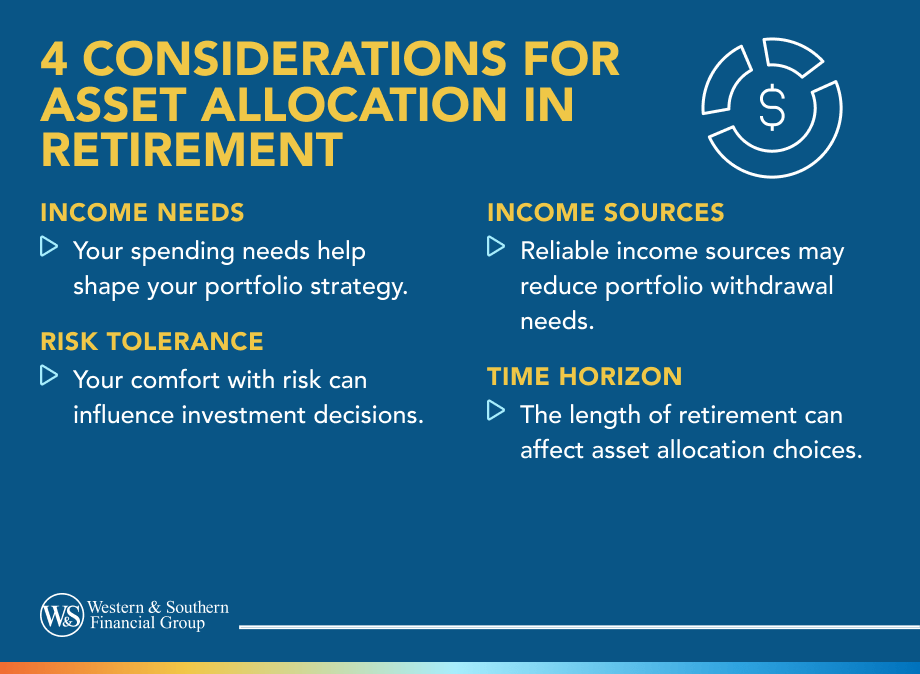
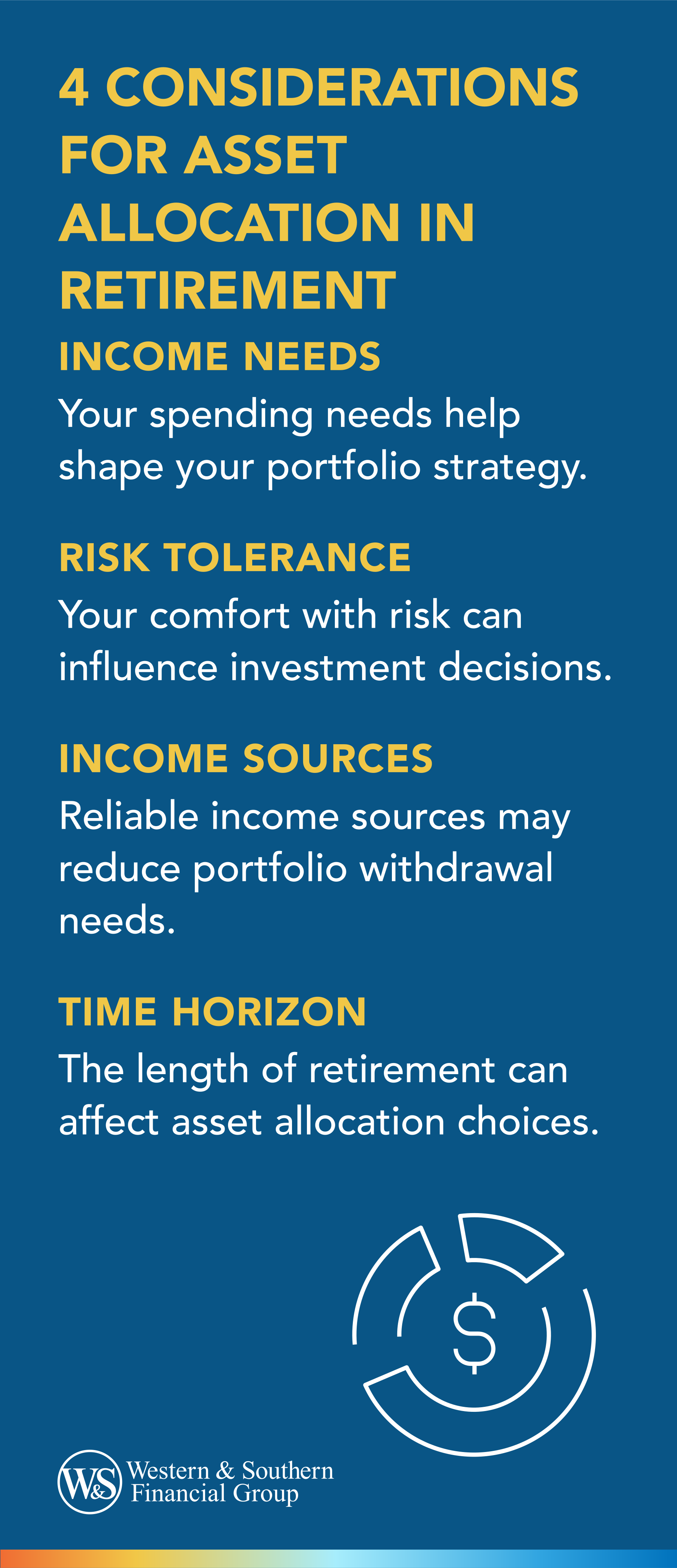
In retirement, asset allocation often shifts from a primary focus on accumulating wealth to a broader objective that includes generating income, maintaining liquidity, managing risk, and supporting long-term growth. Retirement asset allocation decisions typically involve determining an appropriate mix of stocks, bonds, and cash reserves within an investment portfolio, based on factors such as income needs, risk tolerance, and time horizon.
Common Asset Classes in a Retirement Portfolio
While portfolio allocations vary, most retirement portfolios include a mix of the following asset classes:
| Asset Class | Common Role in Retirement |
|---|---|
| Domestic Stocks | Long-term growth and inflation protection |
| International Stocks | Diversification and global market exposure |
| Government and Corporate Bonds | Income generation and reduced volatility |
| Treasury Securities | Stability and capital preservation |
| Cash Reserves | Liquidity for near-term expenses |
| Money Market Funds | Access to short-term funds |
| Real Estate Investments | Income potential and diversification |
The goal is to build a diversified portfolio in which different asset classes work together to support retirement income needs while helping manage market fluctuations.2
Why Is Asset Allocation Important in Retirement?
Asset allocation becomes increasingly important in retirement because a portfolio often needs to balance income needs, market volatility, and long-term growth throughout retirement.
Manage Risk and Market Volatility
Retirees often continue taking withdrawals regardless of market conditions. An appropriate asset allocation can help manage overall portfolio risk and reduce the impact of market fluctuations, particularly during periods of volatility.
Support Retirement Income Needs
For many retirees, investment assets supplement income from sources such as Social Security benefits, pensions, and annuities. Asset allocation plays an important role in determining how retirement savings may support spending needs throughout retirement.
Maintain Long-Term Purchasing Power
Even after retirement begins, investment growth may remain important. Inflation can gradually reduce purchasing power over time, making it important for many retirees to maintain some exposure to assets that have the potential to support long-term growth.
Provide Flexibility as Circumstances Change
Retirement needs often evolve over time. Changes in spending, health expenses, income sources, or financial goals may require portfolio adjustments. A well-structured asset allocation can provide flexibility as circumstances change throughout retirement.
Key Factors That Influence Asset Allocation in Retirement
No single asset allocation strategy works for everyone. A retirement portfolio should reflect an individual's risk tolerance, retirement savings, income needs, and overall financial situation.
Risk Tolerance
Risk tolerance reflects both an investor's willingness and ability to handle market volatility.1 Asset allocation should align with both emotional comfort and financial capacity.
Investors with higher risk tolerance may choose larger stock allocations, while more conservative investors may favor additional fixed-income investments and cash reserves.
Retirement Income Needs and Cash Flows
Retirement income needs often influence allocation decisions. Factors may include:
- Living expenses
- Healthcare needs
- Housing costs
- Lifestyle goals
- Legacy plans
These factors help shape how much liquidity, income generation, and growth potential a portfolio may need.
Social Security and Other Income Sources
Social Security benefits can significantly influence portfolio construction.
Retirees with higher guaranteed income may have greater flexibility to maintain higher stock allocations because they rely less on portfolio withdrawals to fund everyday expenses. Retirees who depend more heavily on portfolio withdrawals may need a different mix of income-producing, liquid, and growth-oriented assets.
Time Horizon and Overall Financial Situation
Retirement planning may span decades, making it important to balance current income needs with long-term growth. Factors such as total retirement assets, health status, withdrawal rates, tax considerations, and wealth management goals can also influence how an investment portfolio is allocated.
Together, these factors help determine whether a more conservative, balanced, or growth-oriented approach may be appropriate.
How Different Asset Classes Work Together in Retirement
A retirement investment portfolio typically includes multiple asset classes that serve different purposes. Combining growth, income, and liquidity assets can help retirees balance spending needs, manage risk, and support long-term financial goals.
Growth Assets
Stocks and domestic equity investments are often the primary drivers of long-term growth, making stock allocations an important component of many retirement portfolios. While these assets can experience volatility, they may help preserve purchasing power throughout retirement.
Income Assets
Bonds, treasury securities, and bond ladder strategies are commonly used to generate income and help reduce portfolio volatility. Fixed-income investments may also provide more predictable cash flows than stocks, although their performance can be influenced by changing interest rates.
Liquidity Assets
Cash reserves and money market funds provide liquidity for near-term expenses and unexpected spending needs. Although these assets generally offer lower return potential, they can reduce the need to sell long-term investments during unfavorable market conditions.
Common Approaches to Retirement Asset Allocation
After identifying income needs, risk tolerance, and time horizon, retirees can compare several broad allocation approaches. These approaches are general frameworks, not fixed formulas.
| Approach | Typical Allocation Focus | Primary Objective |
|---|---|---|
| Conservative | Higher bond and cash exposure | Stability and income |
| Balanced | Mix of stocks and fixed income | Income and growth |
| Growth-Oriented | Higher stock exposure | Long-term growth |
| Bucket Strategy | Assets grouped by spending timeline | Cash flow management |
No single approach is appropriate for every retiree. The right allocation depends on individual goals, available income sources, withdrawal needs, and overall financial circumstances.
Conservative Allocation
A conservative allocation places greater emphasis on bonds, cash reserves, and other lower-volatility investments. This approach is often used by retirees who prioritize portfolio stability and income generation, though a reduced allocation to equities may limit long-term growth potential.
Balanced Allocation
A balanced allocation combines equities and fixed-income investments to pursue both growth and stability. By maintaining exposure to multiple asset classes, this approach may appeal to retirees seeking current income while preserving opportunities for long-term portfolio growth.
Growth-Oriented Allocation
Growth-oriented portfolios maintain higher stock allocations to support long-term appreciation and purchasing power throughout retirement. They may appeal to retirees with longer time horizons, substantial assets, or significant guaranteed income sources, though they typically involve greater market volatility.
Bucket Strategy
The bucket strategy is not a separate asset allocation approach. Instead, it is a way of organizing a portfolio's asset allocation according to when the funds are expected to be used. A typical framework may include:
- Short-term bucket: Cash and money market funds
- Intermediate bucket: Bonds and fixed-income investments
- Long-term bucket: Equities and growth-oriented assets
By separating assets according to spending time horizons, the bucket approach can help retirees address near-term cash flow needs while keeping a portion of their portfolio invested for long-term growth.
How Asset Allocation May Change Throughout Retirement
Asset allocation is not a one-time decision. As retirement progresses, spending needs, income sources, and investment goals may change, leading to adjustments in a retirement portfolio.
Before Retirement
Before retirement, many investors prioritize long-term growth and often maintain higher allocations to stocks. With retirement still years away, portfolios may be positioned to pursue growth while managing market risk.
Early Retirement
As retirement begins, income generation and liquidity often become more important. Many retirees increase fixed-income exposure and maintain cash reserves to help support withdrawals and manage sequence-of-returns risk.
Mid-Retirement
During mid-retirement, investors often focus on balancing current income needs with preserving purchasing power. Asset allocation may be adjusted as spending patterns, market conditions, or income sources evolve. Maintaining exposure to multiple asset classes can help support both income and growth objectives.
Later Retirement
Later in retirement, stability and liquidity may become greater priorities, particularly as healthcare and other expenses change. Some retirees shift toward a more conservative allocation while maintaining exposure to growth assets for long-term needs. The appropriate mix depends on individual circumstances, income sources, and financial goals.
Asset allocation changes should reflect evolving finances, not a set schedule. Regular reviews keep investments aligned with income needs, risk tolerance, and retirement goals.
Managing and Rebalancing Your Retirement Portfolio
Market performance can gradually shift a portfolio away from its intended allocation.3 For example, a prolonged stock market rally may increase equity exposure beyond target levels, changing the portfolio’s overall risk profile.
Steps in the Rebalancing Process
- Review Your Current Asset Allocation: Review how your retirement portfolio is allocated among stocks, bonds, cash, and other investments. This helps determine whether it remains aligned with your goals.
- Compare Current and Target Allocations: Compare your current allocation with your target mix. Differences between the two may indicate that portfolio adjustments are needed.
- Identify Allocation Drift: Market performance can cause certain asset classes to grow faster than others over time. As a result, your portfolio may gradually move away from its intended allocation.
- Rebalance When Appropriate: If allocation drift becomes significant, adjustments may be made to restore the desired balance. Rebalancing can help maintain your intended level of risk and diversification.
- Evaluate Tax Considerations: Before making portfolio changes, consider the potential tax implications of transactions. Reviewing tax consequences can help support retirement and wealth management objectives.
When to Review Your Asset Allocation
In addition to periodic reviews, asset allocation may warrant a closer look when:
- Market conditions change significantly: Inflation, interest rates, and market volatility can affect how different asset classes perform and may alter your portfolio's risk profile.
- Retirement spending needs shift: Changes in expenses, withdrawals, healthcare costs, or withdrawal needs may affect portfolio needs and distribution strategies.
- A major life event occurs: Retirement, marriage, divorce, receiving an inheritance, or the death of a spouse can affect financial priorities, risk tolerance, and time horizons.
- Health circumstances change: New or ongoing health concerns may increase expenses or influence long-term income and estate considerations.
- Long-term goals evolve: Changes in lifestyle plans, charitable intentions, legacy objectives, or other goals may warrant adjustments to an investment strategy.
Reviewing account statements, performance updates, and information included in an annual comprehensive financial report can help determine whether a portfolio remains aligned with retirement goals and evolving circumstances.
Common Asset Allocation Mistakes Retirees Should Avoid
Even with a thoughtful strategy, certain decisions can make a retirement portfolio less aligned with a retiree’s needs.
Becoming Too Conservative Too Soon
Many retirees reduce stock allocations significantly after retirement, sometimes more than necessary based on their income needs, time horizon, and overall financial situation. While this may reduce volatility, it can also limit long-term growth potential and increase inflation risk over time.
Taking More Risk Than Your Situation Supports
Asset allocation should align with an investor's risk tolerance, income needs, and overall financial situation. Higher return potential often comes with greater exposure to market volatility.
Overlooking Diversification
A diversified portfolio involves more than simply owning multiple investments. Reviewing holdings, mutual fund composition, and fund managers can help identify unintended concentration risks across sectors, regions, or asset classes within an investment portfolio.
Failing to Rebalance Periodically
Market performance can cause a portfolio's allocation to drift from its intended targets over time. Periodic reviews can help ensure the portfolio remains aligned with long-term objectives.
Making Changes Based on Short-Term Market Movements
Reacting to market fluctuations may lead to decisions that are inconsistent with a long-term investment strategy. Asset allocation decisions are generally most effective when guided by objectives rather than short-term performance.
Conclusion
Asset allocation can help retirees balance income, liquidity, risk, and long-term growth. Diversifying across asset classes and reviewing allocations regularly can help keep investments aligned with changing goals, market conditions, and spending needs. Regular reviews of retirement savings, portfolio performance, and annual financial reports can help determine whether portfolio adjustments may be needed as circumstances change.
Sources
- Asset Allocation and Diversification. https://www.investor.gov/introduction-investing/getting-started/asset-allocation
- Diversifying Risk. https://www.sec.gov/resources-small-businesses/capital-raising-building-blocks/diversifying-risk
- Managing Your Retirement Portfolio. https://www.finra.org/investors/learn-to-invest/types-investments/retirement/managing-retirement-income/managing-your-retirement-portfolio