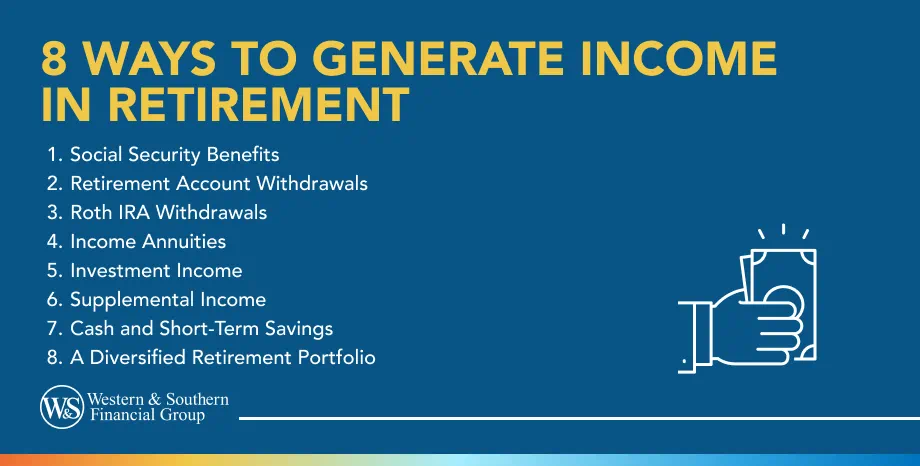
Retirement income planning requires a different mindset than saving for retirement. While the focus during your working years is often on accumulating assets, retirement shifts the focus to creating reliable cash flow. Here's what to know before you decide.
Why Is Generating Income in Retirement Important?
Retirement requires replacing a steady paycheck with income from other sources. Many retirees rely on a combination of Social Security benefits, retirement account withdrawals, investment income, and supplemental income streams rather than a single source of income.
Diversifying retirement income may help create more consistent cash flow and reduce dependence on any one strategy during periods of market fluctuations.
| Income Category | Purpose | Examples |
|---|---|---|
| Guaranteed Income | Help cover essential expenses | Social Security, pensions, income annuities |
| Portfolio Income | Support ongoing spending needs | Retirement accounts, dividends, bonds |
| Supplemental Income | Add flexibility and additional cash flow | Rental income, consulting, part-time work |
The following income sources and strategies can play different roles in supporting retirement cash flow.
1. Social Security Benefits
For many retirees, Social Security serves as the foundation of retirement income. Benefits provide lifetime income and are generally not tied directly to market performance.
Understanding Full Retirement Age
Your monthly benefit depends largely on your earnings history and when you claim benefits. Full retirement age generally falls between ages 66 and 67, depending on your birth year.
Claiming before full retirement age reduces monthly payments, while delaying benefits can increase monthly income through age 70.1
When to Claim Benefits
Because claiming age can affect lifetime income, retirees may want to evaluate several personal factors before deciding when to begin benefits. This may include:
- Current income needs
- Health and life expectancy
- Marital status
- Other retirement assets
- Tax considerations
Someone with substantial retirement savings may choose to delay benefits to maximize guaranteed income. Another retiree may claim earlier to meet immediate cash flow needs.
2. Withdrawals From Retirement Accounts
Traditional IRAs and 401(k) plans are often among the largest retirement assets many households own. As a result, they frequently become a primary source of retirement income.
Managing Withdrawal Rates
Retirement account withdrawals are often based on a retiree's spending needs, portfolio value, and other income sources. Some retirement income discussions reference the 4% rule, which suggests withdrawing approximately 4% of a retirement portfolio during the first year of retirement and adjusting future withdrawals for inflation.
However, withdrawal strategies can vary significantly depending on individual circumstances.
Understanding Sequence of Returns Risk
Market declines early in retirement can have a lasting impact on portfolio sustainability.
When withdrawals occur during a downturn, fewer assets remain invested to participate in future recoveries. This is known as sequence of returns risk and is one reason many retirees maintain diversified investment portfolios.
Required Minimum Distributions
Beginning at age 73, many traditional retirement accounts become subject to required minimum distributions (RMDs).2 These mandatory withdrawals can increase taxable income and should be coordinated with other retirement income sources.
Someone who does not need the additional income may still be required to take RMDs from a traditional IRA or employer-sponsored retirement plan. Because these distributions can affect taxes and other retirement planning decisions, they are often considered as part of an overall income strategy.
3. Roth IRA Withdrawals
Roth IRAs can provide valuable tax flexibility in retirement because qualified withdrawals are generally tax-free and typically do not increase taxable income.
Tax Flexibility in Retirement
Tax-free withdrawals can be useful when retirees want additional income without increasing taxable income. For example, a retiree who needs funds for a large purchase or unexpected expense may choose a Roth IRA withdrawal rather than increasing taxable income through additional traditional IRA distributions.
Because qualified Roth IRA withdrawals generally do not increase taxable income, they can complement other retirement income sources and provide additional flexibility when managing retirement cash flow.
Roth IRA vs. Traditional IRA
| Feature | Traditional IRA | Roth IRA |
|---|---|---|
| Contributions | Generally pre-tax | After-tax |
| Qualified Withdrawals | Taxable | Generally tax-free |
| Required Minimum Distributions | Yes | No during owner's lifetime |
| Tax Treatment in Retirement | May increase taxable income | Generally does not increase taxable income |
When used strategically, Roth assets can complement other retirement income sources and provide additional flexibility.
4. Income Annuities
Income annuities are designed to convert retirement assets into predictable payments. Purchased through an insurance company, they can provide income for a specific period or for life.3
How Income Annuities Work
A retiree contributes a lump sum to an insurance company. In exchange, the insurer agrees to make regular payments according to the terms of the contract.
Because some income annuities provide lifetime payments, they can help address concerns about outliving retirement assets.
Potential Benefits and Tradeoffs
Like any retirement income tool, income annuities involve both advantages and limitations.
| Potential Benefits | Potential Tradeoffs |
|---|---|
| Lifetime income | Reduced liquidity |
| Predictable cash flow | Purchasing power may be affected by inflation |
| Reduced longevity risk | Less flexibility |
| Simplified budgeting | Contract complexity |
Income annuities are not appropriate for every situation, but they may provide an additional source of dependable income.
5. Investment Income
Investments often continue playing an important role after retirement. Dividend-paying stocks and bonds can generate income while supporting long-term portfolio growth.
Dividend-Paying Stocks
Some companies distribute a portion of their profits to shareholders through dividends. These payments can provide ongoing income without requiring investors to sell shares.
Potential advantages include:
- Income potential
- Growth opportunities
- Potential to help offset inflation over time
A retiree may use dividend payments as part of their monthly income while continuing to hold shares for potential long-term growth. However, dividends are not guaranteed and may be reduced during challenging economic conditions.
Bonds and Fixed-Income Investments
Bonds generate income through interest payments and can help reduce overall portfolio volatility. However, bond values can fluctuate, particularly when interest rates change.
Examples include:
- Treasury securities
- Corporate bonds
- Municipal bonds
- Certificates of deposit
- Bond funds
Combining stocks and fixed-income investments can help balance growth potential with income generation.
6. Supplemental Income
Not all retirement income comes from investment portfolios. Many retirees supplement income through real estate, consulting, or part-time work.
Rental Income
Rental properties can provide recurring cash flow that is not directly tied to stock market performance.
Potential considerations include:
- Maintenance expenses
- Property taxes
- Vacancy periods
- Property management responsibilities
Property ownership may create an additional source of retirement income, but ongoing costs and management responsibilities should be considered when evaluating this strategy.
Part-Time Work or Consulting
Retirement does not necessarily mean leaving the workforce entirely. Retirees may choose part-time employment or consulting opportunities to generate additional income, remain socially engaged, or reduce portfolio withdrawals.
Even modest earnings may help reduce portfolio withdrawals, especially during periods of market volatility.
7. Cash and Short-Term Savings Strategies
While cash reserves may produce lower long-term returns than stocks or bonds, they can support near-term spending needs and reduce the need to sell investments during downturns.
Maintaining Liquidity
Retirees often keep a portion of their assets in:
- High-yield savings accounts
- Money market accounts
- Treasury bills
- Short-term certificates of deposit
These assets provide liquidity and can be used to cover near-term expenses.
Supporting Retirement Cash Flow
Maintaining a cash reserve can help retirees avoid selling long-term investments during market downturns. For example, some retirees keep a portion of anticipated near-term spending needs in cash, high-yield savings accounts, or other short-term vehicles to provide liquidity during periods of market volatility.
Although cash generally offers lower long-term returns than stocks or bonds, it can provide flexibility and stability within a broader retirement income strategy.
8. A Diversified Retirement Portfolio
Many retirees rely on multiple income streams rather than a single source of income. A diversified retirement portfolio may combine guaranteed income, portfolio income, and supplemental income sources to support retirement cash flow.
Combining Multiple Income Streams
A mix of income sources is typically used to support retirement cash flow, including:
- Guaranteed income: Social Security benefits, pensions, and income annuities that may provide predictable income.
- Portfolio income: Retirement account withdrawals, dividend-paying stocks, and bonds that can support ongoing spending needs.
- Supplemental income: Rental income, consulting work, or part-time employment that can provide additional flexibility.
The mix of income sources used in retirement varies based on individual goals, assets, and income needs.
Managing Longevity Risk and Sequence of Returns
Diversification cannot eliminate risk, but it may reduce dependence on any one income source.
When one asset class struggles, another may continue generating income. This flexibility can help retirees manage market volatility while supporting long-term cash flow needs.
How to Build a Retirement Income Strategy
Every retirement situation is different, but a few core considerations can help guide the process.
Assess Spending Needs
Estimate your anticipated retirement expenses and distinguish between essential costs and discretionary spending. Understanding how much income you may need can help inform retirement income decisions.
Review Income Sources
Consider how different income sources may work together to support retirement cash flow. Some retirees use more predictable income sources to cover essential expenses while relying on other assets for additional flexibility.
Evaluate Risk Tolerance
Your comfort level with market volatility can influence your investment strategy, withdrawal approach, and the overall mix of retirement income sources.
Consider Professional Guidance
A financial advisor and tax advisor can help evaluate Social Security claiming decisions, retirement account withdrawals, tax considerations, and other factors that may affect retirement income. Periodic reviews can help ensure an income strategy remains aligned with changing goals and circumstances.
Conclusion
Generating income in retirement often requires combining several sources rather than relying on one approach. Social Security, retirement accounts, Roth IRA assets, income annuities, investments, cash reserves, and supplemental income opportunities can each support different spending needs. A diversified and flexible retirement income approach can help retirees adapt as expenses, markets, and personal goals change over time.
Sources
- Delayed Retirement Credits. https://www.ssa.gov/benefits/retirement/planner/delayret.html
- Retirement topics - Required minimum distributions (RMDs). https://www.irs.gov/retirement-plans/plan-participant-employee/retirement-topics-required-minimum-distributions-rmds
- Annuities. https://content.naic.org/insurance-topics/annuities