Can you have multiple life insurance policies? In many cases, yes, and for some households it’s a practical way to align coverage with different financial responsibilities. Understanding how multiple life insurance policies work could help you think more clearly about total coverage amounts and long-term financial stability.
Life rarely stays the same. Your income changes. Your family grows. Debts shrink, then reappear in new forms. Life insurance coverage often evolves right along with it.
Is It Legal To Have Multiple Life Insurance Policies?
Yes. There’s generally no law prohibiting someone from owning multiple life insurance policies, but insurers may limit total coverage based on underwriting guidelines and require accurate disclosure.
You can purchase coverage from different insurance companies or even hold more than one policy with the same carrier. However, there are guardrails.
Insurers typically apply financial underwriting limits, which include guidelines that help determine how much total coverage they may approve based on income, age, existing coverage, and the reason for the coverage. The purpose is to ensure the total coverage amount aligns with legitimate financial need.
When applying for new life insurance policies, you’ll typically be asked to disclose existing coverage. Insurers may verify application information using industry tools such as the Medical Information Bureau (MIB), which helps underwriters check for inconsistencies or omissions from prior insurance applications.2
Why Someone Might Consider Multiple Life Insurance Policies
The question isn’t just can you have multiple life insurance policies. It’s also why would you?
Think about the different financial obligations in your life:
- Mortgage payment: A 30-year home loan with a significant outstanding amount
- Income replacement: Several years of household expenses
- Funeral costs and final expense needs: The National Funeral Directors Association reports the median cost of a funeral with a viewing and burial was $8,300 in 2023.1 Totals vary by region and services selected.
- Education funding: Future tuition considerations
- Estate planning goals: Potential estate liquidity needs
One policy may not always align neatly with every responsibility. That’s where layering coverage (owning more than one policy) enters the conversation.
Real-World Example: A Layered Approach
Consider a 40-year-old parent earning $85,000 annually:
- $400,000 30-year term life insurance policy for income replacement
- $250,000 20-year term insurance aligned with a mortgage payment
- $100,000 whole life insurance policy for permanent coverage
This structure could provide $750,000 in total death benefit coverage initially. After 20 years, coverage decreases as financial obligations potentially decline.
Premiums vary widely based on age, health and insurer. Term insurance is typically less expensive per dollar of coverage than permanent insurance, while permanent coverage can cost significantly more because it’s designed for lifelong protection and may build cash value, depending on the policy type and how it’s structured.
If premiums are not maintained, policy lapses could occur and coverage would end.
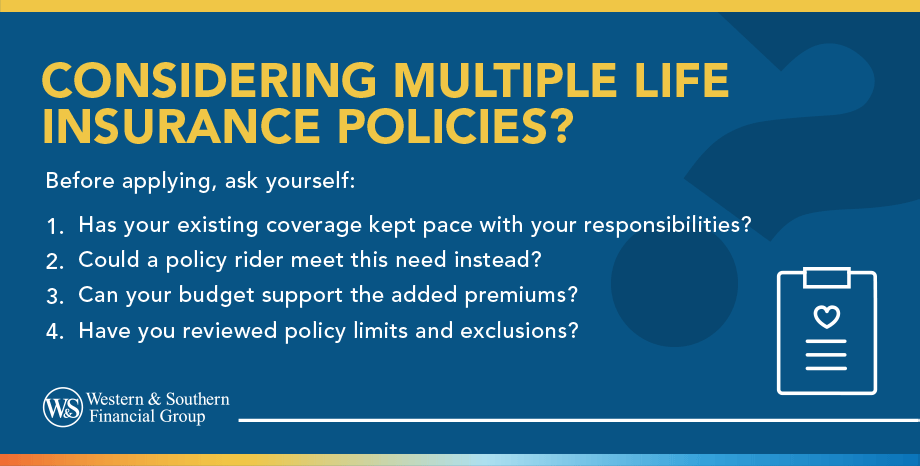
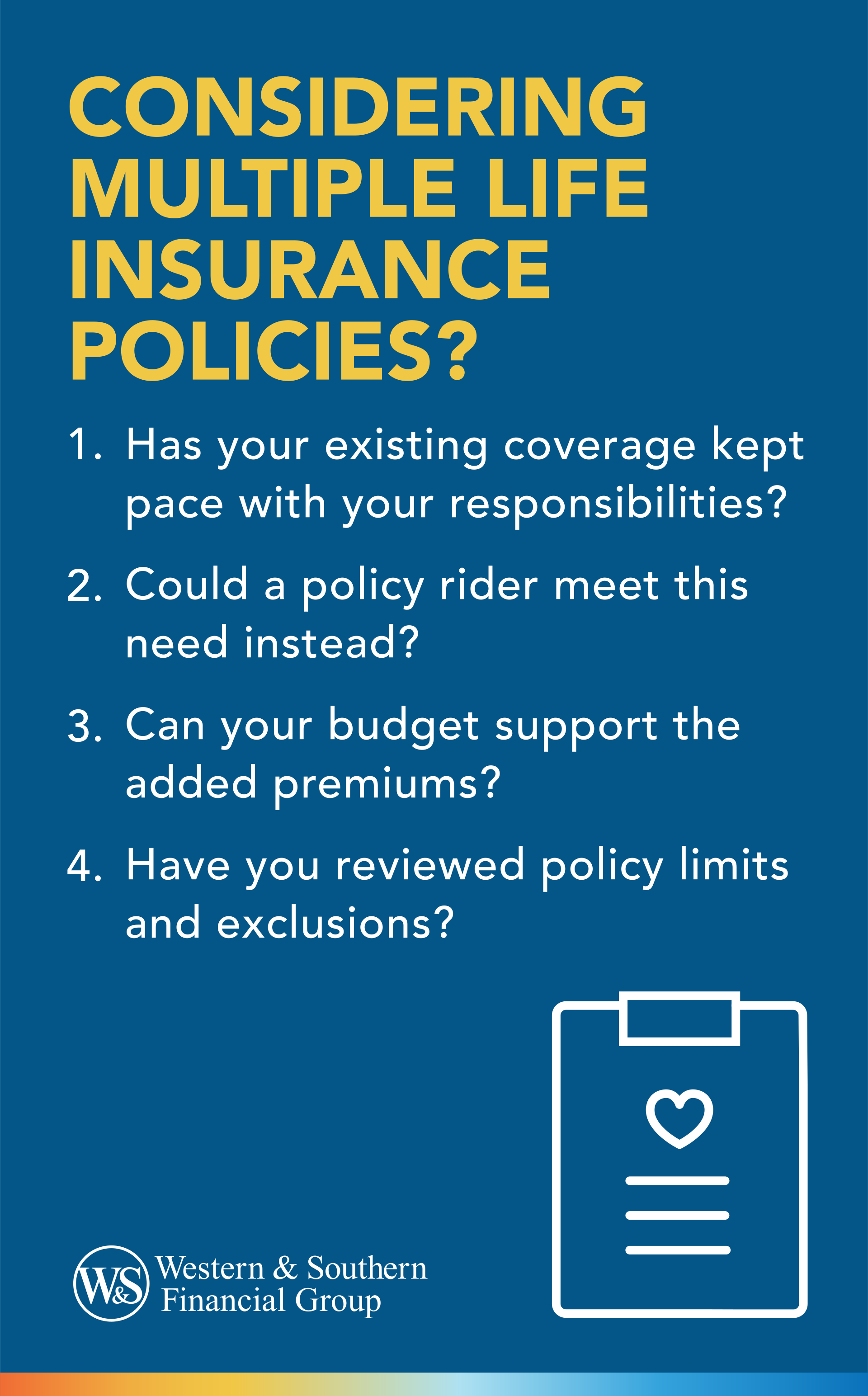
Key Questions To Ask Yourself
Before applying for another policy, you may want to consider:
- Has your existing coverage kept pace with your responsibilities?
- Could a policy rider meet this need instead?
- Can your budget support the added premiums?
- Have you reviewed policy limits and exclusions?
How Multiple Life Insurance Policies Typically Work
At its core, each life insurance policy stands on its own contract. If you pass away while coverage is in force and the claim is valid under the policy terms, each insurer typically pays its stated death benefit. For example:
| Policy Type | Coverage Amount | Term Length | Purpose |
|---|---|---|---|
| Term life insurance | $500,000 | 30 years | Mortgage and income replacement |
| Whole life insurance | $100,000 | Permanent | Estate planning and legacy |
| Group life insurance | $100,000 | Employer-based | Supplemental coverage |
If all three policies remain in force, the combined payout could total $700,000.
That said, premiums, policy fees and potential policy lapses must be considered individually.
Layering Term Life Insurance
One practical approach involves purchasing multiple term insurance policies with different lengths, sometimes called “laddering.”
How It Might Look
- 30-year term life insurance: Larger coverage amount tied to a mortgage payment
- 20-year term insurance: Covers income replacement during peak earning years
- 10-year term policy: Addresses short-term debt or college tuition
As shorter-term policies expire, your total coverage declines, ideally aligning with reduced financial obligations.
This structure could help manage premium costs compared to buying one large permanent life insurance policy upfront. Still, term life insurance provides coverage for a defined period only, and renewal premiums often increase, sometimes significantly, depending on the policy.
Mixing Term & Permanent Life Insurance
Another common scenario involves combining term life insurance with permanent life insurance, such as whole life insurance or universal life.
Term Life Insurance
- Lower initial premiums: Typically less expensive per dollar of coverage
- Temporary coverage: Designed for a specific period
- No cash value: Pure death benefit protection
Permanent Life Insurance
- Lifetime coverage: As long as premiums are paid
- Cash value component: Grows over time, generally tax-deferred
- Higher premiums: Reflect long-term guarantees and policy fees
Permanent insurance, including universal life, introduces flexibility. Some universal life policies allow adjustable premiums and death benefit amounts. However, crediting rates and policy charges can change over time, so coverage may lapse if the policy isn’t sufficiently funded.
Pros & Cons of Having Multiple Life Insurance Policies
| Potential Benefits | Potential Challenges |
|---|---|
| Flexible coverage: Tailor policies to specific goals |
Higher overall premiums: Multiple payments to manage |
| Flexibility across carriers: Access different pricing or rider options |
Administrative complexity: Tracking due dates and riders |
| Adaptability: Add coverage as life changes |
Insurability risk: Health changes could limit future options |
| Estate planning tools: Survivorship life insurance may help address estate liquidity |
Cash flow strain: Permanent insurance often carries higher costs |
The balance is rarely perfect. Some households value flexibility, while others prefer simplicity.
Special Situations Where Multiple Policies May Be Considered
Group Life Insurance & Supplemental Coverage
Employer group life insurance may provide a flat amount (around $50,000, for example) or a multiple of salary such as 1x, with optional supplemental coverage available in many workplaces. Plan designs vary by employer. While helpful, it may not fully address long-term financial security needs.
If you leave your employer, coverage could end. For that reason, some people maintain an individual term life insurance policy alongside group life insurance.
Key Person Insurance For Business Owners
Business owners sometimes carry personal life insurance policies in addition to key person insurance. Key person insurance helps a company manage financial disruption if an essential employee dies.
Final Expense Insurance & Guaranteed Acceptance Life Insurance
Final expense insurance policies are generally smaller and designed to address funeral costs and medical bills. Guaranteed acceptance life insurance typically does not require a medical exam, though premiums are often higher and coverage amounts lower.
These policies may be layered with larger term or permanent insurance coverage.
Estate Planning Considerations
For households with more complex estate planning goals, survivorship life insurance, also called second-to-die coverage, insures two people under one policy and pays the death benefit after both have passed away.
This type of permanent life insurance is sometimes used to help address estate taxes or provide liquidity to heirs. According to the IRS, federal estate tax thresholds are relatively high, but they may change over time. For deaths in 2026, the federal basic exclusion amount is $15,000,000 per person, though limits can change over time.3 State-level estate taxes may apply at lower thresholds.
Estate planning involves legal and tax considerations, so many people consult a qualified professional before making decisions.
The Role of Riders In Multiple Life Insurance Policies
Instead of purchasing separate policies, you may want to think about adding an insurance rider.
Common examples:
- Long-term care rider: May allow access to a portion of the death benefit if certain care conditions are met
- Child rider: Provides coverage for dependent children
- Waiver of premium rider: Premiums may be waived if you become disabled
Riders increase costs, and availability varies by insurer. In some cases, adding a rider could simplify coverage instead of opening another policy.
Underwriting & The Medical Exam Process
Most fully underwritten life insurance policies generally require a medical exam. Insurers assess:
- Age
- Income
- Health history
- Existing life insurance policies
- Lifestyle factors
Applying for multiple policies at the same time can sometimes streamline underwriting. However, approval is not guaranteed, as each insurer still makes its own underwriting decision. If your health changes between applications, obtaining additional coverage could become more difficult or expensive.
When Multiple Life Insurance Policies May Not Make Sense
There are situations where a single policy could be more practical:
- Simple financial picture: Few dependents and limited debt
- Budget constraints: Premium strain may affect other priorities
- Administrative burden: Multiple billing cycles increase complexity
Every financial decision involves trade-offs. Adding coverage may increase protection but also long-term costs.
Conclusion
So, can you have multiple life insurance policies? In many cases, yes. The more important question is whether layering policies aligns with your coverage needs, budget and long-term goals.
Term life insurance, permanent life insurance and supplemental options like group life insurance each serve different roles. Combining them could offer flexibility, though it may also increase complexity and cost.
If you’re evaluating this financial decision, consider reviewing your current life insurance policies, coverage limits and long-term obligations. You may want to speak with a qualified financial professional to explore how different structures could fit your situation.
Consider layering life insurance policies for enhanced financial security. Get a Free Life Insurance Quote
Sources
- Statistics. https://nfda.org/news/statistics
- Who is MIB? https://www.mib.com/facts_about_mib.html
- What's new — Estate and gift tax. https://www.irs.gov/businesses/small-businesses-self-employed/whats-new-estate-and-gift-tax