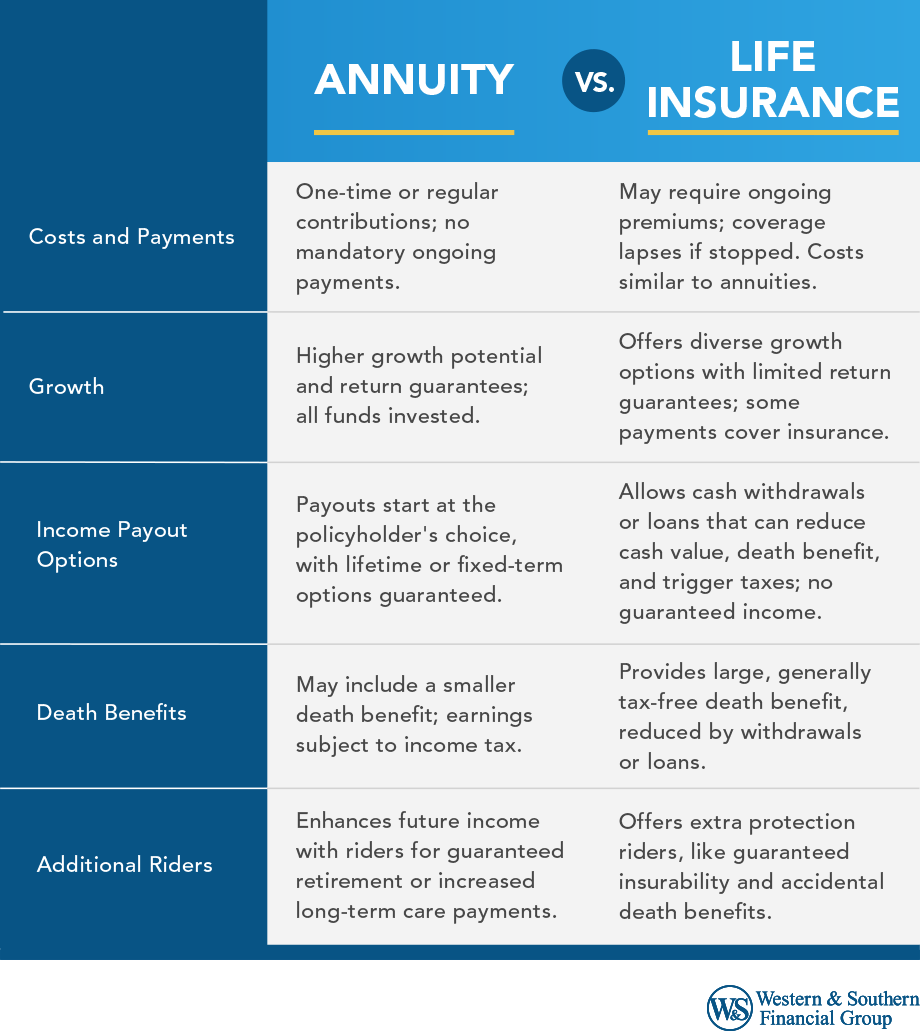
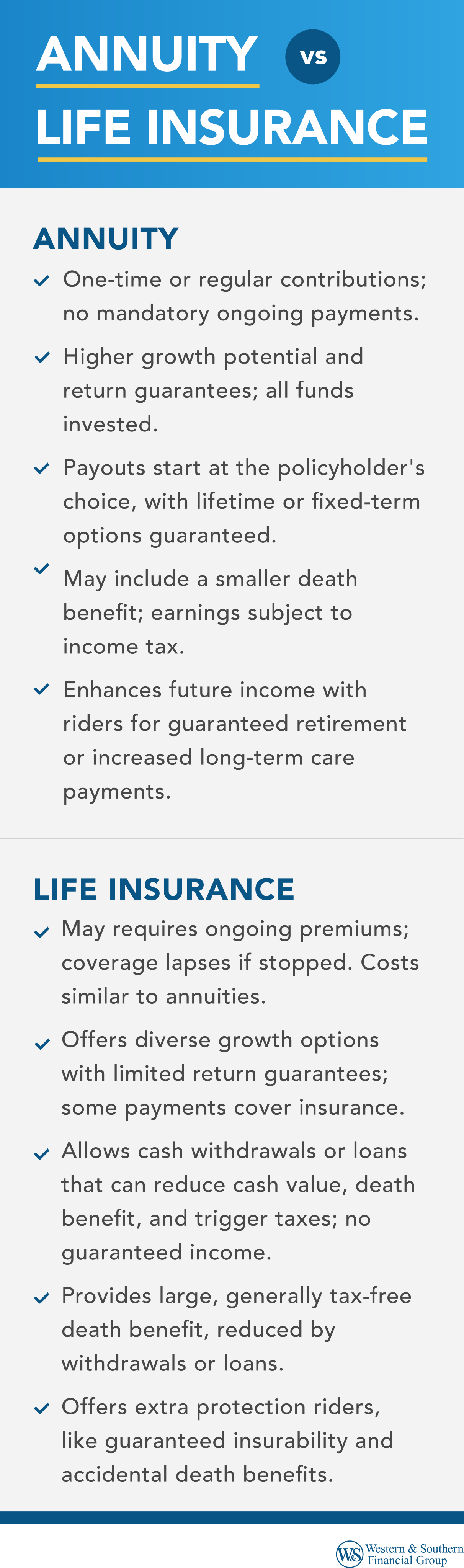
The debate between annuities and life insurance often starts with one simple question: income or protection? While both are issued by insurance companies, they serve different financial purposes. Understanding how each works can help you align the right product with your retirement income, estate planning, and overall financial goals.
Annuity vs Life Insurance: Why the Comparison Matters
At first glance, annuities and life insurance can seem similar. In both cases, you pay money to an insurance company and enter into a contract that may include guarantees, riders, and detailed terms.
The difference is the purpose.
- Annuities are designed to create income payments, often later in life.
- Life insurance is designed to pay a death benefit to beneficiaries when the insured person dies.
One focuses on income during your lifetime, while the other focuses on financial protection after death. That single distinction shapes everything else, including how each product is taxed, how accessible your money is, the level of risk involved, and how each fits into retirement income or estate planning decisions.
Can You Use Both?
Annuities and life insurance are not an either or decision. In many long term financial goals, each plays a different role.
- Annuities are commonly used to help generate retirement income and support financial stability later in life.
- Life insurance is designed to help protect beneficiaries and support estate planning goals.
When coordinated thoughtfully, annuities can help provide reliable income during retirement, while life insurance can help support beneficiaries and carry out legacy plans.
Annuity Defined
An annuity is a contract with an insurance company designed to turn money into income, either immediately or later. Many people use annuities to supplement retirement income alongside Social Security and retirement accounts, often to help cover expenses while delaying Social Security benefits until age 70 to increase their monthly payment.
Most annuities are funded with a lump sum, though some allow flexible contributions. Once the contract enters the payout phase, the insurer makes income payments based on the selected option. Many annuities also offer optional riders that can help boost future income, such as guaranteed lifetime income or added payments if long-term care needs arise.
Common Types of Annuities
| Annuity Type | Key Features |
|---|---|
| Fixed Annuuities | Guaranteed interest rate for a set period Predictable growth and income payments Often appeal to those who prefer stability over market exposure |
| Indexed Annuities | Growth linked to a market index such as the S&P 500 Caps or participation rates limit upside Typically offer protection against market losses |
| Variable Annuities | Invest in subaccounts similar to mutual funds Growth and income depend on market performance Generally involve higher risk and fees |
| Immediate Annuities | Income payments begin shortly after purchase Often used to create a pension style income stream Usually funded with a lump sum |
How Annuities Are Taxed
Annuities grow on a tax deferred basis, meaning earnings are not taxed until they are withdrawn.
When you take withdrawals, the earnings portion is taxed as ordinary income, not capital gains. Withdrawals before age 59½ may also trigger an early withdrawal penalty on top of income tax. Income riders and long-term care riders don’t change how annuities are taxed, but they can affect when and how income is paid, which may influence overall tax planning.
Definition of Life Insurance
Life insurance helps provide financial protection for others. In exchange for premium payments, an insurance company agrees to pay a death benefit to beneficiaries when the insured person passes away.
Unlike annuities, life insurance focuses on managing risk and supporting legacy goals rather than generating income. Many policies also offer optional riders, such as guaranteed insurability or accidental death benefits, that add flexibility as life changes.
Types of Life Insurance Policies
| Policy Type | Key Features |
|---|---|
| Term Life Insurance | Coverage lasts for a set period, often 10 to 30 years. Premiums are typically lower. No cash value component. |
| Whole Life Insurance | A type of permanent life insurance. Builds cash value over time. Offers guaranteed premiums and a guaranteed death benefit. |
| Variable Life Insurance | Combines a death benefit with market based cash value growth. Cash value fluctuates based on investment performance. Higher complexity and risk. |
| Permanent Life Insurance | A general category that includes whole and variable life insurance. Coverage lasts for life as long as premiums are paid. Often used in estate planning. |
Cash Value Explained
Some life insurance policies include a cash value component that grows over time. Policyholders can access this money through loans or withdrawals, but doing so can reduce the death benefit, slow future cash value growth, and may trigger taxes. Unpaid loans can also cause a policy to lapse if the balance becomes too large.
Cash value growth is generally tax deferred. Loans taken against the policy are not taxable as long as the policy remains in force, though unpaid loans reduce the death benefit. Certain riders can influence how cash value is used, such as riders that accelerate benefits in specific situations or provide additional flexibility without changing the underlying policy structure.
Take the next step toward your financial goals. Request a Free Life Insurance Quote
Pros & Cons of Annuities & Life Insurance
Annuities
| Pros | Cons |
|---|---|
| Provide guaranteed income during retirement. | Limited liquidity can make it difficult to access funds when needed. |
| Grow on a tax-deferred basis. | Early withdrawal penalties may apply if money is taken out before a specified age. |
| May include optional living benefits, such as income riders. | Income received is taxed at ordinary income rates. |
| Can help manage the risk of outliving your savings. | Fee structures can be complex, especially with variable annuities, which may reduce overall returns. |
Life Insurance
| Pros | Cons |
|---|---|
| Provides financial support for beneficiaries after the policyholder’s death. | Premiums for permanent policies are often higher than other life insurance options. |
| Death benefits are typically free from income taxes. | Cash value growth may occur at a slower pace. |
| Can support estate planning by helping manage and distribute assets. | Policy performance depends on the policy’s structure, funding level, and associated fees. |
| Some policies include a cash value component that may be accessed during the policyholder’s lifetime if structured properly. | As the insured ages, rising insurance costs can reduce cash value growth if the policy isn’t funded properly. |
Estate Planning & Retirement Income Tools
Estate planning often includes strategies for retirement income and long-term financial support. Annuities and life insurance serve different roles, but both can help support long-term goals.
How Annuities Fit Into Retirement Income Planning
Annuities may appeal to retirees who worry about outliving their savings. Unlike retirement accounts that depend on withdrawal strategies and market performance, annuities can provide predictable income payments.
Example: A retiree at age 65 may use part of their savings to purchase an immediate annuity to help cover basic expenses. This can help stabilize income while allowing other assets to remain invested.
Important tradeoff: Annuities offer limited flexibility. Once income payments begin, changing or reversing the decision is often difficult or not possible.
How Life Insurance Supports Estate Planning
Life insurance is designed to create liquidity at the policyholder’s death. This liquidity can support several estate planning goals, including:
- Replacing lost income for family members
- Covering final expenses and outstanding debts
- Helping equalize inheritances among heirs
- Providing funds for estate-related costs
Permanent life insurance is often used alongside trusts or more advanced estate planning strategies. This approach is common for individuals with higher net worth or specific financial goals and can help support a more tailored estate plan.
Additional Factors to Consider in Your Decision
Tax Considerations You Shouldn’t Ignore
Taxes affect how annuities and life insurance impact your overall financial picture.
- Annuities: Withdrawals are taxed as ordinary income, which can increase your total tax liability.
- Life insurance: Death benefits are generally received income tax free by beneficiaries. Cash value growth inside a policy is tax deferred, allowing funds to grow without immediate tax consequences.
Accessing funds at the wrong time can create avoidable tax issues. A 1035 exchange can help by allowing funds to move from one insurance contract to another without immediate taxes if IRS rules are followed.
A life insurance policy can be exchanged for an annuity on a tax deferred basis. However an annuity cannot be exchanged for a life insurance policy tax free. The IRS treats that transaction as a taxable distribution.
Understand the Potential Financial Risks
Both annuities and life insurance involve trade-offs. Each comes with risks to consider before choosing one.
Annuities
- Inflation can reduce the purchasing power of future income.
- Funds may be locked in and unavailable
- Liquidity is often limited, making access to money more difficult after purchase.
Life Insurance
- Premiums usually require a long-term commitment.
- Policies can lapse if premiums are not paid.
- Variable life insurance may expose cash value to market fluctuations.
These risks do not mean either option is unsuitable. They simply show why it helps to align each product with your goals, needs, and overall financial situation.
Additional Influential Factors
Health
Your health affects which options are available. Serious pre existing conditions can limit eligibility for life insurance or make it too expensive to build cash value. In those cases, annuities may be the more practical choice. If you are in good health for your age, both options may be available.
Age and Retirement Timeline
Life insurance often makes more sense at younger ages. Lower premiums and a longer time horizon allow more time to build cash value. Younger individuals are also more likely to need coverage for income replacement or dependents. Cash value is generally easier to access earlier in life than with an annuity.
As retirement gets closer, annuities may be a better fit. They can help grow savings before retirement and align more closely with income needs. You are also closer to or past age 59½, when early withdrawal penalties often no longer apply.
Risk Tolerance
Risk tolerance depends more on the specific product than on choosing life insurance or annuities overall. Both can offer guarantees or higher return potential. The difference comes down to the type selected, not the category itself.
Final Thoughts
The choice isn't about which product is superior but about addressing specific needs. Annuities provide income, life insurance offers protection. Both can contribute significantly to retirement planning and estate management. Knowing their differences and similarities empowers you to make informed decisions for your financial future.
Explore your options and help secure your financial future. Request a Free Life Insurance Quote