Becoming a parent brings joy, but it also reshapes your financial life in ways you may not expect. From adjusting your household budget to thinking about long-term financial goals, the stakes get higher quickly. This guide walks through practical financial tips for new parents, covering everything from insurance to college savings and daily money decisions.
Understanding the Financial Impact of a New Child
Bringing a child into your family can quickly change your finances. The cost of raising a child to age 18 now exceeds $300,000, not including college.1 For many new parents, this means adjusting spending, income, and long-term priorities. Even in the first year, expenses can rise quickly. Medical bills, childcare, and baby essentials all add to monthly costs.
There are also trade-offs to consider. One parent may cut back on work hours or leave the workforce for a period of time. This can impact:
- Household income
- Retirement savings
- Future earning potential
Reviewing these factors ahead of time can help you make informed decisions that align with your long-term goals.
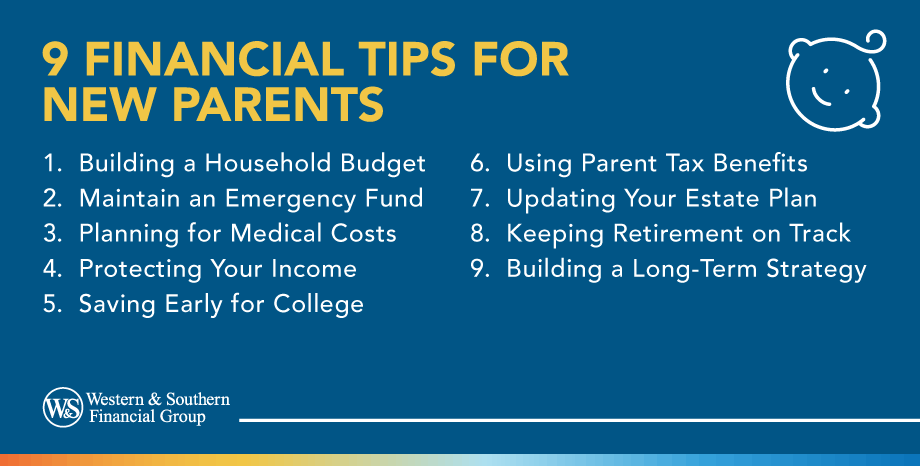
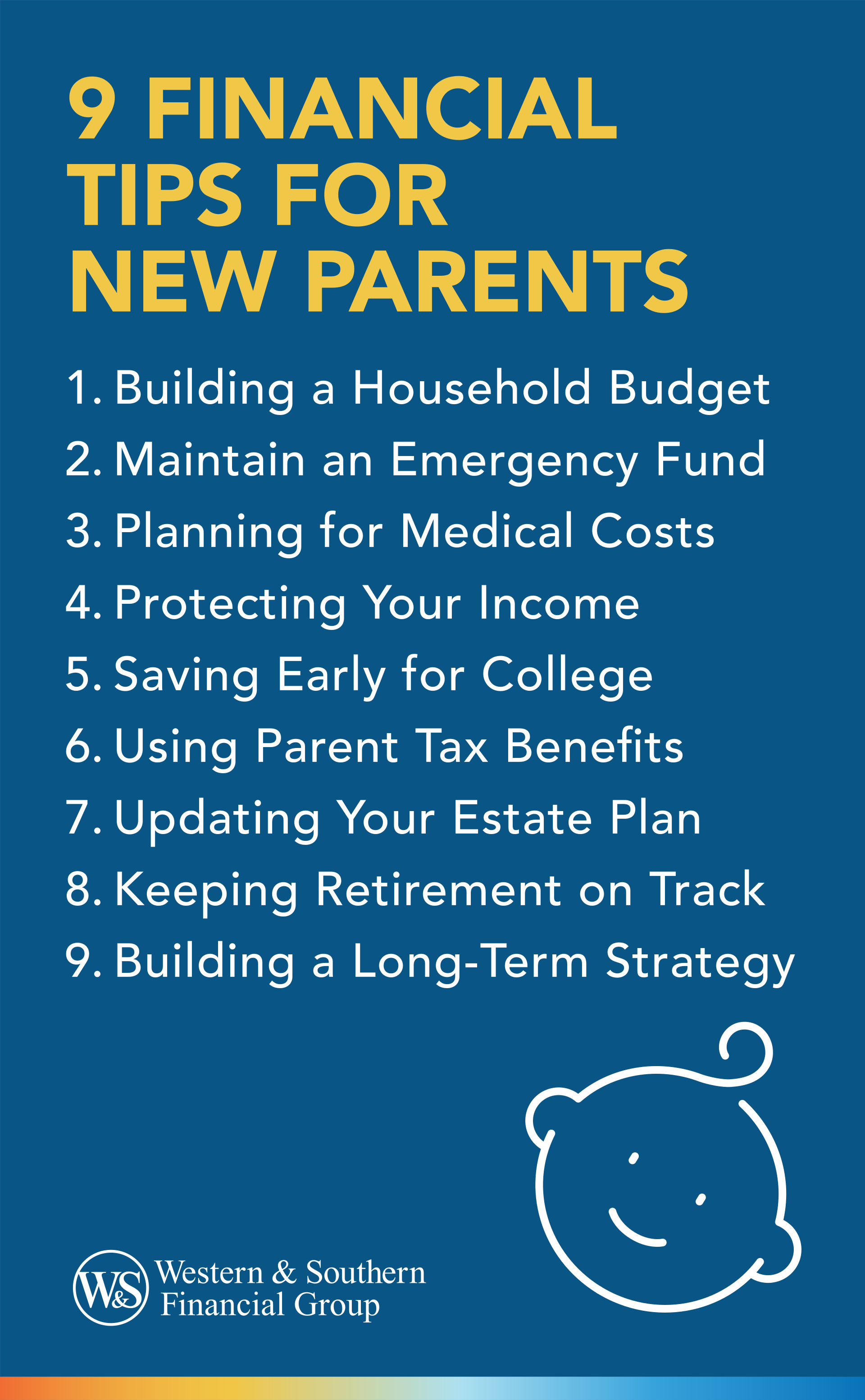
Here are nine common financial tips for new parents.
Tip 1: Building a Practical Household Budget
Creating a household budget is one of the first steps new parents should take. It helps you direct income toward essentials while setting aside money for the future.
Steps to Get Started
- Calculate your total monthly income: Add up all reliable income sources after taxes to get a clear starting point.
- List fixed expenses such as housing, insurance, and loan payments: These are consistent monthly costs that typically do not change.
- Estimate variable expenses like groceries and childcare: Review past spending to get a realistic average for these flexible costs.
- Set aside money for savings and retirement: Treat savings like a regular bill so it becomes part of your routine.
- Adjust spending categories to stay on track: Make small changes as needed to help keep your budget balanced each month.
Example Monthly Budget
| Category | Amount |
|---|---|
| Monthly income | $6,000 |
| Fixed expenses | $3,500 |
| Variable expenses | $1,500 |
| Remaining funds | $1,000 |
In this example, the remaining $1,000 can go toward savings and discretionary spending. Setting clear limits makes it easier to build an emergency fund and grow savings while covering daily needs.
Budgeting can also reveal areas where money slips away. Subscription services, convenience purchases, and takeout can add up over time. Redirecting even $200 per month toward long-term goals can have a noticeable impact.
Tip 2: Build & Maintain an Emergency Fund
An emergency fund becomes more important when you have a child. Unexpected costs like medical bills, job interruptions, or urgent childcare needs can come up at any time.
A common suggestion is to save three to six months of living expenses. That can feel like a large goal, but starting smaller still helps you move forward.
Building an emergency fund takes consistency. Setting up automatic transfers to a separate savings account can make the process easier. Even smaller contributions can add up over time, such as:
- $100 per month
- $150 per month
- $200 per month
These steady deposits can gradually grow your balance.
To put this into perspective, a household with $5,000 in monthly expenses may aim for a $15,000 reserve. Breaking that goal into smaller milestones, like reaching $5,000 first, can make it feel more manageable and easier to achieve.
Tip 3: Review Health Insurance & Plan for Medical Costs
Health insurance plays a key role in managing rising medical costs for new parents. The first year often includes pediatric visits, vaccinations, and unexpected care. Reviewing your coverage can help confirm it fits your family’s needs.
Start by looking at:
- Monthly premiums
- Deductibles
- Out-of-pocket maximums
A plan with a lower premium may seem appealing at first. However, higher out-of-pocket costs can add up quickly. If you expect frequent doctor visits, a plan with a higher premium and lower deductible may lead to lower total costs over time.
For example:
| Plan | Monthly Premium | Deductible |
|---|---|---|
| Plan A | $300 | $6,000 |
| Plan B | $500 | $2,000 |
If your child needs ongoing care, Plan B may result in lower total spending despite the higher monthly cost.
You can also consider tax-advantaged accounts like a health savings account or flexible spending account. These accounts let you use pre-tax income for qualified healthcare costs, which may lower your taxable income.
Tip 4: Protect Your Income With Life & Disability Insurance
Once you have a child, your income plays a larger role in supporting your household. Life insurance and disability insurance can help provide support if something unexpected happens.
Life Insurance
A life insurance policy pays a death benefit to your beneficiaries. This money can help cover:
- Daily living expenses
- Outstanding debts
- Future costs, such as education
Term life insurance provides coverage for a set period, such as 20 or 30 years. This timeline often aligns with the years your child depends on your income.
Disability Insurance
Disability insurance is also important to consider. According to the U.S. Bureau of Labor Statistics, about 83% of employed individuals with a disability are between ages 16 and 64.2 This highlights how disabilities can affect people during their working years. This type of coverage replaces a portion of your income if you cannot work due to illness or injury.
Together, life and disability insurance can help support your household’s financial stability if your income is interrupted.
Tip 5: Start College Savings Early
Starting early can make a noticeable difference when preparing for education costs. A 529 plan is a common tax-advantaged account designed for college savings. Contributions grow tax-deferred, and withdrawals are tax-free when used for qualified expenses such as tuition and fees.
Common College Savings Options
| Account Type | Tax Benefits | Flexibility | Use Case |
|---|---|---|---|
| 529 Plan | Tax-free growth and withdrawals | Limited to education expenses | College savings |
| Custodial Account | Taxed at child’s rate | Flexible use | General savings |
| Savings Account | No tax advantages | Highly flexible | Short-term goals |
It is important to balance college savings with retirement savings. Saving for your child’s education matters, but staying on track with your retirement goals should remain a priority.
Tip 6: Take Advantage of Tax Benefits for Parents
New parents may qualify for several tax benefits that can lower overall tax liability. One of the most valuable is the Child Tax Credit, which offers up to $2,000 per qualifying child, depending on income limits.3
Another option is a Dependent Care FSA. This account lets you use pre-tax income to pay for childcare expenses.4 It can help reduce the impact of daycare costs, which are often one of the largest expenses for new parents.
You may also want to keep these additional points in mind:
- Some families may qualify for deductions or credits tied to future education expenses
- Tax rules and eligibility can change over time
- Keeping detailed records of expenses can help you claim all available benefits
Tip 7: Create or Update Your Estate Plan
An estate plan outlines how your assets will be managed and who will care for your child if something happens to you. For new parents, this step is especially important.
Key components often include:
- A will that outlines how assets are distributed
- Naming a legal guardian for your child
- Beneficiary designations on accounts
- Powers of attorney for financial and medical decisions
Reviewing and updating your estate plan on a regular basis helps keep it aligned with your current situation and wishes.
Tip 8: Keep Retirement Savings on Track
Focusing on your child’s needs can sometimes lead you to overlook your own retirement savings. While it may feel counterintuitive, continuing to contribute to your retirement account is still important. Employer-sponsored plans like a 401(k) often include matching contributions. Taking full advantage of this match can help grow your long-term savings.
For example, if your employer matches 5% of your salary and you earn $80,000, contributing at least $4,000 each year helps you receive the full match. Missing this benefit means giving up part of your total compensation.
Balancing retirement savings, daily expenses, and future goals takes consistency and a clear approach.
Tip 9: Build a Long-Term Financial Strategy
As your family grows, your financial strategy should change with it. Setting long-term goals can help guide decisions about saving, investing, and spending.
These goals may include:
- Funding education expenses
- Paying down debt
- Increasing retirement savings
- Building wealth through an investment account
Reviewing your strategy each year allows you to make adjustments based on changes in income, expenses, or priorities. This ongoing process helps keep your approach aligned with your family’s needs.
Common Mistakes New Parents Should Avoid
Even with a solid plan in place, it is easy to overlook key financial decisions during this transition. Small missteps early on can have a lasting impact, especially as expenses increase and priorities shift.
Here are some of the most common financial mistakes new parents make:
- Underestimating ongoing expenses: Many new parents plan for upfront baby costs like cribs and strollers but overlook recurring expenses such as childcare, diapers, medical costs, and education expenses.
- Delaying life insurance coverage: Getting coverage earlier may also help you lock in lower premium rates, especially with term life insurance.
- Not building an emergency fund early enough: Without a financial cushion, unexpected expenses can lead to debt. Even a small emergency fund can help reduce the need to rely on credit cards during emergencies.
- Failing to adjust your household budget regularly: Expenses can change quickly in the first few years of parenting. Not reviewing your budget often can lead to overspending or missed chances to save.
- Ignoring rising medical costs: Not reviewing your health insurance or planning for medical expenses can result in higher out-of-pocket costs.
- Taking on too much debt too quickly: It can be easy to rely on credit for baby-related purchases. Without a clear repayment plan, this can lead to long-term financial strain.
- Not setting clear long-term goals: Without defined goals, it becomes harder to prioritize saving, investing, and spending as your family grows.
- Not working with a financial advisor when needed: Some new parents try to manage everything on their own. A financial advisor can offer guidance on topics like insurance coverage, tax strategies, and long-term goals.
Avoiding these mistakes does not require perfection. It comes down to staying aware, reviewing your plan often, and making adjustments as your family’s needs change.
Final Thoughts
Adjusting to parenthood includes learning how to manage money in a new way. These financial tips for new parents provide a starting point for building stability while preparing for the future.
By focusing on budgeting, protection, savings, and long-term planning, you can create a strategy that supports both your current needs and future goals.
Sources
- The Cost of Raising a Kid Just Hit $300K—Here’s What Parents Are Paying by State. https://www.parents.com/cost-of-raising-a-kid-rises-11950122.
- Table A. Employment status of the civilian noninstitutional population by disability status and age, 2024 and 2025 annual averages. https://www.bls.gov/news.release/disabl.a.htm.
- Child Tax Credit - IRS. https://www.irs.gov/credits-deductions/individuals/child-tax-credit.
- Dependent Care FSA. https://www.fsafeds.gov/explore/dcfsa.
















.jpg?rev=b30888445a984cb9af391aebc08860da&la=en&h=130&w=270&hash=811D9A81F81B2D381CDBDE831D4D12BA)