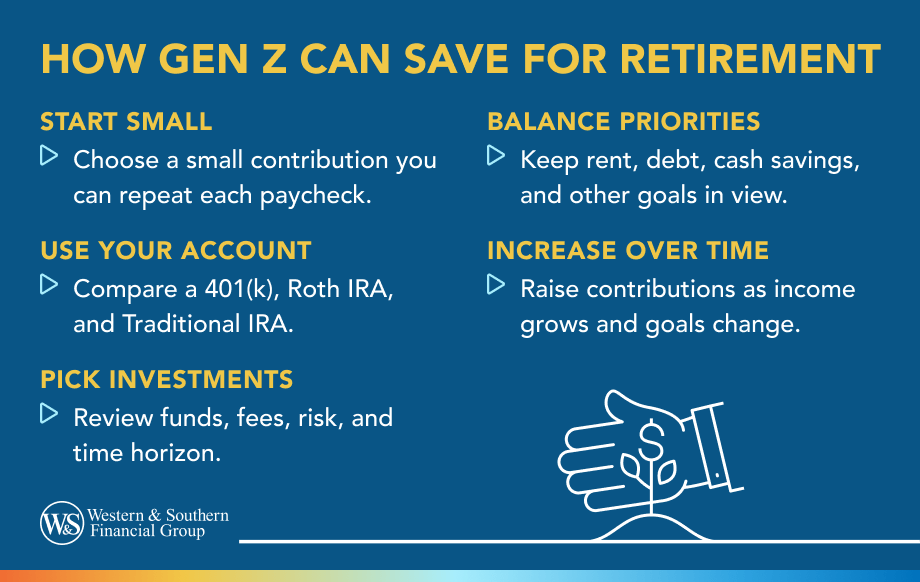
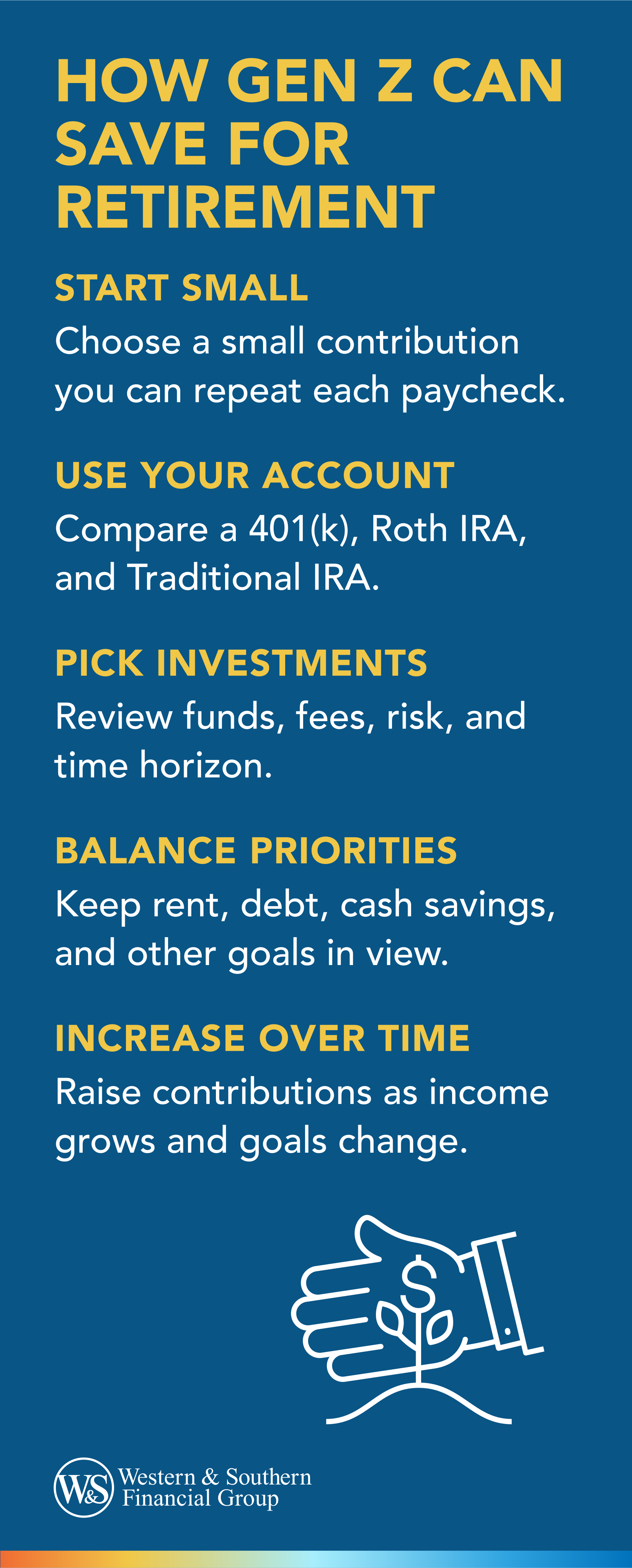
Gen Z retirement starts with a few practical decisions: how much to contribute, which account to use, and how to invest the money. You do not need to map out your entire future at once. Starting with a manageable contribution and adjusting it as income, debt, and goals change can make the process easier to maintain.
Why Gen Z Has a Time Advantage
For Gen Z, retirement may be decades away. That time can be useful because money invested earlier has more years to grow and stay invested through market changes. Waiting 10 years to start may mean needing to set aside much more each month to pursue the same retirement goal because there is less time for contributions and potential earnings to build.
That is where compound growth, often discussed alongside compound interest, can help. Reinvested earnings may generate future earnings of their own, so even a small contribution can matter if you keep going and increase the amount as your income grows. For many Gen Zers, time can be difficult to make up later.
Understand Your Retirement Account Options
Retirement accounts have different rules for contributions, taxes, and withdrawals. For many Gen Z savers, the first options to understand are workplace retirement plans, such as 401(k)s, and individual retirement accounts, known as IRAs.
Workplace Retirement Plans (401(k)s)
A 401(k) is a retirement account offered through an employer. It allows employees to contribute part of their wages to individual accounts, and employers can also contribute.¹ A 401(k) may be one of the easiest places to start if you have access to one at work because contributions usually come straight from your paycheck.
When reviewing a 401(k), look for:
- Your contribution amount: How much of each paycheck you want to set aside
- Employer match: Whether your employer adds money when you contribute
- Traditional or Roth options: How taxes may apply now or later
Traditional and Roth 401(k) options differ mainly in when taxes apply:
| Account type | Simple explanation |
|---|---|
| Traditional 401(k) | Contributions generally reduce current taxable income. Withdrawals are generally taxed later. |
| Roth 401(k) | Contributions are made with money that has already been taxed. Qualified withdrawals may be tax-free later if IRS rules are met.¹ |
If your employer offers a match, check how much you need to contribute to get it. That can help you decide where to start. Even if you cannot contribute much today, participating in a workplace retirement plan can help establish long-term saving habits.
Individual Retirement Accounts (IRAs)
An IRA is a retirement account you open outside of an employer plan. It can be useful if you do not have access to a 401(k), want another way to save, or want more control over where you open the account.
Roth and traditional IRAs also differ mainly in how taxes apply:
| IRA type | Simple explanation |
|---|---|
| Roth IRA | Contributions are not deductible, but qualified withdrawals may be tax-free.² |
| Traditional IRA | Contributions may be tax-deductible.² Withdrawals are generally taxed later. |
A Roth IRA may appeal to someone who wants the potential for tax-free qualified withdrawals later. A traditional IRA may appeal to someone who qualifies for a deduction now.
Some Gen Z savers may eventually use both account types. The right mix depends on your employer benefits, income, and retirement goals.
A Simple Investment Guide for Gen Z
Opening a retirement account is an important first step, but the money usually still needs to be invested. The next step is choosing investments that fit your timeline, comfort with risk, and retirement goals. For many Gen Z savers, that does not have to mean picking individual stocks.
Consider Funds Before Individual Stocks
An individual stock concentrates your investment in one company. Mutual funds and ETFs pool money from many investors and may invest in stocks, bonds, other securities or assets, or a combination of investments.
Some mutual funds and ETFs spread investments across many companies or industry sectors. This diversification may help reduce risk if one company or sector performs poorly, but it does not prevent losses.³
Common Fund Options
Two common fund approaches are target-date funds and index funds:
- Target-date funds: These funds are built around an expected retirement year, such as 2065 or 2070. They typically hold a mix of investments and become more conservative as the target date approaches.
- Index funds: These funds seek to track the performance of a market index.
Target-date and index funds may be offered as mutual funds or ETFs.³
- Mutual funds: Pooled investments that may hold stocks, bonds, or other assets. Investors generally buy or sell shares at a price calculated at the end of the trading day.
- ETFs: Pooled investments that trade on an exchange throughout the day. Some track broad indexes, while others focus on specific sectors, assets, or strategies.
Because these categories can overlap, compare each fund by its holdings, strategy, costs, and risks.
How to Compare Investment Options
When comparing funds, review what each fund holds, its expense ratio and other costs, and its principal risks. Also consider how much involvement you want in choosing and managing investments.
Several factors can affect results over time:
- Risk: The possibility that an investment may lose value or perform differently than expected.
- Fees: Costs that reduce how much of the investment return remains in your account.
- Market volatility: Changes in investment prices, which may occur gradually or quickly.
Because Gen Z investors may have decades before retirement, investments have time to experience both gains and losses. Choose an approach you understand, can contribute to consistently, and are willing to review as your goals change.
How Much Should Gen Z Save for Retirement?
There is no single retirement savings amount that works for every Gen Z saver. Income, debt, rent, employer benefits, and retirement goals can all affect how much you can contribute.
If you have a workplace retirement plan with an employer match, start there. Review how much you need to contribute to qualify for the match, then decide what fits your budget. A common guideline is to save 10% to 15% of pretax income for retirement, if your budget allows.⁴ If that is not realistic right away, consider starting with enough to qualify for an employer match, then increase contributions when you get a raise or have more room in your budget.
A retirement calculator can help you compare different contribution amounts, timelines, and growth assumptions before deciding what may fit your budget.
Simple Savings Checkpoints
Once you know the general guideline, break it into smaller next steps.
| If you can... | Consider this step |
|---|---|
| Access an employer match | Contribute enough to qualify, if your budget allows. |
| Start small | Choose an amount you can repeat each paycheck. |
| Get a raise | Consider increasing your contribution. |
| Review once a year | Adjust as income, debt, and goals change. |
Consistency matters more than getting the number perfect at the start. A smaller contribution may be easier to maintain than a larger amount you stop after a few months.
How to Balance Retirement Savings With Other Financial Goals
After choosing an account and investment approach, the next question is how much you can contribute without straining your current budget.
Student Loans and Retirement Savings
Student loans do not always mean retirement savings must wait. Compare the interest rate, required payment, employer match, and room in your budget. If your employer offers a match, review how much you need to contribute to qualify before deciding how much retirement saving fits your budget.
Rent, Necessities, and Short-Term Savings
Retirement contributions should not cause missed rent, late bills, or credit card reliance for groceries. Cover necessities, minimum debt payments, and near-term costs first.
Emergency Savings and Retirement Contributions
Cash savings can help keep surprise expenses from turning into credit card balances or retirement account withdrawals. Even a small starter reserve can make retirement saving easier to maintain.
Common Gen Z Retirement Mistakes to Avoid
A few common mistakes can make it harder for Gen Z savers to build retirement momentum.
| Mistake | Why it matters | What to do instead |
|---|---|---|
| Waiting for higher income | Less time remains for compound growth. | Start with a small, repeatable contribution. |
| Missing the employer match | You may miss employer contributions. | Check the match formula and contribute enough to qualify, if your budget allows. |
| Opening an IRA but not investing | Money may stay in cash. | Choose investments that fit your timeline and risk tolerance. |
| Following social media advice | Posts may skip risks, taxes, fees, or conflicts. | Check credible sources or a qualified financial advisor. |
| Forgetting old retirement accounts | Accounts may be overlooked after job changes. | Track providers, beneficiaries, fees, and rollover options. |
Avoiding these missteps can help keep your retirement strategy simple, consistent, and easier to manage over time.
How the FIRE Movement Fits
The FIRE movement, short for Financial Independence, Retire Early, is one way some Gen Zers think about retirement differently. It focuses on saving more, investing consistently, managing expenses, and building enough assets to make work optional sooner.
What Gen Z Can Learn From FIRE
Gen Z does not need to follow an aggressive FIRE strategy to use some of its ideas. The main takeaway is being deliberate: limit lifestyle creep when income rises, save more when possible, and define what financial independence means for your own goals.
Why FIRE Is Not the Only Path
FIRE may not fit every income, debt level, or life situation, especially for someone managing rent, student loans, family support, or early-career wages. Even if early retirement is not the goal, FIRE can still offer useful lessons about saving, investing, and building flexibility over time.
What Gen Z Should Know About Social Security
Younger generations often hear mixed messages about Social Security. Some stories focus on future funding concerns, while others point out that benefits are still expected to continue. The main takeaway is simple: Social Security may still be part of Gen Z retirement, but it should not be the only source of future income.
Social Security Snapshot
Because future benefits may depend on funding, policy decisions, and personal earnings history, other savings can help fill more of the retirement picture. 401(k) plans, IRAs, and other savings can give Gen Zers more control over how much they set aside, how the money is invested, and how they work toward their retirement goals.
How to Start Saving for Retirement
Getting started can feel more manageable when the process is broken into clear steps. These actions can help Gen Zers move from planning to consistent saving:
- Review your budget: Find a starting contribution that fits after necessities, minimum debt payments, and basic cash savings.
- Check your workplace retirement plan: Look for the plan type, employer match, Roth option, investment choices, fees, and vesting rules. Also review the plan's vesting schedule, which determines when employer contributions become fully yours.
- Open an IRA if needed: Consider an IRA if you do not have access to a workplace plan, want another account, and meet the rules.
- Choose investments: Review options such as target-date funds and index funds, which may be offered as mutual funds or ETFs. The principal value of the target date funds is not guaranteed at any time, including at or after the target date.
- Automate contributions: Use payroll deductions for a workplace account or recurring transfers for an IRA.
- Review once a year: Check your contribution rate, investments, beneficiaries, old accounts, and any changes in income, debt, taxes, or life goals.
You do not need to complete every step at once. Starting with one manageable action can make the process easier to maintain over time.
Final Thoughts
Gen Z retirement does not require a perfect number at the start. It starts with a budget, an account, an investment choice, and a contribution you can repeat. Use an employer match if available, consider an IRA when it fits, and adjust contributions as income, debt, and life goals change. Starting earlier gives compound growth more years to work.
Sources
- 401(k) Plans. https://www.irs.gov/retirement-plans/401k-plans
- Individual Retirement Arrangements (IRAs). https://www.irs.gov/retirement-plans/individual-retirement-arrangements-iras
- Mutual Funds and ETFs: A Guide for Investors. https://www.investor.gov/sites/investorgov/files/2019-02/mutual-funds-ETFs.pdf
- Retirement Planning by the Decade: A Savings Guide. https://www.schwab.com/learn/story/retirement-planning-by-decade-savings-guide
- Social Security Board of Trustees: Projection for Combined Trust Funds Remains Consistent with Prior Year. https://www.ssa.gov/news/en/press/releases/2026-06-09.html