You've finally retired after a long and dedicated career, but you may find yourself missing work more than expected. You might want extra income to help cover expenses, or you may feel bored and want to stay active.
Before you return to work, it helps to think through how it could affect your finances. Here are a few things to consider as you decide whether to work after retirement.
A Potential Increase in Expenses
Even though you will earn income, going back to work can bring new costs. For example, if you plan to work in an office, you may need to spend money on commuting and work clothes. You may also have less time to keep up with your home, which could mean paying for services like cleaning or yard work.
If you plan to work as an independent consultant or take on a remote role, you may need to pay for your own equipment and supplies. You might also spend money on professional events or other business-related costs.
Before returning to work, compare how much you expect to earn with the costs tied to the job. This can help you decide if going back to work makes sense for your situation.
Tax Implications
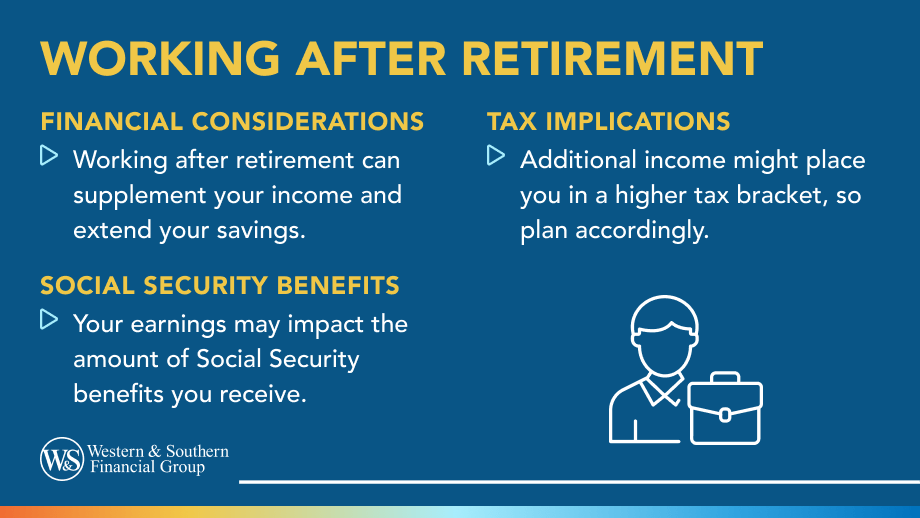
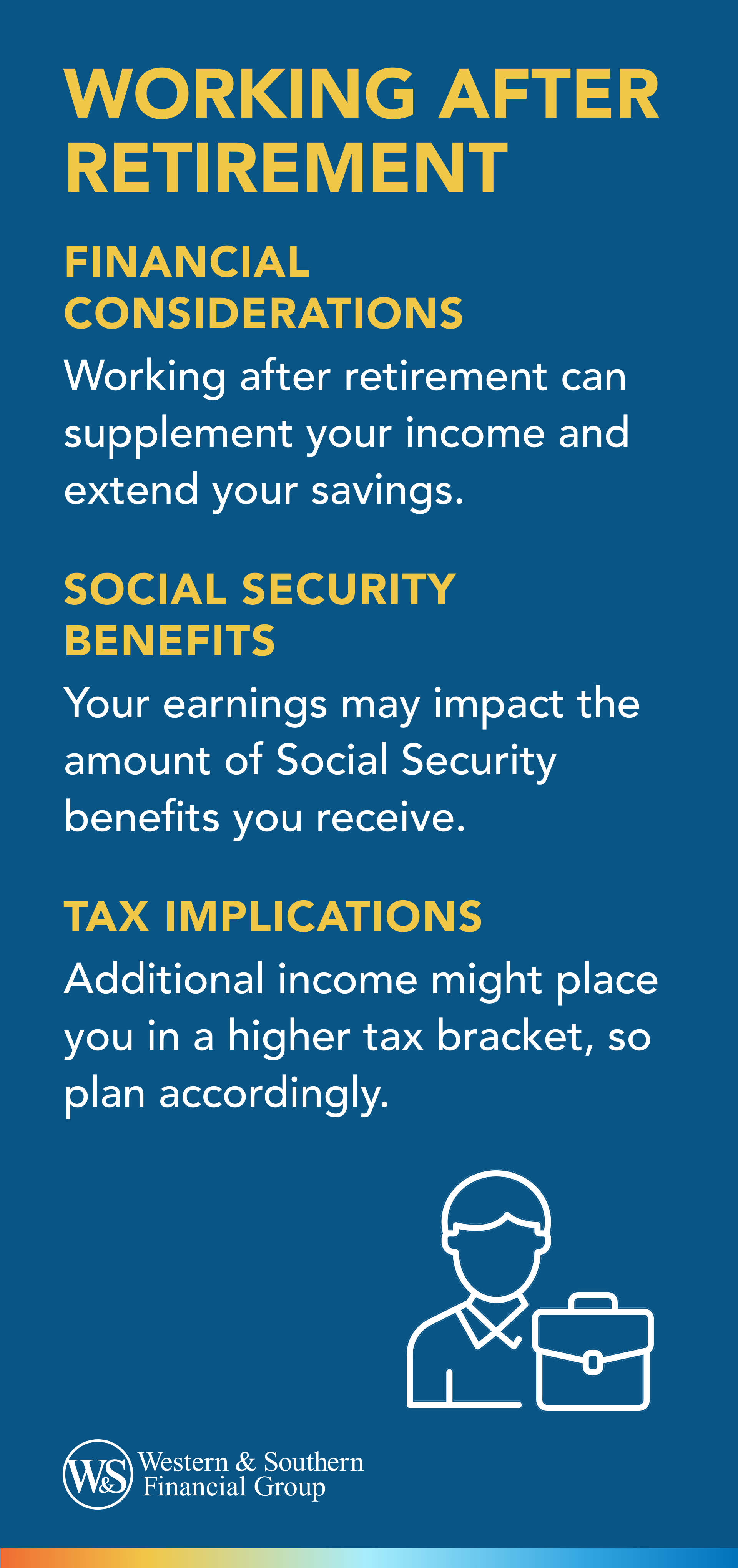
Working in retirement can change how your income is taxed.
Tax Credit for the Elderly or Disabled
There's a chance you may no longer be eligible for the tax credit for the elderly or disabled.1 This credit is available for those 65 and over and is anywhere from $3,750 to $7,500. To qualify, your adjusted gross income (AGI) can't be equal to or higher than a certain dollar amount. This ranges from $12,500 to $25,000 and depends on your tax filing status.
Nontaxable income that can affect eligibility:
- Social Security benefits
- Annuities
- Pension income
- Disability income
These limits also vary by filing status and range from $3,750 to $7,500.
Taxes on Social Security Benefits
If you have additional income, you may have to pay taxes on your Social Security benefits.2
| Filing Status3 | Income Level | Taxable Portion |
|---|---|---|
| Individual | $25,000 | Up to 50% |
| Joint | $32,000 | Up to 50% |
How much you pay will depend on your income and benefit amount, and working more and generating a higher income could bump up the amount you have to pay in taxes.
Impacts on Social Security
When deciding whether to start working again in retirement, you may want to consider how it could affect your Social Security benefits.
Full Retirement Age
You can still collect Social Security while working, but if you haven't reached the full retirement age, you may not get your full benefit.4
| Birth Year | Retirement Age |
|---|---|
| 1943 to 1954 | 66 |
| 1955 to 1959 | Increases gradually |
| 1960 or later | 67 |
Social Security Benefit Reductions by Age
- If you have not yet reached your full retirement age, you may want to review the exempt amounts under the Social Security Administration’s retirement earnings test.5 The earnings test applies only to people who have not reached full retirement age. In 2026, your Social Security benefits are reduced by $1 for every $2 you earn above $24,480.
- If you reach full retirement age during the year, different rules apply. If you earn more than $65,160 that year, Social Security deducts $1 for every $3 you earn over the limit. Earnings count only for the months before you reach full retirement age.5
- Once you reach full retirement age, you can earn any amount without a reduction in benefits. However, you should understand the tax implications you may face, as noted above.
The Bottom Line
Working after retirement can offer a number of perks: an income boost, career fulfillment and the potential to learn new skills and expand your social circle. However, before you return to work, you'll likely want to figure out how doing so impacts your finances. With a little forethought, you can help create a retirement that's both financially secure and emotionally satisfying.
Sources
- Credit for the Elderly or the Disabled at-a-Glance. https://www.irs.gov/credits-deductions/individuals/credit-for-the-elderly-or-the-disabled.
- Request to withhold taxes. https://www.ssa.gov/manage-benefits/request-withhold-taxes.
- About Publication 915, Social Security and Equivalent Railroad Retirement Benefits. https://www.irs.gov/forms-pubs/about-publication-915.
- Starting Your Retirement Benefits Early. https://www.ssa.gov/benefits/retirement/planner/agereduction.html.
- Exempt Amounts Under The Earnings Test. https://www.ssa.gov/oact/cola/rtea.html.