Table of Contents
Key Takeaways
- Compound returns allow your investments to grow exponentially over time, so investing early can pay off.
- Paying off high-interest debt like student loans may make more financial sense than investing.
- 401(k)s and Roth IRAs offer tax advantages like tax-deferred growth or tax-free withdrawals.
- Brokerage accounts offer more flexibility to access your investments whenever you want.
- Taking full advantage of any employer 401(k) match is like getting free money for retirement.
You're out of college, making your own salary and choosing what you do with that money. There's no getting around the fact that your first priority is probably paying off student loans while learning to make ends meet. There's another money move you may want to consider making: investing.
Investing after college isn't something you should necessarily put off until you're older or earning more. Putting money in the market early on can be ideal timing. Here's why and how to think about postgraduate investing while juggling all your other financial responsibilities.
Why Invest After College?
With everything else that comes with life after college, why should you bother adding "learn how to start investing" to your to-do list? One of the answers is pretty simple: compound returns.
Compound Returns
Compound returns may help you build wealth from investments. The money you contribute to an investment fund could earn a return. Those returns are added to your initial contribution, as long you don't make withdrawals, and can possibly go on to earn their own returns. There's the possibility that you may not earn a return and could even lose your initial investment. Compounding can create a positive effect if your investments are earning money, but there's always the risk of loss.
You can use a compound interest calculator to see what a difference investing over time can make. The longer you wait, the less your potential for overall returns could be (depending on interest rates), even if you invest more when you finally decide to start. There's always the risk you'll lose the money you invest.
Shouldn't I Pay Off My Debt First?
Investing after college could provide some serious benefits but could result in the loss of the principal investment. It doesn't change the fact you have a lot of bills to pay and possibly a lot of debt to get rid of. What should you do first: invest, or pay off that debt?
You might be able to do both. It could make more sense to strike a balance between repaying your student loans and learning how to start investing. That would allow you to start building your investment funds while making progress toward a $0 balance on those student loans.
One possibility is to prioritize whatever gives you a better rate of return. The interest rate on your loan is a little like a guaranteed return. Guessing the return of the market is a little trickier, so this isn't a fail-safe strategy.
Depending on your situation, you could make the minimum payments on your debt while putting the rest of your available cash into investments.
How Can I Start Investing?
401(K) Plan
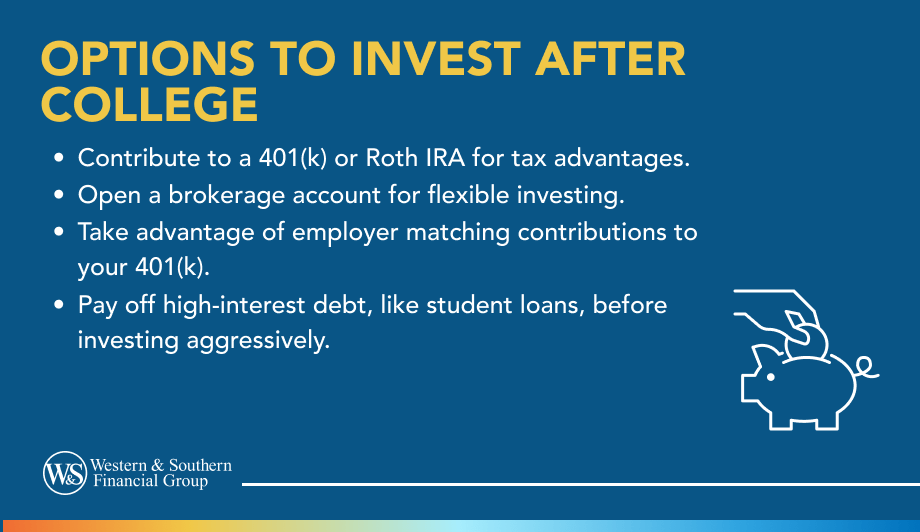
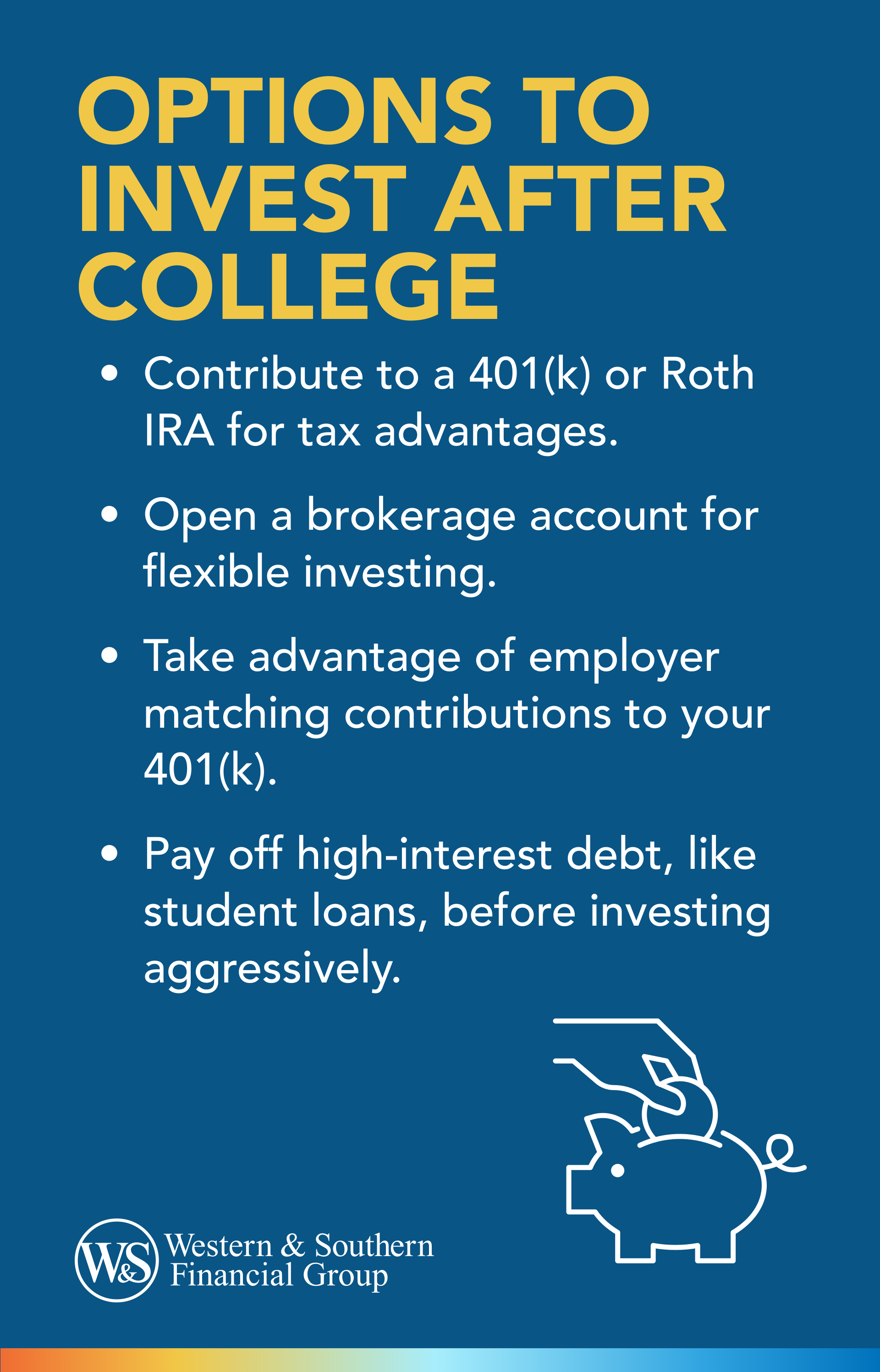
To begin investing, you consider contributing to your 401(k) plan or a similar plan like a SIMPLE IRA, especially if your employer offers matching contributions. The match is like free money and taking advantage of your employer matching contributions is an easy way to increase how much you can contribute to your investments each year. If you have money left in your budget after that, you could always put it toward your student loans in order to pay them off faster.
Roth IRA
You could also open a Roth IRA. The earnings you withdraw from a Roth IRA in the future may be tax-free, as long as you've held the account for at least five years and are at least 59 1/2 years old when you withdraw. Many people assume they'll be in a higher tax bracket later on, when they're more experienced and thus able to earn more. This is the opposite of a 401(k), where your contributions are tax-deferred but you pay taxes on your withdrawals.
Contributing to both these types of accounts allows you to balance their different tax advantages. While you can withdraw money from Roth IRAs for certain reasons (like buying your first home), you can't get to the money in your 401(k) before retirement age (59 1/2) without incurring penalties and interest.
Brokerage Accounts
You might consider a taxable brokerage account, which is essentially an individual investment account you can open with a financial institution. While a brokerage account won't help you save on taxes, it does give you more freedom than retirement accounts to access your money when you want to. You may also want to consider discussing your investment options with a registered representative.
Investing after college can feel overwhelming, but you can always start small. The earlier you begin, the easier it will likely be to build up your investments. It's generally better to save a little bit over a long period of time than to wait and try to catch up later.